Open this article in your favourite assistant
Get an instant summary, or save it as a source your AI can cite later.
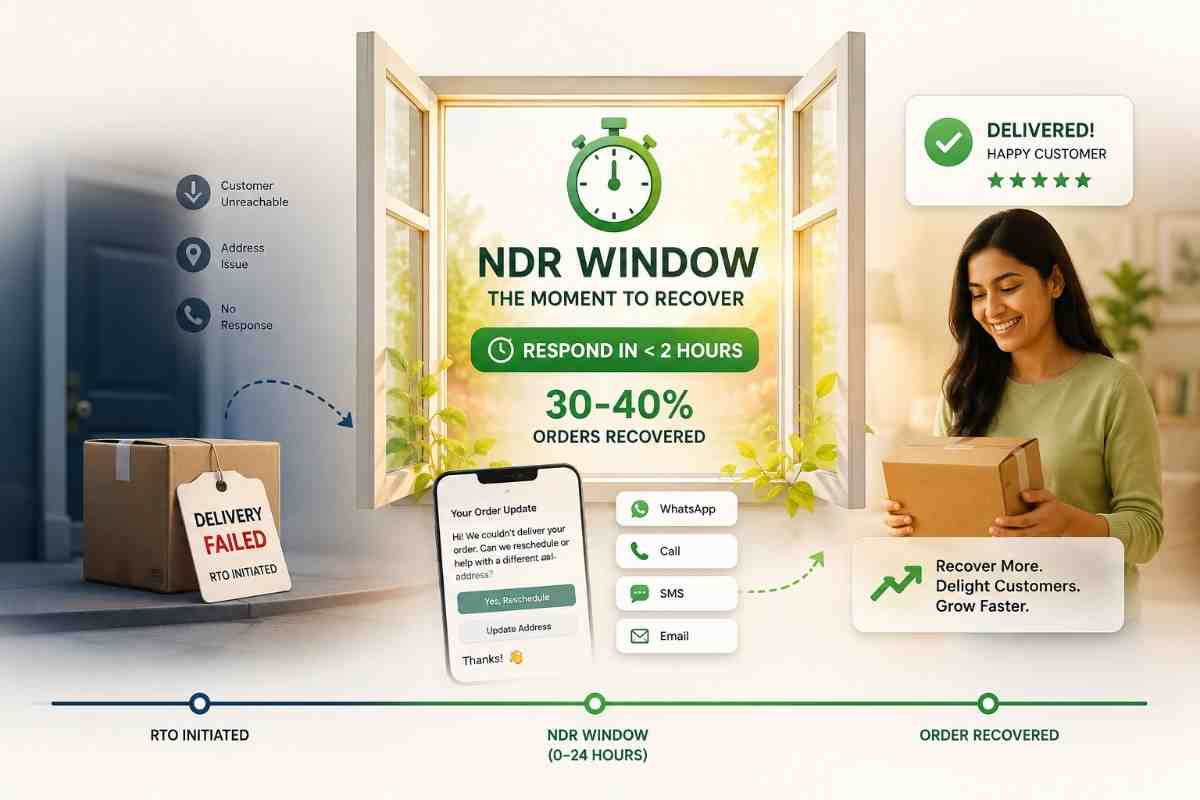
Open your NDR dashboard right now. There are probably 40, 60, maybe 120 orders sitting in it. Each one had a first delivery attempt that failed. Each one is 24 to 48 hours away from becoming a permanent RTO if nothing changes.
Most brands focus on what to say in the follow-up WhatsApp. The message copy, the tone, whether to offer a discount to get the customer to accept the parcel. That is not the real problem. The real problem is that your courier attempted delivery at 11am on a Tuesday, your customer was at their office in Sector 62 Noida, and no amount of well-worded WhatsApp copy is going to retroactively put them at home.
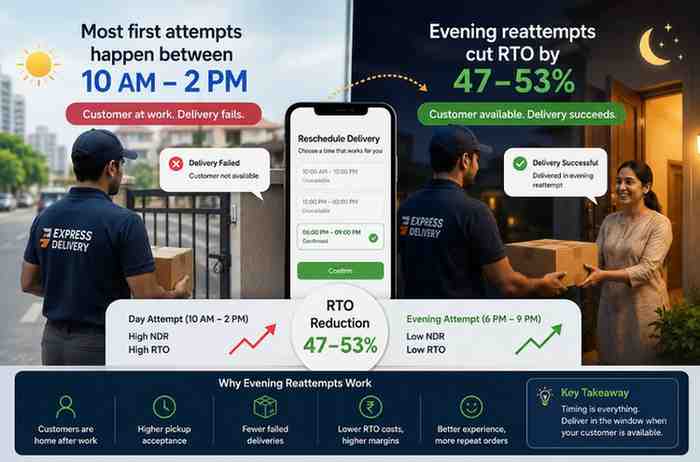
The operational intervention that actually moves NDR-to-delivery conversion is not the message. It is the timing of the reattempt. Customers offered evening delivery windows between 5pm and 9pm show 47 to 53% lower RTO rates compared to standard daytime delivery. The reason is not complicated: they are home.
This post explains why daytime delivery attempts fail at the rates they do in India, what the data says about evening windows, and how to actually implement this in your operation without needing to change your courier contract.
The Timing Problem Nobody Tracks
Most Indian D2C brands track their RTO rate. Almost none track their first-attempt delivery success rate broken down by time of day. That gap in measurement is why the timing problem persists.
Here is what is happening operationally. A courier's daily route is optimised for distance efficiency, not customer availability. A Delhivery agent starting their day at 8am from their hub in Ghaziabad will work through a route that takes them across multiple pincodes in a sequence driven by geography, not by when the buyers at those addresses are most likely to be home. The result is that most first delivery attempts land between 10am and 2pm.
10am to 2pm is when India works. Salaried buyers are at their offices. Small business owners are at their shops. Homemakers in urban households are running errands or at the market. The courier arrives, rings the bell, gets no answer, marks NDR, and moves on. The parcel goes back to the hub.
Industry data puts "customer not available" as one of the top two NDR reason codes across Indian D2C, accounting for 35 to 50% of all failed first delivery attempts depending on category and geography. This is the single largest fixable bucket of RTOs. Not "customer refused." Not "wrong address." Not "fake order." The customer wanted the product. They just were not home when the courier came.
Why Daytime Deliveries Fail at Scale in India
The working hours problem is structural
India's working population is disproportionately young: the median age of an online D2C buyer is well below 35. This cohort is in offices, co-working spaces, construction sites, schools, and shops during the hours when most couriers are making their rounds. A fashion brand selling to 24-year-olds in Lucknow or Coimbatore is shipping to people who are definitionally not home before 6pm on weekdays.
Unicommerce's India D2C Report 2026 found 66% of new D2C orders in FY26 coming from tier-2 and tier-3 markets. These are cities where the economy runs on small businesses and shops. The buyer who ordered a ₹1,299 serum or a ₹899 kurta is likely the person managing a kirana, a tailoring shop, or a medical store. They leave home at 9am and return at 7pm. A courier at the door at noon will find no one.
Couriers cannot easily personalise timing at scale
A Delhivery or XpressBees delivery agent handles 60 to 100 parcels a day on a route that covers 15 to 25 pincodes. The route is set by the hub's dispatch system. Asking the agent to "come back at 6pm for this one address" is not operationally realistic at that volume. The system is not built for personalised timing on first attempts.
This is not a criticism of the couriers. It is a structural reality. The workaround is not to change how couriers plan first attempts. It is to use the NDR reattempt as the timing intervention: when the first attempt fails, ensure the second attempt happens in the evening.
The impulse-decay problem compounds timing failure
A COD buyer who placed an order four days ago and now has the courier arriving unexpectedly at their door is a different buyer from the one who clicked "place order" on Reels at 9pm. The gap between order placement and delivery is where purchase intent decays. Every additional day of non-delivery extends that gap. A first attempt that fails at 11am, gets logged as NDR, waits 24 hours for a WhatsApp, and gets rescheduled for the next afternoon is a four-day-old order being re-delivered five days after placement. The probability of refusal at that point is much higher than if the reattempt had happened the same evening.
Speed of reattempt matters as much as timing of reattempt. NDRs resolved on the same day convert to deliveries at meaningfully higher rates than NDRs resolved the following day. Combining same-day response with an evening reattempt is where the 47 to 53% RTO reduction comes from.
The Evening Window: What the Data Shows
Between 5pm and 9pm, Indian households are at their most predictably occupied. Workdays end. Shops close. Children return from school. Dinner is being prepared. The person who ordered a product is physically present at the delivery address with near-certainty. This is not a preference pattern unique to metros: it holds across tier-2 and tier-3 cities too, where the workday may be structured differently but the evening home-presence pattern is consistent.
When customers are given a choice of delivery time slot at checkout, evening options (5pm to 9pm) are selected more than 60% of the time in South Asian markets. This is not a marginal preference. It is the dominant preference. Most D2C brands have never asked their customers when they want to receive their order. The ones that do find that the answer is almost always some variant of "after work."
Why evening reattempts outperform daytime reattempts
Three factors compound:
Physical presence. The customer is home. This is the primary driver. No amount of NDR messaging sophistication compensates for the courier arriving at an empty house.
Psychological readiness. A customer who confirmed a 6pm delivery on WhatsApp is mentally prepared to receive it. They have not forgotten they ordered something. They are not caught off-guard by a ring at the door. The commitment to the transaction has been reactivated.
Shorter gap from NDR to redelivery. An evening reattempt on the same day as the failed morning attempt keeps the order experience tight. The customer feels the brand is responsive. Contrast this with a reattempt three days later: by that point, the buyer may have already found the product elsewhere or simply moved on.
The category dimension
Evening delivery lift is largest for fashion, lifestyle, and beauty categories whose buyers are predominantly working professionals. The lift is real but smaller for jewellery and premium categories where buyers tend to be older, more available during business hours, and more likely to have domestic staff present at the delivery address. Electronics sits in the middle: entry-level accessories skew toward young buyers with strong evening advantage; higher-value products have slightly more flexible buyer availability.
For fashion and lifestyle brands running significant COD volume in tier-2 cities, evening reattempts are the single highest-impact operational change available without touching the courier contract or changing payment architecture.
How to Actually Implement This
Most of this is achievable with tools you already have. None of it requires a new courier contract or a platform migration.
Step 1: Add a delivery time preference at checkout
The highest-impact version of evening delivery starts before the shipment leaves your warehouse. Add a delivery time preference field to your checkout, with three options: Morning (9am to 1pm), Afternoon (1pm to 5pm), Evening (5pm to 9pm).
Keep it simple. Three options is enough. More granular windows create decision fatigue for the customer without meaningfully improving delivery accuracy, because most Indian couriers cannot guarantee 30-minute windows at scale. Store the preference against the order in your OMS.
On Shopify, this is a custom field in the checkout. Checkout extensions (Shopify Plus) or third-party apps like EasySell allow you to add this without custom development. Make the Evening option appear first or pre-selected: brands that have done this see 60 to 70% of customers picking evening, which is consistent with stated preference data from South Asian markets.
Step 2: Pass the preference to your courier
Both Delhivery and Shiprocket support a special instructions or remarks field on the AWB (Air Waybill). Pass the customer's preferred delivery window in this field: "Customer preference: Evening delivery (5pm to 9pm)." It is not a guaranteed instruction. Couriers honour it on a best-effort basis, but experienced delivery agents in pincodes where your brand ships regularly will recognise and accommodate it.
For high-value orders (above ₹1,500), consider a same-day dispatch confirmation call or WhatsApp that also confirms the delivery window: "Your order has been dispatched and will be delivered by [courier] tomorrow evening between 5pm and 8pm." This primes the customer to be available and reduces the probability of a first-attempt failure entirely.
Step 3: Configure same-day NDR response
This is where most of the 47 to 53% RTO reduction actually comes from. The NDR response speed and reattempt timing are more important than any other variable in the NDR-to-delivery conversion rate.
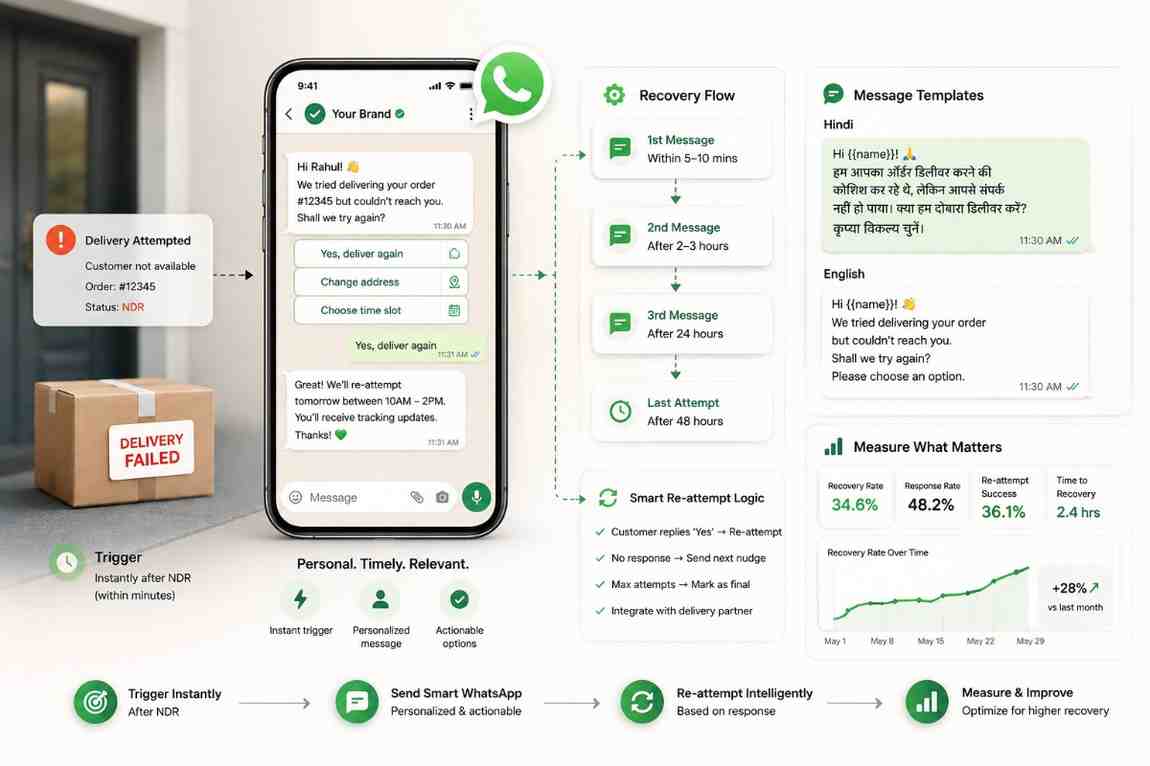
Connect to your courier's NDR webhook. When an order status changes to NDR (first failed attempt), trigger an automated WhatsApp within 30 minutes. Do not wait for your operations team to manually work through the NDR queue at end of day. The 30-minute window matters because it gives the customer time to confirm the evening reattempt before the courier's afternoon dispatch window closes.
Shiprocket's NDR module, Delhivery's seller API, and Ekart's partner portal all support real-time NDR webhooks. Bepragma and ClickPost have built dedicated NDR automation layers on top of these APIs if you want a managed solution.
Step 4: Default all reattempts to evening slots
When your automated NDR WhatsApp fires, default the offered reattempt window to evening. The message structure:
NDR WhatsApp template: "Hi [Name], our delivery partner tried to reach you today at [address]. We can redeliver this evening between 5pm and 8pm. Reply YES to confirm or share a new address if needed." One-tap confirmation. No essay. No apology. Just a specific time and a single action.
Customers who respond YES are telling you two things: they are going to be home in the evening, and they still want the product. That combination converts to a successful delivery at dramatically higher rates than a generic "we'll try again tomorrow" message.
Step 5: Send a morning-of reminder on reattempt day
On the day of the evening reattempt, send a morning confirmation WhatsApp: "Your [brand name] order is scheduled for redelivery today between 5pm and 8pm at [address]. The delivery agent will call before arriving." This serves two purposes: it keeps the customer from making plans that take them out of the house, and it gives them a channel to update the address if something has changed.
Brands running this workflow, with pre-delivery notification plus evening reattempt, report 25 to 35% lower "customer not available" NDR rates on second attempts. The morning reminder is the piece most brands skip, and it is the piece that reduces the "customer confirmed but was not home" failure mode.
Step 6: Track evening vs daytime delivery success separately
Tag your NDR reattempts by the confirmed delivery window in your logistics system. After 30 days and a minimum of 200 NDR events, compare the delivery success rate for evening-confirmed reattempts against all other reattempts. This is the data that makes the business case for making evening the permanent default, and it is data no industry report can give you. Only your own operation can generate it.
Most brands who run this comparison see a 20 to 40 percentage point difference in reattempt success rate between customer-confirmed evening windows and unconfirmed reattempts. That difference is the margin recovery story for your ops team and the justification for investing in the WhatsApp automation infrastructure to run it at scale.
What about Saturday deliveries?
Saturday is different from weekdays and is worth treating separately. Most Indian buyers are home on Saturday afternoons: after morning errands, afternoons are family time. Saturday afternoon delivery slots (12pm to 4pm) can perform almost as well as weekday evenings for buyer availability. If your NDR reattempt falls on a Friday, offer Saturday afternoon as the reattempt window instead of Monday evening. The 48-hour gap from Friday NDR to Monday delivery is enough time for purchase intent to fade further.
What Good Looks Like
These are operational benchmarks for Indian D2C brands running more than 1,000 COD orders per month with an active NDR management workflow:
| Metric | Without evening reattempt strategy | With evening reattempt + same-day NDR |
|---|---|---|
| NDR-to-delivery conversion | 30–45% | 55–70% |
| "Customer not available" NDR rate on reattempt | 25–35% | 8–15% |
| Time from NDR to reattempt | 24–48 hours | Same-day or next-day |
| Overall COD RTO rate (impact) | Baseline | 5–12 point reduction |
| NDR queue age (orders > 48 hrs) | 40–60% of queue | Under 15% of queue |
A 5 to 12 percentage point reduction in COD RTO from NDR timing alone is significant. For a brand doing 3,000 COD orders a month at 26% RTO, a 7-point reduction (to 19%) saves roughly ₹1 lakh per month in true RTO cost at ₹480 per return. That number compounds monthly and does not require any change to your product, pricing, or courier rates.
The brands running below 15% COD RTO in India almost all have this infrastructure in place: same-day NDR response, evening default for reattempts, and morning-of confirmation messages. It is not one piece of technology. It is a workflow. The technology (webhook connections, WhatsApp BSP, NDR classification) enables the workflow, but the discipline of running it every single day is what produces the result.
If you want this running without stitching together courier webhooks, a WhatsApp BSP, and an NDR management tool separately, OneflowAI bundles NDR automation, WhatsApp notifications, and delivery preference capture into one system. Worth evaluating if you are above 800 COD orders a month and your NDR-to-delivery conversion rate is below 50%.
Frequently Asked Questions
Why do evening delivery reattempts reduce RTO?
Most Indian D2C couriers make first delivery attempts between 10am and 2pm, when working-age customers are at offices, shops, or businesses. Evening reattempts between 5pm and 9pm find customers home, dramatically increasing delivery success. Customers offered evening windows show 47 to 53% lower RTO rates compared to standard daytime delivery. The mechanism is straightforward: the customer is home and was expecting the delivery.
What percentage of RTOs are caused by the customer not being home?
"Customer not available" is consistently one of the top two NDR reason codes in Indian D2C, accounting for approximately 35 to 50% of all failed first delivery attempts depending on category and geography. This makes it the single largest fixable category of RTOs. The customer wanted the product. They just were not home when the courier arrived.
Can I actually control what time Delhivery or Shiprocket delivers?
Not perfectly on first attempts, but more than most brands realise. Both Delhivery and Shiprocket support a special instructions field on the AWB. Passing a preferred delivery window there is honoured on a best-effort basis by experienced agents in your key pincodes. For NDR reattempts, you have more direct control: you can specify the reattempt window when the customer confirms via WhatsApp, and the courier can note it in the reattempt instruction before the agent leaves the hub.
What time window works best for evening reattempts in India?
5pm to 8pm works for most Indian markets. Metros and IT cities like Bangalore, Pune, and Hyderabad skew slightly later (6pm to 9pm) because office commute times extend the workday. Tier-2 cities with shop-based economies tend to have customers home earlier, making 5pm to 7pm sufficient. Start with 5pm to 8pm as the default and refine based on your pincode-level delivery success data after 30 days.
Does evening delivery work for all product categories?
Yes, but the impact varies. Fashion and lifestyle categories see the largest lift because their buyers skew toward working professionals who are almost never home during the day. Electronics and beauty see a meaningful but slightly smaller improvement. Jewellery and premium categories often involve buyers who are more available during business hours, so the evening advantage is less pronounced. If more than 40% of your orders are going to tier-2 cities and your buyers are young working adults, evening reattempts will have a visible impact on your RTO rate.
How quickly should I respond to an NDR for the best reattempt success?
Within the first 4 hours of the NDR being logged. NDR resolution speed is the strongest operational predictor of reattempt success. An NDR resolved same-day converts to a successful delivery at meaningfully higher rates than one resolved 24 to 48 hours later. The combination of fast response (30 minutes via automated WhatsApp) plus evening reattempt scheduling is where the largest RTO reductions come from.
What should the WhatsApp message say when offering an evening reattempt?
Specific and short: "Hi [Name], our delivery partner tried to reach you today at [address]. We can redeliver this evening between 5pm and 8pm. Reply YES to confirm or send a new address." A specific time window plus one-tap confirmation gets the highest response rate. Vague messages like "please let us know your availability" create friction and reduce response rates. If the customer confirms YES, send a morning-of reminder on the day of the reattempt.
Is evening delivery more expensive?
No, not for reattempts. You are working within the courier's normal delivery window and attempt count. The reattempt cost is the same regardless of what time of day it happens. The value is that the same reattempt cost results in a successful delivery far more often when timed to evening, rather than failing again and eventually initiating RTO. Over time, higher reattempt success rates also reduce your overall courier cost by cutting the number of return shipments.
How do I track whether evening reattempts are actually reducing my RTO?
Tag NDR reattempts by the confirmed delivery window (morning, afternoon, evening) in your logistics system. After 30 days and a minimum of 200 NDR events, compare delivery success rates by window. Most brands see a 20 to 40 percentage point difference in reattempt success between customer-confirmed evening slots and unconfirmed or morning reattempts. That gap is your business case for making evening the permanent default.
What to Change This Week
The evening reattempt strategy has two components: how fast you respond to NDR, and what window you offer for the reattempt. Both are configurable without changing your courier contract.
This week: connect your courier's NDR webhook to your WhatsApp tool (Interakt, WATI, or similar) and set up a trigger that fires within 30 minutes of an NDR status update. Change the default reattempt offer in that message from "we will try again soon" to a specific evening window. Those two changes, response speed and reattempt timing, are where most of the NDR-to-delivery conversion lift comes from.
Next week: add a delivery time preference field at checkout. Make Evening the first option. Track what percentage of your customers select it. That data will tell you exactly how much of your current RTO is sitting in the "customer wanted evening, courier arrived at noon" bucket, and how much you can recover by closing that gap.

Omkar Kamble builds OneflowAI, which shows consumer brands what every order really earned after RTO, freight and COD. These guides come from real order and courier data, not theory. Figures we cannot independently verify are flagged.
Published 15 May 2026 Last reviewed 15 May 2026 12 min read