Open this article in your favourite assistant
Get an instant summary, or save it as a source your AI can cite later.
What Shows Up on the Invoice
When a courier returns an order to your warehouse, you see the return shipping charge. Depending on your logistics partner and the weight of the shipment, that's roughly ₹80 to ₹150. Sometimes more.
That feels manageable. For every 100 orders, if 20 come back, you're looking at ₹2,000 to ₹3,000 in return freight. Annoying, but not catastrophic.
Except that's not the full picture.
What Doesn't Show Up on Any Invoice
Forward shipping, already spent. The ₹60 to ₹90 you paid to ship the order out in the first place is gone. You don't get it back. So your logistics cost for a returned order isn't just the return leg, it's both legs combined.
Payment gateway fees on prepaid orders. If the customer paid online and then returned the item, you're often still paying the 1.5 to 2% processing fee. Some gateways refund it, most don't, and tracking this per order is painful enough that most brands stop trying.
The packaging. Your box, your branded tape, your dunnage all came back destroyed or unusable. That cost per shipment is small, but it adds up when you're processing returns at scale.
Quality check and repackaging labor. Someone at your warehouse has to open that return, inspect the product, re-label it, and either put it back in sellable inventory or flag it as damaged. That takes time. Time has a cost. Most brands don't track this because it gets absorbed into warehouse ops, but it's real.
The product itself. This is where it gets painful. A significant percentage of returned products (20 to 30% is common in apparel and fragile categories) come back in a condition where you can't resell them at full price. You're either discounting them, liquidating them, or writing them off. That's not a logistics cost. That's inventory loss.
COD remittance that never arrived. If the order was cash on delivery and the customer refused it, you never collected the payment at all and you still paid the shipping out. COD RTO rates in India can run 30 to 50% in certain categories, which means for every two COD orders you ship, one might come back.
Customer acquisition cost. You spent money on Meta ads, Google, influencer partnerships, affiliate commissions to get that customer to place an order. If they return it, that acquisition spend produced zero revenue. The CAC doesn't disappear just because the order came back.
Running the Real Numbers
Take a ₹799 product. Here's what one returned order actually costs:
| Cost Component | Amount |
|---|---|
| Forward shipping | ₹75 |
| Return shipping | ₹110 |
| Packaging (wasted) | ₹20 |
| QC and repack labor | ₹30 |
| Payment gateway fee (prepaid) | ₹16 |
| Customer acquisition cost | ₹120 |
| Product markdown / write-off | ₹80 |
"Total cost of that one returned order: roughly ₹450. On a ₹799 product. Before you've accounted for your COGS."
That's not a shipping problem. That's a margin problem.
Why This Hits Indian D2C Brands Differently
A lot of the RTO conversation in India gets compared to return rates in the US or Europe, which is a bit misleading. The dynamics here are different.
COD is still a large chunk of orders for most D2C brands outside metro cities, sometimes 50% or more. And COD orders have structurally higher RTO rates. The customer hasn't committed money upfront. If they change their mind between placing the order and delivery, refusing it costs them nothing.
Impulse purchases on social ads, where the customer wasn't fully sure about the product, convert at better rates at the top of funnel but return at worse rates on the back end.
Delivery experience also matters more than people think. An order that takes 7 to 9 days to arrive in a tier-2 city is more likely to be refused than one that shows up in 2 to 3 days. Customer enthusiasm fades. Plans change.
None of this is the customer's fault. But the cost lands on the brand.
The Part Brands Get Wrong
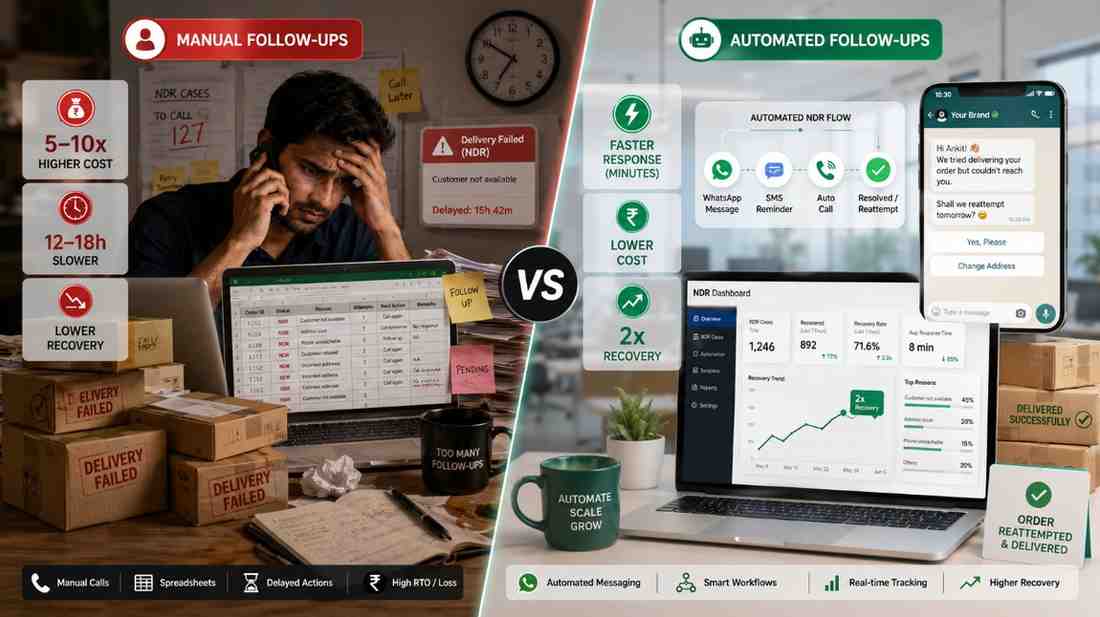
Most brands treat RTO as a logistics problem. They negotiate return rates with couriers, try to tighten delivery SLAs, and maybe add some NDR (non-delivery report) follow-up calls. That helps at the margins.
The bigger levers are upstream. This is where tools like OneflowAI come in: platforms built specifically for D2C RTO reduction that work on these pressure points before the shipment even goes out:
- Address quality at checkout. Bad addresses create failed deliveries. Failed deliveries become RTOs. Catching these before dispatch saves both time and money.
- Prepaid vs COD nudges. Even small incentives like ₹20 off or free shipping on prepaid can shift the mix meaningfully. Knowing which customers to nudge and when is where data actually helps.
- Product description accuracy. Returns that happen because the customer says "not as described" are almost entirely preventable.
- Proactive communication between order and delivery. Customers who feel informed don't refuse deliveries as often.
The real shift: RTO reduction stops being a fulfillment metric the moment you start treating it as a revenue problem. The ops team can't fix this alone.
What a 5% Reduction Actually Means
If you're doing 1,000 orders a month with a 25% RTO rate, that's 250 returns. At ₹450 true cost per return, you're burning ₹1,12,500 a month on returns.
Drop RTO from 25% to 20%, just 5 percentage points, and you're saving ₹22,500 a month. That's ₹2,70,000 a year, from one operational metric.
For a brand at this scale, that's not a rounding error. That's what you'd spend on a mid-tier marketing campaign.
The ₹200 return shipping label is just what the courier charges you. The real number, what a returned order actually costs when you add it all up, is closer to double or triple that depending on your category and operations.
That gap is worth understanding. Because you can't fix a problem you're not measuring correctly. And once you do measure it correctly, the case for reducing RTO stops being an ops conversation and starts being a very obvious business decision.

Omkar Kamble builds OneflowAI, which shows consumer brands what every order really earned after RTO, freight and COD. These guides come from real order and courier data, not theory. Figures we cannot independently verify are flagged.
Published 10 May 2026 Last reviewed 10 May 2026 7 min read