Open this article in your favourite assistant
Get an instant summary, or save it as a source your AI can cite later.
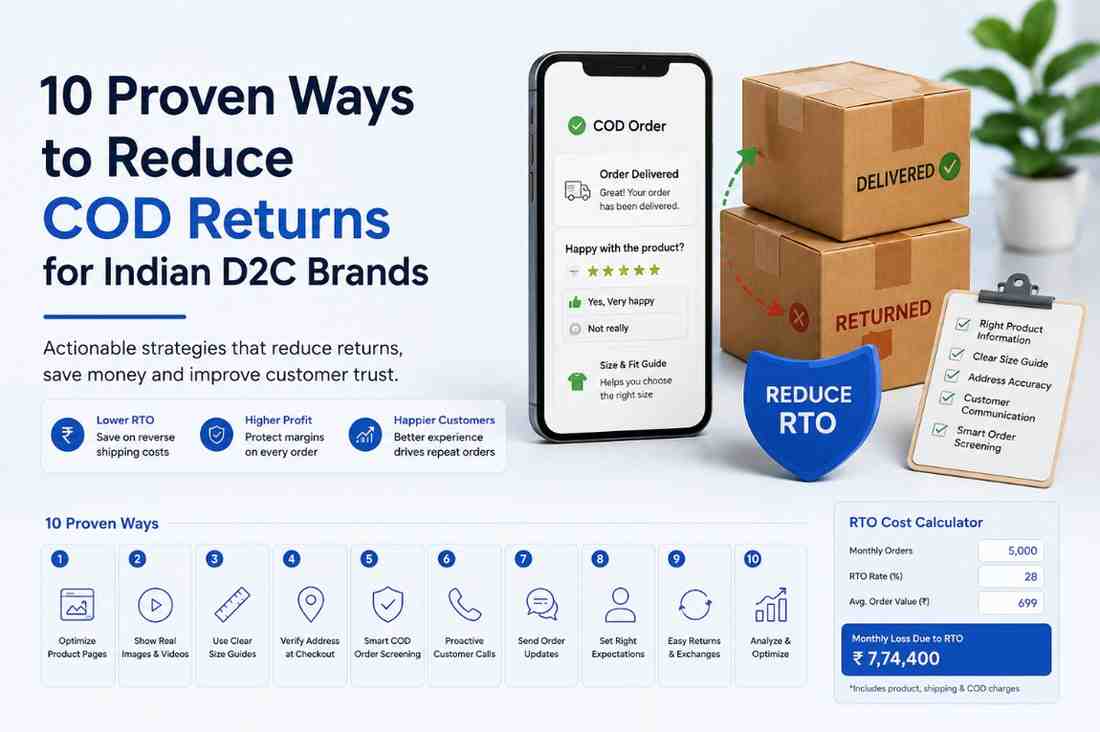
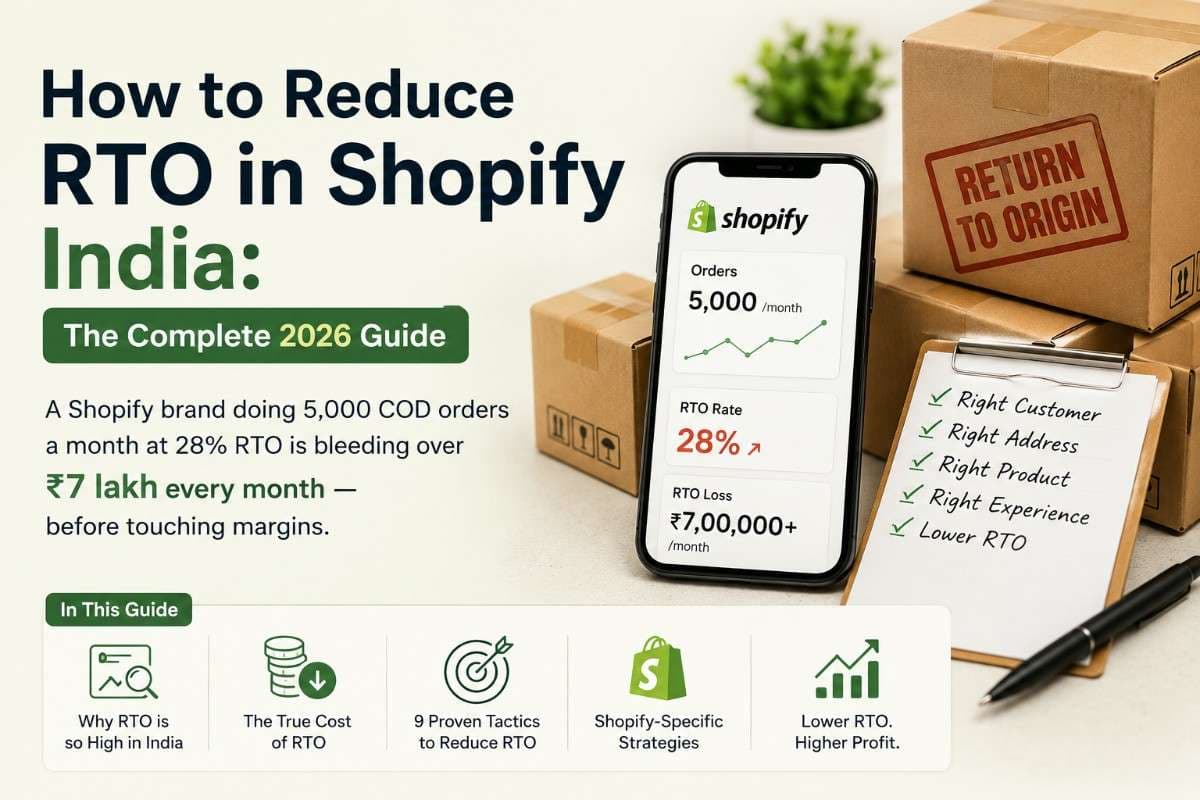
A brand doing 5,000 COD orders a month with a 28% RTO rate is processing 1,400 returned parcels. At a true per-order cost of ₹500 (shipping both legs, packaging, labor, CAC), that is ₹7 lakh gone every single month. Before anyone has looked at margins.
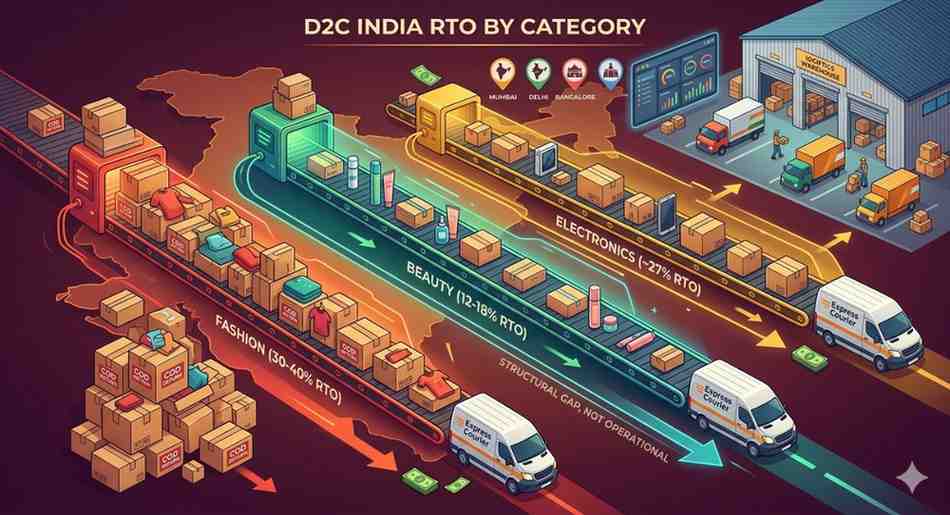
This is not a niche problem. Industry data from Shipway ShipNotes (July 2025) puts average Indian COD RTO at 26%. GoKwik's August 2025 report shows electronics at 27% and footwear at 27.9%. Fashion COD runs 30 to 40% at many brands. Unicommerce's D2C Report 2026 found festive-season RTO hitting 39% in November 2025.
Shopify's native checkout makes this worse, not better. There is no address intelligence, no COD verification, no pincode-level courier matching. The platform was built for markets where cards dominate and delivery fails are rare. India is neither of those things.
This post covers the full picture: what RTO actually costs per order, why Indian rates are structurally high, the 10 most common reasons a COD order comes back, and nine specific tactics that move the number down. No generic advice.
What Is RTO and How It Works in Shopify India
RTO stands for Return to Origin. It means a shipment that went out and came back without being delivered. The courier attempted delivery, couldn't complete it, and shipped the parcel back to your warehouse.
The lifecycle looks like this: customer places a COD order on your Shopify store, you pack and dispatch it, the courier attempts delivery, the customer is unreachable or refuses the order, the courier marks it as NDR (Non-Delivery Report), makes one or two more attempts, and then initiates RTO. The parcel travels back. You receive it 5 to 12 days after it left. You pay for both legs.
Shopify's default checkout has three structural problems that make Indian RTO worse:
- No address validation. Customers type whatever they want. "Near old temple, behind the blue gate" goes through without friction. The courier's GPS finds nothing. First delivery attempt fails.
- No COD verification. There is no OTP or confirmation step after a COD order is placed. Impulse orders from social ads, joke orders, duplicate orders: all sail through to dispatch.
- No COD/prepaid friction asymmetry. Shopify treats a ₹999 COD order exactly like a ₹999 prepaid order. No nudge, no incentive, no friction differential. You lose the prepaid conversion before you even know you had a chance at it.
Every app in the Shopify ecosystem that claims to solve RTO is working around these baseline gaps. Some fill them better than others.
The Real Cost of One RTO Order
Most brands track RTO rate. Few track RTO cost per order accurately. Here is what a returned ₹799 order actually costs:
| Cost Component | Typical Range | Example (₹799 order) |
|---|---|---|
| Forward shipping | ₹60–₹90 | ₹75 |
| Return shipping | ₹80–₹150 | ₹110 |
| Packaging (wasted) | ₹15–₹35 | ₹22 |
| QC + repack labor | ₹25–₹50 | ₹35 |
| Payment gateway fee | ₹0–₹18 | ₹14 |
| Customer acquisition cost | ₹80–₹250 | ₹130 |
| Product markdown / write-off | ₹0–₹150 | ₹75 |
| Total RTO cost | ₹260–₹733 | ₹461 |
The ₹200 figure you hear is just forward plus return freight. The real number for most D2C brands is ₹400 to ₹600 per RTO order when you add CAC, packaging, and product degradation. For high-CAC categories like beauty and wellness, it crosses ₹700 easily.
Quick math: 1,000 orders/month at 25% RTO = 250 returns. At ₹460 true cost = ₹1,15,000 bleeding out every month. Drop RTO to 18% and you recover ₹32,200/month (₹3,86,000/year) from one metric.
Why India Has Higher RTO Than Global E-commerce
US and European D2C brands run returns at 15 to 30% of orders, but that's buyer-initiated returns: the customer received the product and sent it back. India's RTO problem is different. The product never reached the buyer at all.
Several things drive this structurally:
COD-default buying behavior
For most of Indian e-commerce history, COD was the only option many customers trusted. That habit is persistent. Even as UPI and card penetration has grown, GoKwik reported in August 2025 that COD share finally fell below 50% of orders for the first time (meaning it was above 50% until very recently). COD buyers have zero financial commitment at order time. Refusal costs them nothing.
Tier 2 and 3 city dynamics
A Jaipur apparel brand scaling into Bilaspur, Kakinada, and Muzaffarpur is operating in markets where last-mile infrastructure is thin, delivery windows are unpredictable, and customers have learned to refuse orders they are not certain about. Impulse purchases on Meta ads that felt like good ideas at 11 PM often get refused when the courier arrives four days later.
Indian address structure
Indian addresses are informal. "Sector 12, near water tank, opp. green building" is a real address that a courier cannot geocode reliably. Landmark-based navigation works for locals, not for logistics systems. First-attempt delivery failure rates in tier-2 cities are meaningfully higher than metro areas.
Phone reachability
Indian customers often have multiple SIM cards, change numbers frequently, or simply don't answer unknown numbers from delivery agents. A courier who can't reach the customer before the delivery attempt goes to the address blind and fails.
Courier consolidation and service gaps
Delhivery acquired Ecom Express in April 2025 for ₹1,407 crore, taking out one of the last large independent alternatives. This consolidation matters for serviceability. Specific pincodes that Ecom Express served well may now get patchy coverage. Brands using single-courier strategies with outdated serviceability data are shipping into gaps they don't know exist.
10 Reasons COD Orders Return to Origin in India
NDR data across Indian D2C brands shows a consistent pattern. Here are the ten most common causes, roughly in order of frequency:
- Customer unreachable on delivery day. The courier calls, no answer, marks it as attempted, and escalates to NDR. This accounts for a large share of RTO. Customers who don't know the delivery is coming are customers who can't be ready for it.
- Incorrect or incomplete address. The delivery agent reaches the general area but cannot find the specific door. In dense apartment complexes or kaccha colonies, one wrong flat number means a failed attempt.
- Customer not present at location. Address is correct, customer is just out. No OTP-based alternative, no neighbor handoff, no locker option. The parcel goes back.
- Price remorse after placing order. The customer thought about it more and decided ₹999 was too much. Refusing the delivery is free. This is almost exclusive to COD.
- Found the same product cheaper elsewhere. Particularly common with commodity-adjacent categories like phone accessories, basic apparel, and home goods. Between order placement and delivery, the customer found a better deal on a competitor.
- Delayed delivery killed purchase intent. A 2-day expected delivery that becomes 8 days is a different customer relationship. By day 8, many buyers have moved on or bought elsewhere. The physical package arriving feels like an unwanted obligation.
- Impulse order placed under social influence. Seen a reel at midnight, ordered without fully thinking about it. No buyer's remorse during checkout because checkout was frictionless. Remorse kicks in after.
- Duplicate order. Customer placed the same order twice: once on your site, once on an aggregator. One of them gets refused. Or placed same-day and then immediately regretted both.
- Family conflict. Sounds anecdotal but appears with regularity in apparel, jewelry, and lifestyle categories. The person who placed the order faces objection from a family member and refuses on arrival to avoid the conversation at home.
- Serial returners and bad-faith buyers. A small percentage of customers RTO systematically. They order to "try before paying" or simply have a habit of refusing. These customers are identifiable through order history. Most brands don't look.
The good news: reasons 1, 2, 3, and 7 are largely preventable at or before dispatch. Reasons 4, 5, 6, and 8 respond to prepaid conversion tactics. Reasons 9 and 10 are behavioral, addressable through customer scoring and COD eligibility rules.
9 Proven Tactics to Reduce RTO on Shopify India
1. Address validation at checkout
Bad address at checkout = failed delivery = RTO. The fix is catching it before the label prints, not after the courier spends a day in the field.
- Use a pincode-aware address validator that checks against India Post and courier serviceability databases, not just Google Maps autocomplete, which normalizes addresses that couriers can't navigate
- Flag addresses with no landmark, missing apartment or floor number, or pincodes where your primary courier has low delivery success rates
- Prompt the customer to clarify at checkout rather than discovering the problem on delivery day
- For high-value orders, send a WhatsApp confirmation of the address before dispatch and ask the customer to confirm or correct
2. COD OTP verification
A simple OTP sent to the customer's phone after a COD order is placed does two things: it confirms the phone number is real and reachable, and it filters out impulse orders that the customer isn't actually willing to acknowledge.
- Send an OTP via WhatsApp or SMS immediately after order placement, not in the dispatch confirmation, which comes too late
- Hold orders with unverified OTPs for 1 to 2 hours before dispatching; most genuine customers confirm within 30 minutes
- Cancel orders that don't receive OTP confirmation after a defined window: these are your highest-risk RTOs
- Track the cancellation rate from OTP holds; this tells you what percentage of your COD orders were never real orders
3. Prepaid nudge at checkout
The gap between COD RTO (26%) and prepaid RTO (<5%) is the single largest lever in RTO reduction. Every COD order you convert to prepaid is an order you've essentially de-risked.
- Offer a flat discount or free shipping on prepaid: even ₹20 off moves the needle for price-sensitive customers
- Show the discount prominently at payment selection, not buried in fine print
- Use customer behavior signals (order value, product category, pincode, previous order history) to determine which customers are worth nudging harder: a first-time buyer from a tier-3 pincode with a ₹1,499 COD order is a very different case than a repeat customer from a metro
- Test nudge copy that is specific ("Save ₹30 if you pay now") versus generic ("Prepaid is faster"): specific wins almost every time
4. Pincode-aware courier selection
Not all couriers perform equally in all pincodes. Shiprocket, Delhivery, Bluedart, and XpressBees each have regions where their delivery success rates diverge significantly. Sending everything through a single courier because the rate is slightly cheaper is a false economy if RTO climbs 4 percentage points in that courier's weaker zones.
- Run 90-day delivery success rate analysis by courier by pincode: your logistics partner should have this data; if they won't share it, that's a problem
- Build routing rules that prefer Bluedart in dense metros for high-value orders and use Delhivery or XpressBees for broader tier-2 and tier-3 coverage
- After Delhivery's acquisition of Ecom Express (April 2025), audit pincodes that were previously Ecom Express strongholds: serviceability may have changed
- For COD orders above a defined threshold (say ₹1,500), route through couriers with verified OTP-on-delivery capability
5. WhatsApp order confirmation and pre-delivery notification
Customers who know a delivery is coming are present for it. The window between dispatch and delivery is where most "customer unreachable" NDRs are preventable.
- Send a WhatsApp message 24 hours before expected delivery with the AWB tracking link and the estimated delivery window, not just "your order is out for delivery" but "your order will arrive between 2 PM and 6 PM tomorrow"
- Include the courier's customer care number so the buyer can reschedule if they won't be home
- Send a morning-of reminder on delivery day: open rates on WhatsApp are dramatically higher than email or SMS
- For orders that hit NDR (first failed attempt), trigger an immediate WhatsApp to the customer asking for a preferred redelivery time: this is where automated NDR recovery systems like Shiprocket's NDR module pay for themselves
6. Cross-brand customer risk scoring
Serial returners are knowable. A customer who has RTO'd two previous orders is not the same risk as a first-time buyer. Brands that have access to cross-merchant order history can score customers at checkout and apply different rules.
- Networks like GoKwik and Shiprocket aggregate order behavior across thousands of D2C brands: a customer marked as high-risk on their network carries that signal to your store
- High-risk COD customers can be shown a mandatory prepaid gate, a higher COD charge, or a reduced COD limit (COD only available for orders under ₹599)
- Low-risk customers with clean prepaid history on the network can be offered smoother checkout with fewer friction steps: this improves conversion without increasing RTO
7. Partial COD
Partial COD means the customer pays a portion of the order value upfront (say 20 to 30%) and the remainder on delivery. It creates financial commitment without the full deterrence of 100% prepaid. For customers who are genuinely interested but COD-only, it filters out the least committed buyers while keeping the order.
- Works best for high-value orders (₹1,500+) where full COD carries significant risk
- Position it as "Pay ₹299 now, ₹700 on delivery" rather than leading with what it is: the framing matters
- Track RTO rates specifically for partial COD orders versus full COD: measure the lift before scaling
8. NDR automation and rapid response
NDR (Non-Delivery Report) is the moment between a failed delivery attempt and an RTO. Most brands lose orders here because no one is watching the NDR queue in real time. Automated NDR workflows change this.
- Set up automated triggers: when an order hits NDR status, immediately send customer a WhatsApp with a rescheduling link. Do not wait for the courier's second attempt
- Classify NDR reasons: "customer unreachable" needs a different response than "address incorrect": the automated message and resolution path should differ
- Shiprocket's NDR module allows you to set auto-escalation rules and add delivery instructions before re-dispatch; Delhivery's API allows address correction on in-flight orders
- Track NDR-to-delivery conversion rate as a separate metric: this tells you how effective your NDR recovery process is independent of your overall RTO rate
9. Post-order prepaid upgrade window
A COD order placed does not have to ship as COD. There is a window between order placement and dispatch (typically 4 to 24 hours) during which you can encourage the customer to switch to prepaid.
- Send a WhatsApp or SMS shortly after COD order placement offering a prepaid switch incentive ("Pay now and we'll add ₹50 to your next order")
- For orders with high RTO risk signals (new customer, high-risk pincode, high value, product category with historically elevated RTO), make the incentive stronger
- Track the upgrade conversion rate and the RTO rate of orders that successfully switched: this validates whether the upgrade is actually pulling high-risk orders into prepaid or just extracting money from low-risk buyers who would have paid anyway
- Razorpay's payment link API can generate a one-click prepaid conversion link that you embed in the WhatsApp message: the customer taps, pays, and the order converts without re-entering any information
What a Good RTO Rate Looks Like by Category
There is no single universal RTO benchmark. Category matters. Order value matters. COD mix matters. Here is a rough breakdown based on available industry data:
| Category | Avg RTO (COD) | World-Class Target | Source |
|---|---|---|---|
| Fashion / Apparel | 30–40% | <15% | GoKwik, 2025 |
| Electronics / Accessories | 27% | <12% | GoKwik Aug 2025 |
| Footwear | 27.9% | <15% | GoKwik Aug 2025 |
| Beauty / Skincare | 18–24% | <10% | |
| Jewellery / Accessories | 20–30% | <12% | |
| Prepaid (all categories) | 2–5% | <3% | Shipway ShipNotes, 2025 |
The gap between average COD RTO and prepaid RTO is the clearest number in Indian D2C. It is also the most actionable. Every percentage point you shift from COD to prepaid directly compresses your RTO rate, often more than any courier optimization or NDR workflow can deliver.
Brands that have aggressively deployed address validation, COD scoring, and prepaid nudges report COD RTO in the 12 to 16% range. That is not theoretical. It is achievable with the right operational stack.
Building Your Anti-RTO Stack
RTO is a systems problem. You can solve it partially at each layer, but the compounding effect comes from coverage across all layers.
Think of it in four layers:
- Checkout layer. Address validation, prepaid nudges, COD eligibility rules, partial COD. This is where you prevent high-risk orders from ever entering your fulfillment pipeline.
- Verification layer. COD OTP, post-order prepaid upgrade, address confirmation via WhatsApp. This is where you confirm intent and catch problems before dispatch.
- Intelligence layer. Cross-merchant customer scoring, pincode-level RTO analytics, category-specific risk models. This is where you make better routing and eligibility decisions based on data rather than gut feel.
- Courier orchestration layer. Dynamic courier selection by pincode, NDR automation, pre-delivery notifications, redelivery scheduling. This is where you rescue orders that would otherwise become RTOs.
Most brands build these layers independently using different tools: a Shopify app for address validation, Shiprocket for NDR, a WhatsApp tool for notifications, manual follow-up for prepaid upgrades. This works but creates operational overhead and gaps between systems.
OneflowAI is built as a purpose-designed checkout and operations layer for Indian D2C that bundles many of these functions into one system (COD verification, prepaid nudges, address intelligence, and NDR automation) so the layers talk to each other rather than operating in isolation. Whether you build it with separate tools or a unified platform, the layer logic is the same. Cover all four and the compounding effect shows up in your RTO number within 30 to 60 days.
Frequently Asked Questions
What is a normal RTO rate for Indian Shopify stores?
For COD-heavy stores, 20 to 30% is typical. Prepaid-heavy stores commonly see 3 to 7%. The average across all order types has been declining as prepaid penetration grows (GoKwik reported COD share fell below 50% for the first time in August 2025), but COD RTO itself has not improved at the same pace.
Should new brands disable COD entirely?
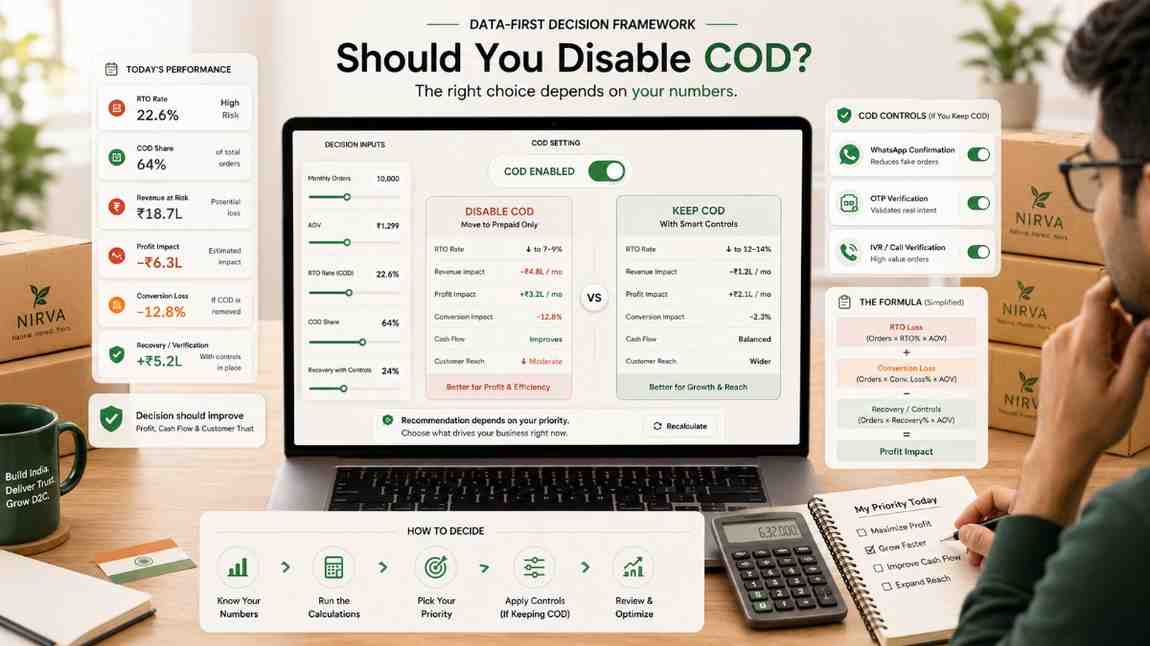
Almost never. For most Indian D2C categories outside premium segments, disabling COD drops conversion significantly (often 30 to 40%) because a meaningful portion of your potential buyers will not pay online for a brand they haven't bought from before. The better approach is to make COD orders smarter: verify them, track the high-risk ones, and convert them to prepaid where possible.
Is COD or prepaid better for new brands?
Prepaid is better for your cash flow and RTO rate. COD is often necessary to reach the full addressable market. The practical answer is to offer both and use the intelligence layer to nudge the right customers toward prepaid. In the first few months, you will also learn which of your customer cohorts are genuinely COD-only versus COD-by-default: that data shapes your incentive strategy.
How quickly do these tactics show results?
COD OTP and address validation show results within days of deployment: you'll immediately see a reduction in dispatched-but-undeliverable orders. Prepaid nudges improve conversion over 2 to 4 weeks as you tune the incentive and messaging. Courier routing improvements take 30 to 60 days to show up clearly in the data because you need enough order volume by pincode to see the signal.
Does Shopify have any native RTO reduction capability?
No. Shopify's native checkout does not include address validation for Indian addresses, COD OTP verification, or prepaid conversion nudges. These require third-party apps or custom checkout extensions. The Shopify Plus checkout extensibility (released 2024) allows more customization but still requires you to build or install the actual logic.
Do address validation tools actually work for Indian addresses?
The better ones do, with caveats. Tools that rely purely on Google Maps geocoding will normalize structurally wrong addresses and give you false confidence. Tools that validate against India Post delivery office databases and courier serviceability APIs are more reliable. The key metric is not whether the tool can find the pincode: it's whether it can flag addresses where delivery success rates are historically low.
What happens to RTO orders once they come back?
Depends on product condition. Sealed products typically go back to sellable inventory after a QC check. Opened or tried products (common in apparel and beauty) often require discounting, liquidation, or write-off. The QC and re-processing cost is real and gets absorbed into warehouse ops. Tracking it explicitly as a per-return cost is important for accurate RTO economics.
Which courier has the lowest RTO rate in India?
No single answer: it varies heavily by pincode, product weight, order value, and time of year. Bluedart typically performs well in metros and tier-1 cities for high-value orders. Delhivery and XpressBees have broader tier-2 and tier-3 coverage. After the Ecom Express acquisition by Delhivery (April 2025), some pincodes that Ecom Express served may have shifted. Run your own 90-day analysis by courier by pincode: the answer for your specific business will differ from industry averages.
Is there a regulatory angle to Indian RTO reduction?
Not directly for RTO, but TRAI's DLT (Distributed Ledger Technology) scrubbing for SMS and WhatsApp Business API registration requirements affect how you can send order verification and pre-delivery messages. Brands running unregistered business WhatsApp for customer communication are at compliance risk. Get on WhatsApp Business API via an approved BSP (Business Solution Provider) before scaling your notification workflows.
What's the fastest way to reduce RTO starting this week?
In order of effort-to-impact: (1) Add a prepaid incentive at checkout: takes 30 minutes to set up, shows results in the first week's COD/prepaid mix. (2) Set up a WhatsApp pre-delivery notification for all dispatched orders: this reduces "customer unreachable" NDRs immediately. (3) Review your last 60 days of NDR data and identify the top 5 pincodes with the highest RTO: route those pincodes to a different courier or apply COD restrictions. These three things require no new infrastructure and can move your RTO meaningfully.
Where to Start This Week
The math is not complicated. Every percentage point of RTO you remove is money that stays in your business instead of funding courier return trips. For a brand doing 3,000 orders a month at 25% RTO, getting to 20% recovers roughly ₹70,000 a month. Getting to 15% recovers ₹1.4 lakh. That is not a rounding error.
If you are doing nothing active on RTO right now, start with three things: add a prepaid incentive at checkout (this week), set up WhatsApp pre-delivery notifications for dispatched orders (this week), and pull your last 90 days of NDR data by pincode and courier (this week). The data will tell you where to go next.
If you want a system that ties address validation, COD scoring, prepaid nudges, and NDR automation together without stitching five tools, OneflowAI is built specifically for this. Worth looking at if you are processing more than 1,000 COD orders a month and the RTO number is eating into what should be real margin.

Omkar Kamble builds OneflowAI, which shows consumer brands what every order really earned after RTO, freight and COD. These guides come from real order and courier data, not theory. Figures we cannot independently verify are flagged.
Published 11 May 2026 Last reviewed 11 May 2026 14 min read