Open this article in your favourite assistant
Get an instant summary, or save it as a source your AI can cite later.
Most D2C founders can quote their RTO rate in one number. "We are running 24% RTO." It is on the weekly slide. It is the number they share with investors. That single number is also why most brands cannot move it.
A 24% aggregate RTO can be 6% prepaid plus 32% COD. Or 18% across both. Or 12% in your top 30 pincodes and 38% in the bottom 30. Each version is a different operational problem with a different fix. The aggregate hides every signal that matters.
Brands running under 15% COD RTO do not have a magic checkout or a special courier. They look at the right slice of data every morning and act on it the same week. That is the entire difference.
This post lists the seven metrics that matter, what good and bad looks like for each, and how often to review them.
The measurement gap most D2C brands have
Walk into a 4,000-orders-a-month D2C brand. "What is your RTO?" gets a clean answer. "What is your RTO on first-time COD customers ordering ₹500 to ₹1,000 in Tier 2 pincodes?" gets silence.
That second question is not theoretical. It decides whether you should run OTP verification on all COD orders or only on a high-risk slice, a 3x to 5x difference in verification cost. Most brands cannot answer it because the default Shopify reports and courier dashboards (Shiprocket, Delhivery, Bluedart) report aggregate RTO, not RTO sliced by payment mode, pincode tier, order value, customer cohort, or time-to-dispatch.
Getting to actionable analytics means pulling the underlying shipment data and re-aggregating it. That is a half-day setup in a spreadsheet for someone with basic skills, and once it exists, it answers questions for years.
What counts as RTO analytics (and what does not)
Reporting tells you what happened. Analytics tells you why and what to do next.
Reporting: "RTO was 24% this week, up from 22%." Analytics: "RTO went up 2 points because COD share rose from 65 to 71%, and within COD, the ₹500 to ₹1,000 bucket is now 31% vs 27% last week, driven by three pincodes in Lucknow and Patna."
Real RTO analytics is segmented (every metric sliced by at least two operational dimensions), tracked on a rhythm (daily, weekly, or monthly depending on the metric), and wired to action (every metric has a named owner and a decision threshold). Without those three, you have wallpaper.
The 7 RTO metrics every D2C brand should track
Listed in rough order of impact. The first three matter for every brand. The rest matter once you are past 1,500 orders a month and have enough volume to see signal in segmented data.
1. RTO rate split by payment mode (COD vs prepaid)
The single most important RTO metric, and the one most brands collapse into an aggregate.
Industry baselines: prepaid RTO under 2%; COD RTO 26 to 28% national average, 35 to 40% for fashion. Aggregate RTO depends almost entirely on COD share.
What this tells you: whether your RTO problem is a payment mix problem (70% COD share, move toward prepaid) or an operations problem (50% COD share but 32% COD RTO, fix verification and NDR workflows). The intervention is completely different in each case.
What good looks like: COD RTO under 18%, prepaid RTO under 3%, COD share trending down over time.
2. First-attempt delivery success rate (FADR) by pincode tier
FADR is the percentage of shipments delivered on the first attempt. Best single indicator of how well your courier and customer base are matched. Track separately for Tier 1, 2, and 3.
Benchmarks: Tier 1 metros 70 to 80%, Tier 2 cities 55 to 65%, Tier 3 and remote 40 to 55%. A 10 point drop in FADR translates roughly into a 5 to 7 point increase in RTO because reattempts are where failure compounds.
3. NDR rate and NDR-to-delivery conversion
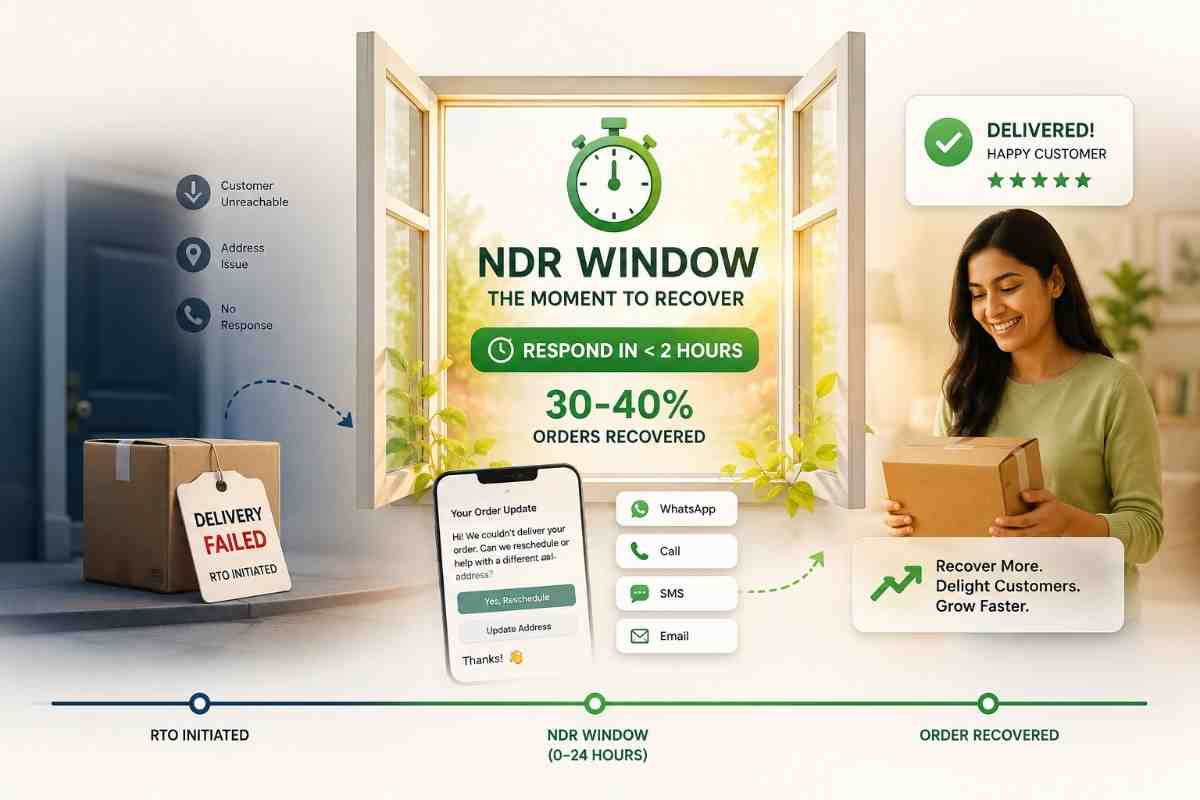
NDR is the count of failed first delivery attempts. NDR-to-delivery conversion is the percentage you recover into successful delivery before they RTO. Track NDR volume daily, conversion rate weekly.
Benchmarks: 15 to 25% of shipments generate at least one NDR. Without intervention, NDR-to-delivery conversion is near zero. With automated WhatsApp workflows: 40 to 60%. A brand recovering 50% of NDRs runs roughly half the RTO of a brand recovering nothing.
4. Order-to-dispatch SLA
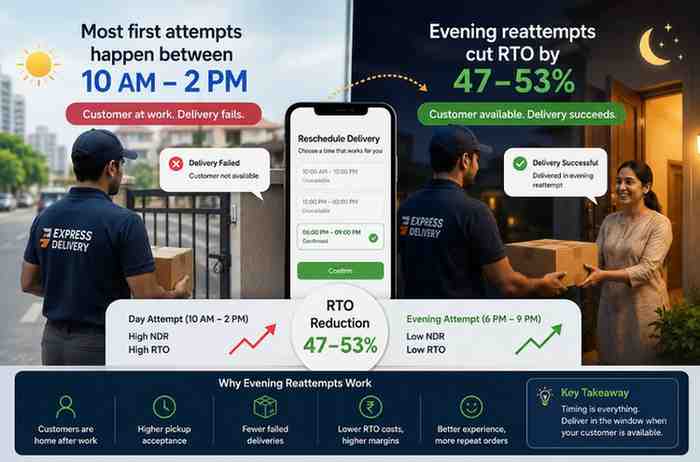
Time from order placement to courier pickup. Orders dispatched within 1 to 2 days RTO at around 22%. Orders dispatched after 5+ days RTO at around 35%. A 13 point swing driven entirely by dispatch speed.
Track daily as P50 (median) and P95 (slowest 5%). P50 tells you your normal operation; P95 tells you your tail, where most RTO leakage hides. Target: P50 under 24 hours for COD, P95 under 72 hours.
5. RTO rate by order value bucket
Split into under ₹500, ₹500 to ₹1,000, and over ₹1,000. Indian D2C data:
| Order value bucket | Average COD RTO | Why |
|---|---|---|
| Under ₹500 | ~25% | Low commitment, low refusal cost |
| ₹500 to ₹1,000 | ~28% | Impulse purchase zone, peak refusal |
| Over ₹1,000 | ~24% | More research, higher commitment |
The ₹500 to ₹1,000 bucket is the impulse purchase zone. Buyers commit without much thought but reconsider when the courier arrives. Most brands apply COD restrictions or run OTP verification on this bucket and above.
6. Pincode-level RTO heatmap
Identify your top 50 pincodes by order volume. Track RTO for each, refreshed monthly on a rolling 90-day window. In almost every D2C brand, 5 to 15 pincodes contribute disproportionately. Patna, Lucknow, and Indore commonly show up.
Decision thresholds:
- Under 20%: standard operations, no intervention
- 20 to 30%: monitor, consider switching couriers
- 30 to 40%: apply pre-dispatch verification (OTP, address confirmation)
- Over 40% on 100+ orders in 90 days: restrict COD, prepaid-only with small discount
Restricting COD on the over-40% band alone usually moves overall RTO by 2 to 4 percentage points within 60 days. One of the highest single-action improvements available.
7. First-time vs repeat customer RTO
Tag every order at placement time. First-time customer RTO is consistently 2x to 3x higher than repeat. Repeat customers have a verified address, payment history, and a track record of accepting deliveries.
This drives where you spend your verification budget. OTP, manual review, and pre-dispatch calls are expensive in time and friction. Apply them to first-time COD customers above ₹500 and skip them for repeat customers. Most brands cut verification cost 60 to 80% this way without losing meaningful RTO recovery.
It also reframes CAC. If first-time RTO is 35% and repeat is 12%, your effective CAC is materially higher than reported because a third of acquired customers never receive their first order. That changes how aggressively you push prepaid at first purchase.
Daily vs weekly vs monthly: tracking rhythm
Match the rhythm to the metric. Daily review of pincode RTO at 4,000 orders a month is noise. Monthly review of NDR volume means three weeks of drift go uncorrected.
| Cadence | Metrics | Owner |
|---|---|---|
| Daily | NDR volume, NDR conversion, order-to-dispatch P95 | CX or ops lead |
| Weekly | RTO by payment mode, RTO by order value, FADR by tier | Ops head |
| Monthly | Pincode RTO heatmap, customer cohort RTO, courier ranking | Ops head + founder |
Daily metrics need same-day action: NDR conversion drops, CX reviews the WhatsApp flow that morning. Weekly metrics drive tactical decisions like prepaid incentives and COD thresholds. Monthly metrics drive strategic ones like courier renegotiation and pincode-level COD restrictions.
How to set this up
For 2,000 to 15,000 orders a month, a spreadsheet is enough. Above that, move to Looker Studio or Metabase (both free).
Step 1. Get the data. Three sources. Shopify orders (order ID, customer ID, date, value, payment mode, pincode). Courier shipment data (dispatch timestamp, first-attempt timestamp, NDR events, delivery, RTO) from Delhivery, Shiprocket, or a unified feed like ClickPost. Customer history from the Shopify customer object's total_orders count. Budget two to four days.
Step 2. Classify every order. One row per order tagged with payment mode, order value bucket, pincode tier (RBI classification), customer cohort, outcome, days-to-dispatch, and NDR count. With these tags, any of the seven metrics is a pivot table away.
Step 3. Build the dashboard. Spreadsheet with pivot tables and conditional formatting for the first six months. Total setup: half a day. Refresh weekly. Move to a BI tool when alerting and historical trending matter more than setup cost.
Step 4. Assign owners and thresholds. Every metric gets a named owner and a decision rule. Examples for a 4,000-orders-a-month brand: NDR conversion below 40% for 3 days, CX reviews WhatsApp flow same week. Pincode crosses 40% RTO on 100+ orders, COD restriction applied within 7 days. Write them down. Review quarterly.
Benchmarks: what good looks like
Here is the rough scorecard. These are aggregated from publicly available Indian D2C ops data and are useful for self-assessment, not as fixed targets.
| Metric | Struggling | Standard | High performer |
|---|---|---|---|
| Overall RTO | over 28% | 20–28% | under 18% |
| COD RTO | over 35% | 25–35% | under 22% |
| Prepaid RTO | over 5% | 2–5% | under 2% |
| FADR Tier 1 | under 65% | 65–75% | over 78% |
| NDR conversion | under 25% | 25–45% | over 50% |
| Order-to-dispatch P50 | over 36 hr | 24–36 hr | under 24 hr |
| First-time vs repeat RTO gap | under 1.5x | 1.5x–2.5x | over 2.5x |
Note the last row. A wider first-time vs repeat gap is actually a good sign. It means your repeat customers are well-served and your acquisition is bringing in some lower-quality orders. The fix is acquisition tuning, not operations. A narrow gap usually means your ops are inconsistent for everyone, which is harder to fix.
Brands hitting the "high performer" column across these metrics consistently run aggregate RTO under 15% and grow 2x to 3x faster than the standard performers.
OneflowAI ships with these seven metrics as a built-in dashboard. Brands plugging in see their first segmented view of RTO within 24 hours of integration, which is usually when the most surprising patterns surface.
Frequently asked questions
What is the most important RTO metric to start tracking?
RTO rate split by payment mode. This single split tells you whether your problem is structural (too much COD) or operational (high COD rate within COD). The intervention is different in each case.
What is the difference between NDR rate and RTO rate?
An NDR is a single failed delivery attempt. RTO is when the shipment is returned after all attempts fail. Every RTO starts as an NDR, but not every NDR becomes an RTO. NDR-to-delivery conversion is near zero without intervention, 40 to 60% with good WhatsApp workflows.
Should I block COD on high-RTO pincodes?
Yes, on a tiered basis. If a pincode shows over 40% COD RTO across 100+ orders in the last 90 days, restrict COD and offer prepaid with a small discount. Below 100 orders, the sample is too small. Most brands find 5 to 15 pincodes in this category. Restricting COD on these alone moves overall RTO 2 to 4 percentage points within 60 days.
How big is the RTO difference between first-time and repeat customers?
Repeat customer RTO is typically 40 to 60% lower than first-time. The gap tells you where to apply expensive verification (OTP, manual review, pre-dispatch calls): cost-effective on first-time COD, wasted on repeat customers.
What tools can I use to build an RTO analytics dashboard?
Native Shopify reports cover the basics but miss NDR detail. Add ClickPost or Shipway for unified NDR and courier dashboards. Razorpay Magic Checkout exposes pincode-level RTO. For custom analytics, pull courier API data into Looker Studio or Metabase (both free).
How long does it take to drive a real RTO reduction?
Two to three weeks to see the first pincode and order value insights that drive action. Six to eight weeks to see 4 to 7 percentage points of RTO reduction from acting on the data. Brands under 15% RTO have usually tracked these metrics weekly for at least six months.
- Shipway ShipNotes 2025, Unicommerce India D2C Report 2026
- Shipway ShipNotes 2025
- EasySell COD value analysis

Omkar Kamble builds OneflowAI, which shows consumer brands what every order really earned after RTO, freight and COD. These guides come from real order and courier data, not theory. Figures we cannot independently verify are flagged.
Published 17 May 2026 Last reviewed 17 May 2026 10 min read