Open this article in your favourite assistant
Get an instant summary, or save it as a source your AI can cite later.
- A courier invoice is seven or eight stacked charges per shipment, each one a place a billing system can be wrong.
- An audit matches the billing report against your orders and rate card, AWB by AWB, and flags every overcharge.
- It catches weight and zone errors, wrong fuel and remote-area surcharges, GST mismatches, duplicates, and billing for undelivered shipments.
- It also surfaces SLA refunds the courier owes you for late delivery that almost nobody claims.
- Audit weekly: dispute windows are short, so cadence matters more than depth.
A skincare brand doing 6,000 orders a month asked their finance head a simple question: what do we actually pay to ship one order? She could not answer it cleanly. The courier invoice was one lump sum, ₹11.4 lakh for the month, with no line she could tie back to a specific order.
So she pulled the detailed billing report and matched it, AWB by AWB, against the orders. It took a weekend. What she found: weight discrepancies on 4% of shipments, a fuel surcharge billed two points higher than the contract, remote-area charges on Pune and Surat pincodes that are not remote, and 11 shipments billed for delivery that had actually been cancelled before dispatch.
Total recoverable that month: about ₹47,000. Annualised, more than ₹5.5 lakh leaking out of a brand that thought its shipping cost was a fixed, trustworthy number.
None of it was visible in the lump sum. Courier invoices are designed to be paid, not audited. The charges are spread across thousands of AWBs, mixed with legitimate fees, and governed by dispute windows that close in days. Most brands pay the total and move on.
A courier invoice audit is how you stop doing that. This post explains what an audit is, every line on a courier invoice that can be wrong, the overcharges that hide in plain sight, and a step-by-step process to run one, whether by spreadsheet or software. By the end you will know exactly what to check and what it is worth.
What a Courier Invoice Audit Actually Is
A courier invoice audit is a line-by-line check of what your courier billed you against what they should have billed you under your contract. Nothing more complicated than that.
You take three things and line them up: the courier billing report, your own order data, and your contracted rate card. Then you ask, for every single charge, does this match what the contract says it should be? Where it does not, you have an overcharge to dispute.
The reason this catches money is that couriers and aggregators make billing errors at scale, and the errors run one direction. A reweigh machine logs a parcel heavier than it is. A pincode is mapped to the wrong zone. A fuel surcharge updates but your contracted cap does not get applied. None of these are usually deliberate fraud. They are systematic mistakes that happen to favour the courier, and nobody on your side is checking.
An audit is not a complaint or a negotiation. It is arithmetic. You are not arguing that the charge feels high. You are showing, with the contract and the shipment data, that the charge is wrong by a specific number. That is what makes overcharges recoverable rather than just annoying.
There are two layers to it. The audit finds the errors. The recovery disputes them and gets the money back. This post is mostly about the first layer, finding everything an audit should catch, because you cannot recover what you never spotted. The recovery workflow is covered in depth separately.
Anatomy of a Courier Invoice: Every Line That Can Be Wrong
To audit an invoice you have to know what is on it. A typical Indian courier or aggregator invoice bills these components per shipment. Each one is a place an error can hide.
| Line item | What it is | How it goes wrong |
|---|---|---|
| Forward freight | Base cost to ship, by weight slab and zone | Wrong chargeable weight or wrong zone |
| COD fee | Charge for collecting cash on delivery | Wrong slab or percentage vs contract |
| RTO freight | Return-to-origin cost on failed delivery | Wrong rate, or charged on a delivered order |
| Fuel surcharge | Percentage on base freight, updated periodically | Billed above contracted rate, applied to wrong base |
| Remote-area surcharge | Extra for hard-to-serve pincodes | Applied to serviceable pincodes |
| Handling / docket / pickup | Fixed accessorial fees | Applied when not contracted, or duplicated |
| GST | Tax on the billable services | Calculated on a wrong base, mismatched rate |
The forward freight is the big one, and it has two inputs that both have to be right: the chargeable weight and the zone. Chargeable weight is the higher of actual and volumetric weight, so an error there is a weight discrepancy. The zone comes from the destination pincode, so an error there is a zone mismatch.
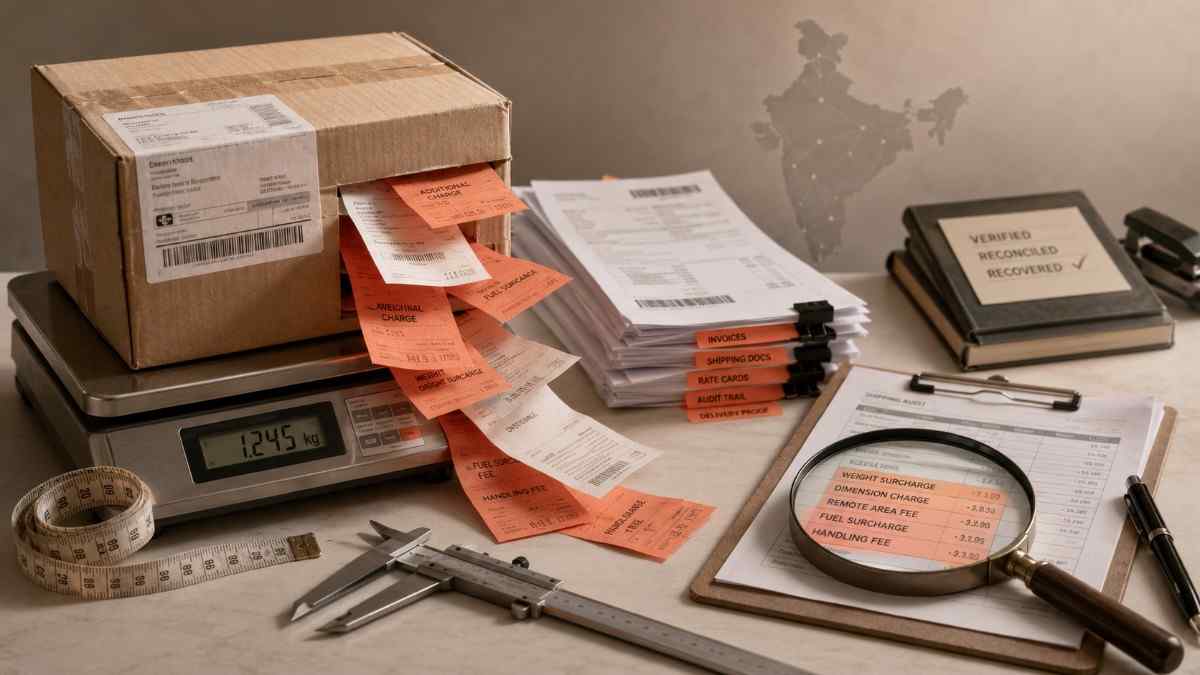
The takeaway: a courier invoice is not one charge, it is seven or eight stacked charges per shipment, each computed by a system that can be wrong. An audit checks every layer, not just the freight total. The brands that only eyeball the monthly lump sum never see any of it.
The Overcharges Hiding in Plain Sight
Weight and zone errors get the attention because they are the largest per shipment. But the most systematic leaks are the ones that touch every order quietly. Here is what a real audit surfaces, beyond the obvious two.
Fuel surcharge drift
Couriers add a fuel surcharge as a percentage on base freight and revise it regularly, often monthly, with fuel prices. The leak: the billed percentage creeps above what your contract specifies, or it gets applied on a base that already includes other fees. Because it sits on every shipment, even a one or two point error compounds across your full volume into real money. This is the single most systematic overcharge an audit catches.
Wrong remote-area charges
Every courier has a serviceability map that flags certain pincodes as remote or extended-area and adds a surcharge. The maps differ between couriers and are frequently out of date, so the surcharge lands on pincodes that are perfectly serviceable. One focused D2C audit reportedly recovered over ₹42,000 from wrong remote-area charges alone. Check every remote-area line against the actual delivery pincode.
Billing for undelivered or cancelled shipments
Orders get cancelled before dispatch, or a shipment is created and never picked up, yet the freight still appears on the invoice. An audit that matches the billing report against your actual dispatched-and-delivered orders catches charges for shipments that never moved.
Duplicate charges
The same AWB billed twice, or a forward charge plus an RTO charge plus a re-attempt fee that double-counts one movement. Rare per shipment, but a clean, self-evident win in the invoice itself.
GST mismatches
GST computed on a wrong base, or at a mismatched rate, quietly inflates the total. It is easy to miss because tax feels non-negotiable, but a wrong tax base is still a wrong charge.
Missed SLA refunds
This one is not an overcharge you paid, it is money the courier owes you and never paid out. Many couriers credit a partial or full refund when they miss a committed delivery timeline, but the claim has to be filed inside a window, and almost nobody files it. An audit that tracks delivery SLAs against the promise surfaces refunds you are entitled to but never claimed.
The pattern across all six: they are individually small, scattered, and invisible in a lump sum. Only a line-by-line audit makes them show up, and only at the portfolio level does the total become worth chasing.
How to Run a Courier Invoice Audit
Here is the process, end to end. The first cycle is the slowest because you build the rate-card baseline once. After that, each cycle is an hour or two for most brands.
Step 1: Structure your rate card once
Turn your contracted rate card into a usable lookup: weight slab by zone gives base freight, plus the COD fee logic, RTO logic, the contracted fuel surcharge percentage, the remote-area pincode list, and any fixed accessorials. Do this once per courier. This is the baseline every audit compares against, and it is the step most brands skip, which is exactly why they cannot prove their overcharges.
If you ship across Delhivery, Shiprocket, Bluedart and Ekart, you need one structured rate card each. They price, zone, and surcharge differently.
Step 2: Pull the billing report and your order manifest
Export two files for the billing period:
- The courier billing report: every charge line by AWB, including forward freight, COD fee, RTO, fuel surcharge, remote-area and other surcharges, and GST.
- Your order manifest: AWB, declared weight, dimensions, destination pincode, payment mode, order value, and dispatch / delivery status.
The AWB is the key that ties what you shipped to what you were billed. If your manifest does not carry the AWB cleanly, fix that first, because the whole audit depends on the match.
Step 3: Match on AWB and catch the easy wins first
Join the billing report to the manifest on AWB. Two checks give you the fastest wins before any recompute:
- Orphan charges: any AWB on the invoice with no matching dispatched shipment in your manifest. That is billing for something that did not ship.
- Duplicates: any AWB billed more than once for the same movement.
These need almost no evidence beyond the invoice itself, so clear them first.
Step 4: Recompute the expected charge, line by line
For every matched shipment, compute what it should have cost from your structured rate card:
Expected = forward freight(chargeable weight slab, correct zone)
         + COD fee (if COD, correct slab/percent)
         + RTO fee (if returned, correct rate)
         + fuel surcharge (contracted % on correct base)
         + remote-area charge (only if pincode is genuinely remote)
         + valid accessorials only
         + correct GST

Flag every line where Billed − Expected > 0
Chargeable weight is the higher of dead and volumetric weight. Correct zone comes from the destination pincode. The flagged lines, where billed beats expected, are your recovery pipeline.
Step 5: Classify each flag by overcharge type
Sort the flags into weight discrepancy, zone mismatch, COD or RTO fee error, fuel surcharge drift, wrong remote-area charge, GST mismatch, duplicate, and undelivered billing. Group them, because each type takes the same evidence, and batching by type is far faster than handling each AWB cold.
Grouping also tells you where your structural leak is. If 60% of your recoverable value is one wrong fuel-surcharge rate, that is a single contract conversation, not a thousand disputes.
Step 6: Dispute in-window, then verify the credit
File each dispute inside its window, which is often as short as 7 working days, with the right evidence: a scale-and-tape photo for weight, the pincode-to-zone mapping for zone, the rate card line for fee and surcharge errors, the two invoice lines for duplicates. Then log every dispute and confirm the approved amount actually lands back in your wallet or next invoice. An approved dispute is not recovered until the money is back.
Step 7: Fix the source so it stops recurring
Every recurring overcharge is a process bug. A repeated weight discrepancy on a SKU means its catalogue weight is wrong. A repeated remote-area charge on a pincode means the serviceability map is stale and worth escalating to your account manager. A wrong fuel surcharge means the contract is not being applied and needs fixing at the source. Recovery returns money already lost; fixing the source stops the leak.
Manual vs Automated Audit
The audit logic is the same whoever runs it. What changes with scale is whether a human can keep up with the dispute windows.
Spreadsheet, in-house. Works under roughly 500 shipments a week with one disciplined owner. Cheapest to start. Fragile, because the moment that person is pulled onto a launch or a stockout, the weekly audit slips and the windows close.
Reconciliation software. Tools that automate the AWB match and rate-card recompute, flagging overcharges for you. Worth it above 1,000 shipments a month or across multiple couriers. You still own the disputing; the software finds the leaks but does not always file for you.
Managed recovery. A service that runs the audit, files the disputes inside each window, and chases the credits, so recovery happens whether or not your team had a free hour. This is where something like OneflowAI fits: it audits your courier billing and marketplace settlements line by line, surfaces every recoverable overcharge, and pursues the claims for you, so the money comes back instead of quietly leaving.
The honest deciding question is not which is most sophisticated. It is whether the disputes will actually get filed, every week, when things are busy. If the answer is no, a system or a partner that guarantees the filing is worth more than a better spreadsheet.
Benchmarks: What a Good Audit Catches
There is no audited public benchmark specific to Indian D2C courier audits, so treat these as operator targets and vendor-reported ranges rather than hard figures.
| Signal | Leaking | Decent | Tight ops |
|---|---|---|---|
| Share of freight spend audited | 0% (pay the lump sum) | Sampled / monthly | 100% weekly |
| Invoice lines checked | Freight total only | Freight + weight | Every line incl. fuel, surcharge, GST |
| Recoverable overcharge found | Unknown | 2–4% of freight | 3–8% of freight surfaced |
| Overcharges caught in-window | Under 20% | 50–70% | 90%+ |
| SLA refunds claimed | Never | Occasionally | Tracked and filed |
Industry estimates put recoverable freight overcharges around 3 to 8% of spend once a brand audits properly, with some Indian vendors citing 5 to 15% from enforcing the contract. The realistic number for a brand that has never audited is a meaningful slice of shipping spend that is currently invisible.
The metric that decides everything is the share of overcharges caught in-window. A perfect audit recovers nothing if the disputes land after the windows close. Cadence beats depth. A weekly rough audit recovers more than a flawless quarterly one.
The Short Version
A courier invoice is not one charge, it is seven or eight stacked charges per shipment, each computed by a system that can be wrong in the courier favour. The errors are small, scattered across thousands of AWBs, and invisible in the monthly lump sum.
A courier invoice audit lines up three things, the billing report, your order data, and your rate card, and checks every line against the contract. It catches weight and zone errors, fuel-surcharge drift, wrong remote-area charges, duplicates, GST mismatches, billing for shipments that never moved, and refunds you are owed but never claimed.
Structure the rate card once. Match on AWB. Recompute every line. Dispute the gaps in-window, verify the credit, and fix the source. Do it weekly and courier billing turns from a trusted lump sum into a number you actually control. The arithmetic is simple. The windows are short. Show up every week.
- hidden shipping cost audit guide
- freight audit recovery estimates

Omkar Kamble builds OneflowAI, which shows consumer brands what every order really earned after RTO, freight and COD. These guides come from real order and courier data, not theory. Figures we cannot independently verify are flagged.
Published 23 June 2026 Last reviewed 23 June 2026 15 min read