Open this article in your favourite assistant
Get an instant summary, or save it as a source your AI can cite later.
- Shiprocket flags weight discrepancies in the Weight Reconciliation tab and holds the disputed amount in your wallet.
- You have only 7 working days to dispute, after which Shiprocket auto-accepts and debits the charge.
- Classify each charge first: volumetric billing and slab rounding are usually valid; implausible jumps are worth disputing.
- Win disputes with a scale-and-tape photo showing the weight, dimensions, and the AWB label in frame.
- Fix recurring discrepancies by correcting the SKU master weight so they stop generating.
You open your Shiprocket wallet on a Monday and the usable balance is lower than it should be. You did not ship anything unusual over the weekend. Then you find the Weight Reconciliation tab, and there are 40 shipments sitting in it, each with a courier-measured weight higher than what you declared. Some are off by 200 grams, a few are off by a full kilo.
Each one is a small charge. ₹38 here, ₹62 there, one at ₹190. Individually, none of them is worth your afternoon. Together, across a month of 4,000 orders, they are quietly draining ₹3,000 to ₹4,000 that you never priced into your shipping cost.
Here is the part that actually hurts: most of those charges will become permanent not because they are correct, but because nobody disputed them in time. Shiprocket gives you 7 working days. Miss the window and the system auto-accepts the charge and debits it from your wallet. The money is gone, and the dispute button disappears with it.
The clock is the whole game. The 7-day window counts working days, not calendar days, so a long weekend or a festival stretch quietly shortens it. Check the Weight Reconciliation tab daily, not at month-end.
Weight discrepancy is one of the most under-watched line items in Indian D2C logistics. It is not fraud and it is not always a courier error. It is a mix of how chargeable weight is calculated, how couriers round, and how rarely sellers verify the numbers. This post breaks down why the charges happen, why most disputes get rejected or expire, and exactly how to dispute one so it actually gets reversed.
What a Weight Discrepancy Actually Is
A weight discrepancy is the gap between the weight you declared when booking a shipment and the weight the courier measured when the parcel reached their hub. When the courier's number is higher, you get back-charged the difference. That charge shows up in your Shiprocket wallet as a hold, then a deduction.
To understand why the courier's number is often higher, you need two terms: dead weight and volumetric weight.
Dead weight is the actual physical weight of the packed parcel on a scale. A 0.5 kg jar of protein in a box is roughly 0.6 kg dead weight after packaging.
Volumetric weight is a weight derived from the size of the parcel, not its mass. Couriers use it because a big, light box takes up the same truck and aircraft space as a small, heavy one. They will not ship a pillow for the price of a paperback just because it is light.
Volumetric weight formula (Shiprocket standard):
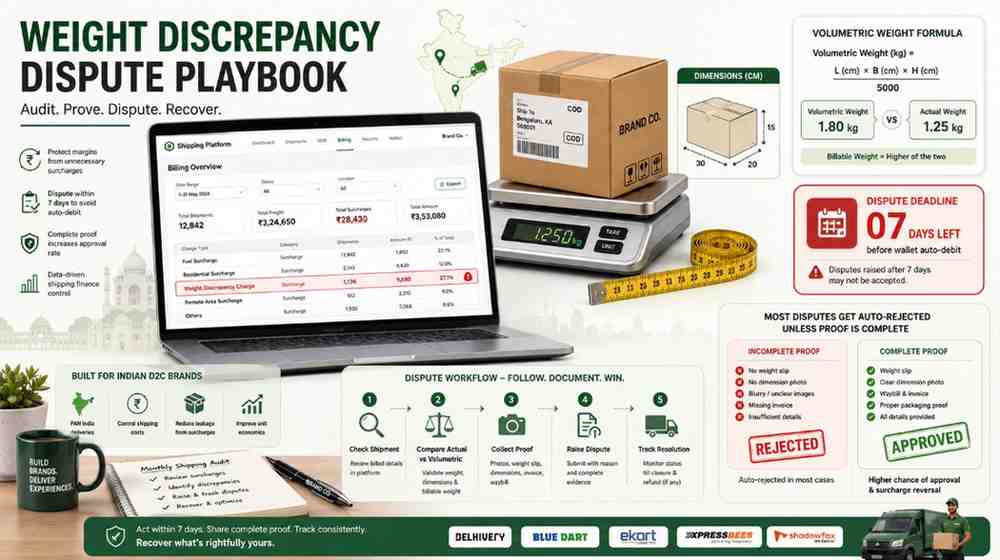
Volumetric weight (kg) = (Length × Breadth × Height in cm) / 5000

Example: a 30 × 25 × 10 cm box
= 7,500 / 5,000
= 1.5 kg volumetric weight
If that box has a dead weight of only 0.6 kg, you are still billed on 1.5 kg, because the chargeable weight is the higher of dead weight and volumetric weight.
That single rule explains most discrepancies. You weighed the product, declared 0.6 kg, and felt that was honest. The courier measured the box, computed 1.5 kg volumetric, and billed the higher number. Neither side is lying. You were measuring different things.
One more wrinkle: the divisor. Shiprocket's standard is 5000, but the divisor is not universal. Some couriers and express services use 4000, which makes the same box heavier on paper. Always check which divisor your courier rate card uses before you assume a charge is wrong.
Why Shiprocket Keeps Charging You
Shiprocket is an aggregator. It does not run the weighing machines. The courier partner, Delhivery, Ekart, Xpressbees, Bluedart, weighs your parcel at their hub, sends the measured weight back into the Shiprocket system, and the system reconciles it against what you declared. The charge originates with the courier. Shiprocket passes it through.
There are four reasons the courier's number comes back higher, and only one of them is an actual error.
1. You declared dead weight, they billed volumetric
This is the most common cause and the least disputable. If your product is bulky and light, apparel in a big poly bag, a lampshade, a cushion cover, the volumetric weight legitimately exceeds the dead weight. The courier is correct to bill on it. You will not win this dispute. You fix it by declaring volumetric weight upfront or shrinking the package.
2. Slab rounding
Couriers bill in weight slabs, usually 0.5 kg steps. A parcel that weighs 0.55 kg is charged as 1 kg. A 1.1 kg parcel is charged as 1.5 kg. If you declared 0.5 kg and the real packed weight is 0.55 kg, you did not under-declare by much, but you crossed a slab boundary and got bumped to the next full slab. The discrepancy charge is the gap between two slabs, which can feel disproportionate to a 50-gram difference.
3. Packaging weight you forgot to count
You weighed the product. You did not weigh the corrugated box, the bubble wrap, the filler paper, the tape, and the printed invoice. On a small item, packaging can add 100 to 250 grams, enough to push you over a slab. The declared weight was honest for the product and wrong for the parcel.
4. A genuine courier reweigh error
This is the one you can and should fight. Conveyor reweigh machines mis-read. A parcel gets weighed while resting against another. Dimensions get entered wrong. A 0.6 kg parcel comes back logged at 2 kg. When the courier's number is implausible given your product, it is almost always a measurement error, and a clean photo of the parcel on a scale overturns it.
The practical takeaway: before you dispute anything, classify the charge. Is it volumetric (probably valid), a slab bump (partly your declaration), packaging (your declaration), or an implausible jump (a real error worth fighting)? Disputing valid charges wastes your evidence and your credibility on future disputes.
Why Most Disputes Get Auto-Rejected (or Never Get Raised)
Sellers lose weight-discrepancy money in two ways. A few disputes get rejected on the merits. Far more never get raised at all, because the 7-working-day window closes while the reconciliation tab sits unopened.
Here is how the workflow actually runs, and where money leaks at each step.
| Stage | What happens | Where you lose money |
|---|---|---|
| Discrepancy raised | Courier reweighs, system flags the gap, amount goes on hold in your wallet | You do not notice the hold |
| 7-working-day window | You can Accept or Dispute in the Actions tab | Window lapses unwatched |
| Dispute submitted | You upload evidence, product description, category | Weak or label-less photos |
| Courier review (5–6 days) | Courier validates against their weighment data | Evidence does not overturn the machine reading |
| Resolution | Amount released back or debited from wallet | Auto-accept if you never responded |
The held amount is not deducted while a dispute is open. It sits separate from your usable balance until the courier responds, then it is either released back to you or debited. That is the good news: raising a dispute genuinely protects the money in the interim.
The bad news is the auto-accept rule. If you do not respond inside 7 working days, Shiprocket auto-accepts on your behalf and the amount is debited. Working days, not calendar days, so a Diwali stretch or a long weekend quietly shortens your real response time.
When disputes are raised but still rejected, the reason is almost always evidence quality. The three failure patterns:
- No identifiable parcel. A photo of a scale with a box on it, but no AWB or shipping label visible. The courier cannot tie your photo to that specific shipment, so it is ignored.
- Reconstructed after the fact. You photograph a similar parcel days later because you did not capture the original at packing. If the weight does not match the courier's reading, it reads as a re-creation, not proof.
- Disputing a valid volumetric charge. You declared dead weight, the courier billed volumetric correctly, and your scale photo only proves the dead weight, which was never in question.
A dispute is not a complaint. It is you presenting better data than the courier's machine. If your data is weaker, you lose, and the charge stands.
How to Dispute a Weight Discrepancy, Step by Step
This is the part that recovers money. The process is mechanical once you set it up, and it takes a few minutes per flagged shipment. The discipline is in doing it inside the window, every time.
Step 1: Check the Weight Reconciliation tab on a fixed cadence
Open the Weight Discrepancy / Weight Reconciliation tab in your Shiprocket panel. Do not wait for an email nudge. Make it a standing task: every working day if you ship 500+ orders a month, every two days if you are smaller. The whole game is catching the hold before the 7-working-day clock runs out.
Assign it to one named person on the ops team. Reconciliation that is "everyone's job" is nobody's job, and that is exactly how windows lapse.
Step 2: Classify each flagged shipment before you act
For every entry, pull the courier-applied dead weight and the volumetric dimensions, and compare against what you declared. Recompute the volumetric weight yourself with the (L × B × H) / 5000 formula. Then ask which of the four causes this is.
| What you see on the flagged shipment | Verdict |
|---|---|
| Courier weight is plausible and volumetric checks out | Accept |
| Courier weight is implausibly high vs your product | Dispute |
| Slab bump from packaging you under-declared | Accept, fix declaration |
| Dimensions entered wrong by courier | Dispute |
Accepting a valid charge is not a loss. It keeps your dispute approval rate high, which matters because couriers and aggregators do notice sellers who dispute everything indiscriminately.
Step 3: Build evidence that overturns a machine reading
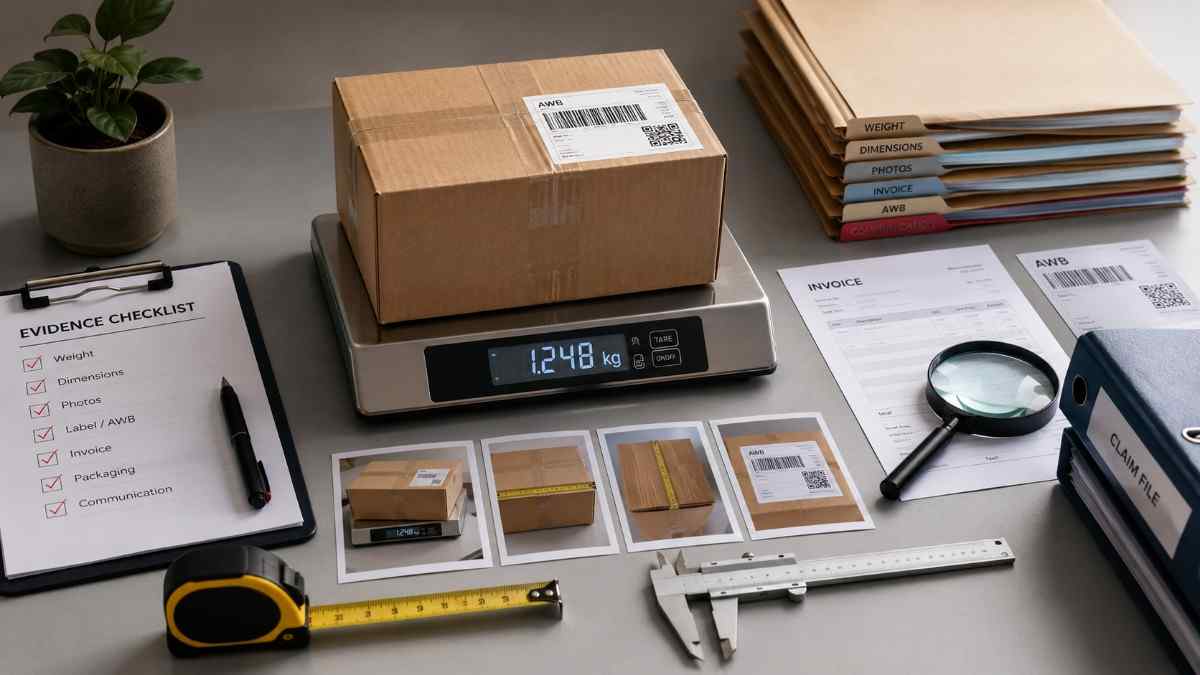
This is where disputes are won or lost. The courier has a weighment machine reading. Your photo has to be more credible than that. Capture:
- The packed parcel on a calibrated weighing scale, with the digital readout clearly legible.
- Each dimension against a measuring tape or ruler, length, breadth, and height in separate clear shots.
- The shipping label or AWB number in the same frame, so the parcel is provably this shipment and not a stand-in.
The single highest-leverage habit: photograph at the packing bench, before dispatch, not after the discrepancy appears. A photo taken at the moment of packing, with the label already on the box, is almost impossible to argue against. A photo reconstructed a week later is easy to dismiss.
For your top 20 to 30 SKUs, you do not need a fresh photo every time. One reference set of scale-and-tape photos per SKU, stored in a shared folder named by SKU, covers the bulk of your disputes. Capture combo and irregular orders live at the bench.
Step 4: Raise the dispute correctly in the panel
In the Actions tab on the flagged shipment, choose Dispute. Upload the weight and dimension images. Add the product description and the product category, both are part of what the courier reviews. State the correct weight plainly. Then submit, well inside the 7-working-day window.
Do not write an essay. The reviewer is matching your photo against their machine data, not reading a paragraph. Clear image, correct weight stated, product and category filled in. That is the whole submission.
Step 5: Track resolution and escalate the rejections worth fighting
Shiprocket aims to resolve disputes in 5 to 6 working days. Watch the status. If the dispute is approved, the held amount is released back to your usable balance. If it is rejected despite clean evidence, you have one more move: reopen a support ticket, re-attach the same evidence, and specifically request the courier's reweigh slip or weighment image. If their machine image contradicts a clear, labelled scale photo from your bench, you have grounds for a manual override.
Keep a simple log: AWB, declared weight, charged weight, disputed amount, outcome. After a month you will see which couriers reweigh aggressively and which SKUs trigger repeat discrepancies. That pattern is worth more than any single recovered charge, because it tells you what to fix upstream.
Step 6: Close the loop upstream so the same charge does not recur
Every won dispute is a clue. If a SKU keeps getting flagged, its catalogue weight or dimensions are wrong. Fix the master data once and the discrepancy stops recurring across every future order of that SKU. Disputing the same SKU every week is treating the symptom. Correcting the declared weight is the cure.
Benchmarks: What Good Weight-Discrepancy Management Looks Like
There is no public industry-standard benchmark for weight discrepancy rates, so treat these as operator rules of thumb rather than published figures. They are the numbers a tight ops team tends to hold.
| Metric | Leaking money | Decent | Tight ops |
|---|---|---|---|
| Shipments flagged for discrepancy | 8%+ | 3–5% | Under 2% |
| Disputes raised within window | Under 30% | 60–80% | 95%+ |
| Dispute approval rate | Under 40% | 55–70% | 75%+ |
| Reconciliation tab checked | Monthly or never | Twice a week | Every working day |
| SKU master weights verified | Never | Top sellers only | Top 80% of volume |
The two metrics that matter most are the percentage of discrepancies you dispute in-window and your approval rate. A brand that disputes 95% of charges in time and wins 75% of them recovers most of the leak. A brand that disputes 30% and wins 40% is handing back roughly four-fifths of the recoverable money without realising it.
If your flagged-shipment rate is above 5%, the problem is not the courier, it is your declared weights. Audit your top SKUs first. A high flag rate that you dispute well is still a flag rate you should not have.
Building a Defence System Instead of Firefighting
Disputing well recovers the money you are owed. Declaring well stops the charge from appearing at all. The brands that barely think about weight discrepancies are not faster at disputes, they have fewer disputes, because their upstream data is clean.
A durable system has four parts:
- Accurate SKU master data. Weigh and measure each high-volume SKU once, packed, and lock the real packed weight and dimensions into your catalogue. Every future order then declares correctly by default.
- Right-sized packaging. For bulky-light products, the cheapest fix is a smaller box. Volumetric weight falls the moment you cut empty space, and the discrepancy disappears with it.
- A daily reconciliation habit owned by one person. The 7-working-day window forgives nothing. A named owner checking the tab daily is the difference between recovering charges and auto-accepting them.
- A standing evidence library. Reference scale-and-tape photos per SKU, stored and labelled, so raising a dispute is a 60-second task, not a scramble.
This is the same discipline that recovers money across every courier and marketplace line item, not just weight. Shipping overcharges, zone mismatches, wrong COD fees, and lost-in-transit claims all leak the same way: small amounts, short windows, nobody watching. The brands that plug it treat reconciliation as a daily operating function, not a quarterly cleanup.
If watching every discrepancy window across couriers is more than your team can hold, this is exactly the kind of recovery work a service like OneflowAI handles for you, auditing settlements and shipping charges, flagging what is recoverable, and disputing it inside the window so the money comes back to your wallet instead of quietly leaving it.
Frequently Asked Questions
How long do I have to dispute a Shiprocket weight discrepancy?
Seven working days from the date the discrepancy is raised. The disputed amount is held, not deducted, during that window. Miss it and Shiprocket auto-accepts and debits your wallet. Because the window counts working days, holidays and long weekends shorten your real response time.
How is volumetric weight calculated?
(Length × Breadth × Height in cm) / 5000, giving kilograms. A 30 × 25 × 10 cm box is 1.5 kg volumetric. You pay on the chargeable weight, the higher of dead and volumetric. Some couriers use a 4000 divisor, which raises the figure, so check your rate card.
What evidence wins a weight dispute?
A clear photo of the packed parcel on a weighing scale, separate photos of each dimension against a tape, and the shipping label or AWB visible in frame. Add product description and category. Photos taken at packing, before dispatch, beat anything reconstructed later.
What happens if I ignore the discrepancy?
Shiprocket auto-accepts after 7 working days and debits the held amount. The charge becomes final and is hard to reverse. This is why reconciliation has to be a daily task, not a monthly one.
Why is the courier weight higher than what I declared?
Usually one of four reasons: you declared dead weight but were billed volumetric, slab rounding bumped you to the next 0.5 kg step, packaging weight you did not count, or a genuine reweigh-machine error. Only the last is worth disputing on its own; the middle two you fix by declaring better.
How much do weight discrepancies cost per month?
Per-parcel charges have been reported from roughly ₹50 to over ₹900, with documented lump-sum auto-deductions in the tens of thousands. At 1,000 shipments and a 5% discrepancy rate with ₹40 to ₹80 average over-charge, that is ₹2,000 to ₹4,000 a month if you dispute nothing.
Can I dispute after the amount is deducted?
The panel dispute usually closes once the window lapses and the amount is debited. Your only route is a support ticket with your packing evidence and a request for the courier reweigh image. Success is much lower than disputing in-window.
Does smaller packaging reduce discrepancies?
Yes, when the discrepancy is volumetric. Right-sizing a bulky-light parcel lowers the volumetric weight directly and can move it under a slab boundary. It does nothing for genuine dead-weight under-declaration, so diagnose the cause first.
Do I have to weigh every order?
No. Lock correct packed weights and dimensions into your catalogue for high-volume SKUs, and weigh only irregular or combo orders at the bench. Accurate declarations make courier reweighs rarely disagree, so disputes become rare.
Who actually decides the dispute, Shiprocket or the courier?
The courier validates the disputed weight, since they hold the weighment data. Shiprocket runs the workflow and holds the amount until the courier responds. That is why your evidence has to be strong enough to overturn a machine reading.
The Short Version
Weight discrepancies are not random. They come from a chargeable-weight rule that bills the higher of dead and volumetric weight, slab rounding, uncounted packaging, and the occasional machine error. Most of the money lost to them is lost not because the charges are right, but because the 7-working-day window closes with nobody watching.
Check the reconciliation tab daily. Classify each charge honestly. Dispute the implausible ones with a clear, labelled scale-and-tape photo. Accept the valid ones and fix the declaration upstream so they stop recurring. Do that consistently and weight discrepancy goes from a silent monthly leak to a line item you control.
The window is short. The fix is a habit, not a heroic effort.
- Shiprocket weight discrepancy encyclopedia
- Shiprocket weight dispute management page
- Shiprocket guide on reducing weight discrepancies through packaging

Omkar Kamble builds the courier billing audit and recovery engine behind OneflowAI, so these guides come from real courier billing data, not theory. Figures we cannot independently verify are flagged.
Published 20 June 2026 Last reviewed 20 June 2026 15 min read