Open this article in your favourite assistant
Get an instant summary, or save it as a source your AI can cite later.
- Delhivery reweighs every parcel on an automated conveyor and bills the higher of dead and volumetric weight.
- The machine reading is treated as final unless you contest it with proof, so real misreads stay billed if nobody disputes.
- Raise claims on Delhivery One under Disputes, then Weight Mismatch, but only after the shipment is delivered.
- A clear scale-and-tape photo with the AWB visible is what wins a claim against a conveyor reading.
- Prevent most mismatches at the source by setting SKU weights and box dimensions in Delhivery One weight rules.
A home-decor brand on Delhivery surface checked their wallet on a Tuesday and the usable balance was down ₹9,200 from the day before. No big dispatch, no recharge pending. The deductions were all weight mismatches, dozens of them, each a few hundred grams to a kilo heavier than what they had declared.
They declared their planters at 0.8 kg. Delhivery billed many of them at 1.5 to 2 kg. The parcels are bulky and light, so the hub conveyor measured the box, computed a higher volumetric weight, and charged it. Some of those were fair. Some were genuine machine misreads on parcels that do not compute to 2 kg by any formula.
The problem was not the deduction. It was that nobody on the team was checking the Weight Mismatch tab, and the claim window for most of those AWBs was already closing. By the time they noticed the wallet, the recoverable share had shrunk to almost nothing.
Delhivery is the largest courier most Indian D2C brands use, and its weight-mismatch system is its own beast: a Delhivery One panel, conveyor machines that scan weight and dimensions automatically, claims that only open after delivery, and a process where the machine reading is treated as final unless you contest it with proof.
This is the seller playbook for that system. How Delhivery mismatches actually happen, exactly how to raise a claim on Delhivery One, the evidence that wins, why claims get rejected, and how to stop the discrepancies generating in the first place. Written for the ops person who has to action this every week.
How Delhivery Weight Mismatches Happen
A weight mismatch is the gap between the weight you manifested when creating the order and the weight Delhivery measured at its hub. When Delhivery measures higher, you get back-charged the difference, and it shows up as a wallet deduction.
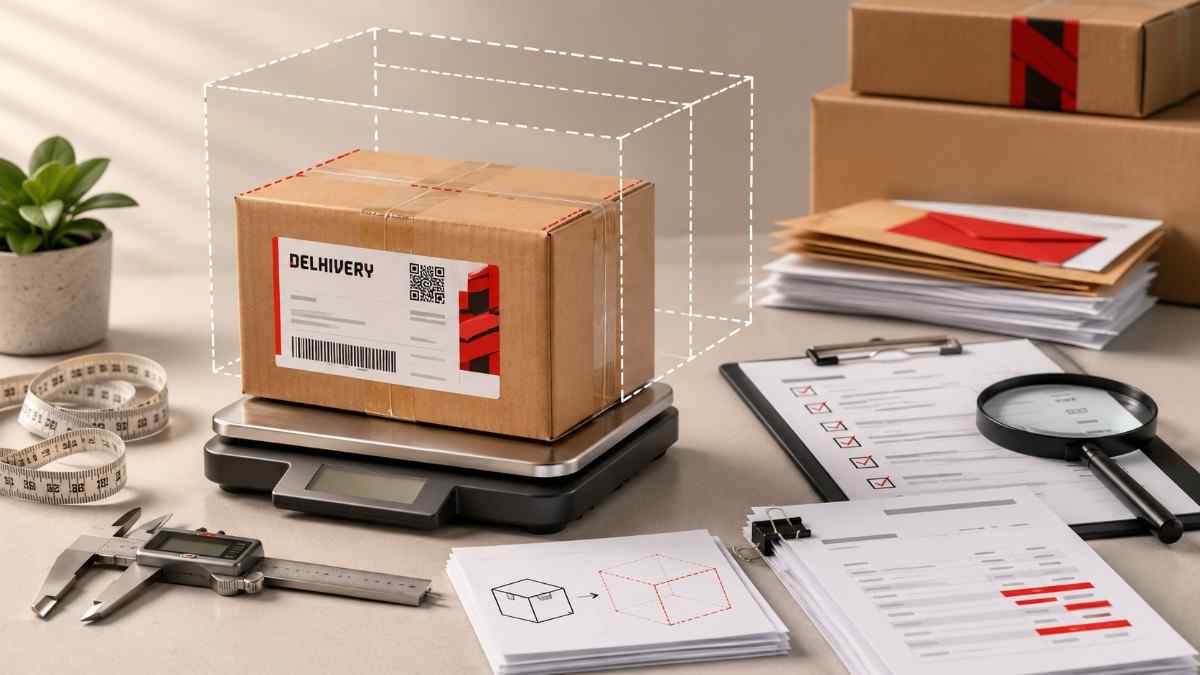
Delhivery does not weigh by hand. It uses conveyor-based sorting machines that capture weight and dimensions automatically with image scanning, then validates the reading against the product description and the shipment history for that SKU. The number that comes out is system-generated, and the platform treats it as the source of truth unless you prove otherwise.
There are four reasons the hub number comes back higher than your declaration, and only one is a clean error.
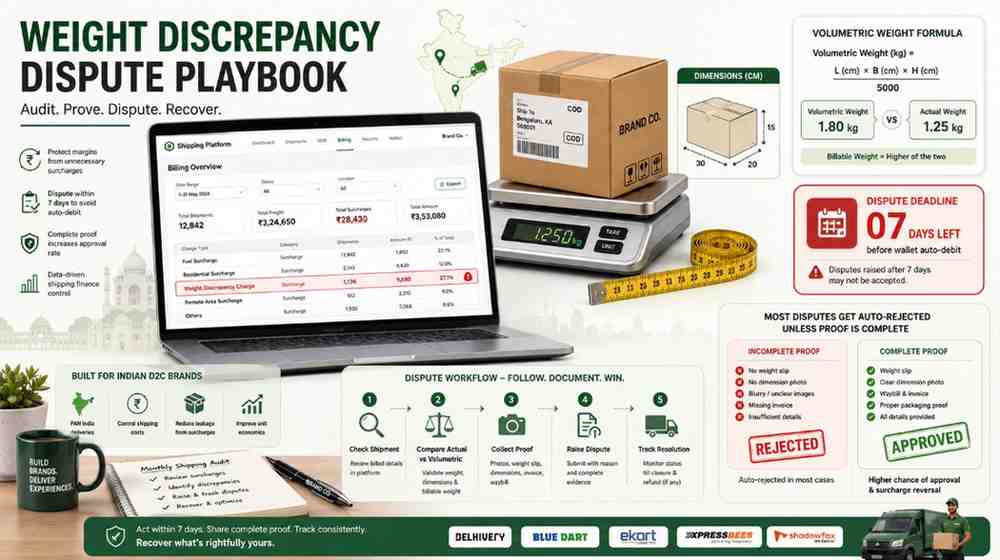
Volumetric weight. Delhivery bills the higher of dead weight and volumetric weight, where volumetric is (L × B × H) / 5000. A bulky-light parcel legitimately computes to more than its scale weight, and Delhivery is correct to bill it.
Uncounted packaging. You declared the product weight but not the corrugated box, bubble wrap, and filler, which can add 100 to 250 grams and tip you over a slab.
Slab rounding. Delhivery bills in weight slabs. A real packed weight of 1.05 kg is billed at 1.5 kg, so a small under-declaration can cost a full half-kilo slab.
A genuine machine misread. The conveyor logs a parcel against another, or image scanning over-reads dimensions, and a 0.8 kg parcel comes back at 2 kg. This is the one you can and should dispute, because it does not compute by any formula.
The takeaway: before you raise a single claim, classify the charge. Three of the four causes are really your declaration and are not winnable. Only the implausible misread is a clean dispute. Firing claims at valid volumetric charges wastes your evidence and your credibility.
What Makes Delhivery Different From an Aggregator
If you also ship on Shiprocket, the Delhivery process will feel different, because Delhivery is the courier itself, not an aggregator reselling couriers. That changes three things.
You deal with Delhivery directly. The reweigh, the billing, and the claim all happen inside the Delhivery One panel. There is no aggregator sitting in between holding the disputed amount. The machine that weighed your parcel and the system that bills you are the same company, which is why your evidence has to directly contest a conveyor reading.
Claims open only after delivery. On Delhivery One, the Raise a Claim button is available only for delivered shipments. The mismatch can be flagged earlier, but you cannot file until the parcel is delivered. This adds a timing trap: the eligibility opens at delivery, and the dispute window can be short, so a claim that becomes eligible on a Friday can lapse over the weekend if nobody is watching.
Watch the timing trap. Because the claim only opens at delivery and the window is short, a daily check of the Weight Mismatch tab is the difference between recovering a charge and auto-accepting it. Do not batch this to month-end.
The divisor is 5000, confirmed. Delhivery uses a 5000 divisor for both surface and express, per its own documentation, and chargeable weight is max(dead weight, volumetric). That is the standard, but worth knowing precisely so you can recompute any charge yourself and know whether it is fair before you dispute.
The practical effect of all this: Delhivery weight disputes reward speed and proof more than argument. The system is automated end to end, so a claim either presents better data than the machine or it does not.
How to Dispute a Delhivery Weight Mismatch, Step by Step
This is the part that recovers money. The process is mechanical once you set it up. The discipline is doing it inside the window, every time, because Delhivery will not chase you to claim what it over-charged.
Step 1: Monitor the Weight Mismatch tab on a fixed cadence
Log in to Delhivery One, open Disputes on the left panel, and select Weight Mismatch. This is the list of shipments where Delhivery measured a different weight or dimensions than you declared. Check it daily if you ship 500+ Delhivery orders a month, every two days if smaller.
Assign it to one named person. Because claims open only at delivery and windows are short, reconciliation that is everyone's job is nobody's job, and that is exactly how deductions become permanent.
Step 2: Classify each flagged shipment before you act
For each AWB, compare Delhivery's measured weight and dimensions against your declared values. Recompute the volumetric weight yourself with (L × B × H) / 5000, and identify which of the four causes this is.
| What you see on the flagged shipment | Verdict |
|---|---|
| Measured weight is plausible and volumetric checks out | Accept |
| Measured weight is implausibly high vs the product | Claim |
| Slab bump from packaging you under-declared | Accept, fix SKU master |
| Dimensions logged larger than the real box | Claim |
Accepting a fair charge is not a loss. It keeps your claim approval rate clean and your evidence focused on the genuine errors.
Step 3: Wait for delivery, then open Raise a Claim
Find the flagged AWB on the Weight Mismatch page. The Raise a Claim option sits on the right and is active only once the shipment is delivered. If it is greyed out, the parcel has not been delivered yet, so flag it to revisit and file the moment it becomes eligible. Do not let an eligible claim sit.
Step 4: Enter your true weight and dimensions
On the claim form, enter the package weight in grams and the dimensions in centimetres exactly as you packed and measured the parcel. Be precise. The claim is a head-to-head between your declared values plus proof and the conveyor's reading, so a rounded or guessed number weakens you.
Step 5: Attach proof that beats a machine
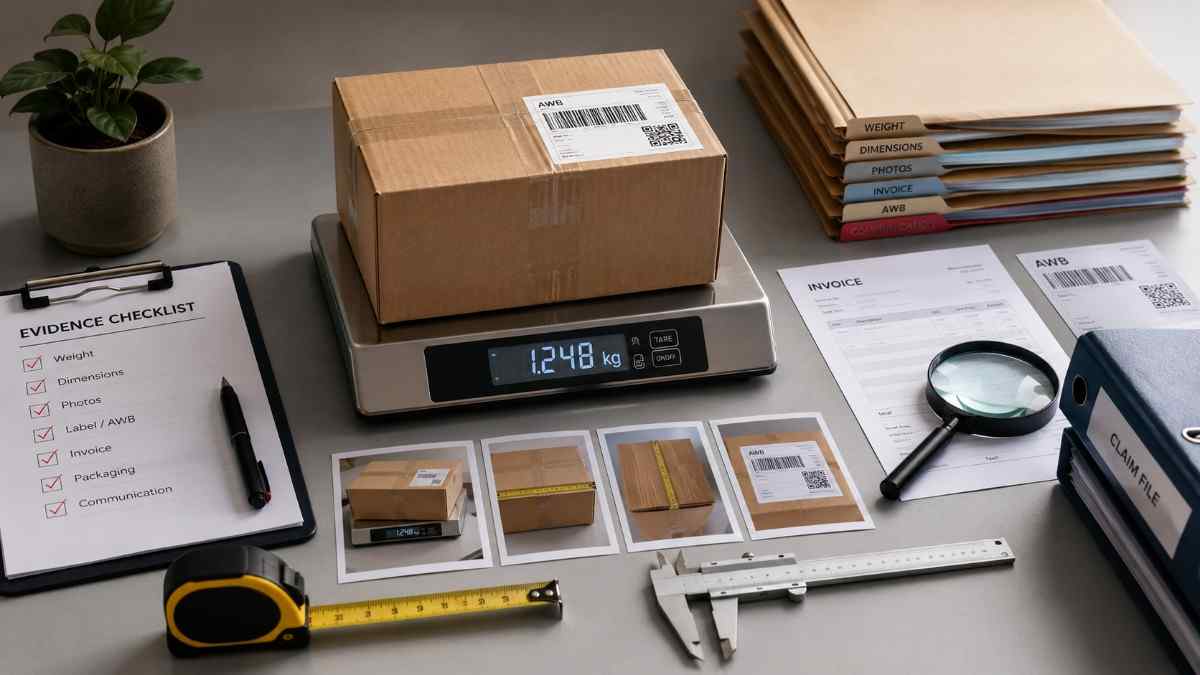
Package images are marked optional on the form. Treat them as mandatory. They are the single thing that turns a claim from rejected to approved, because you are contesting an automated machine reading. Capture:
- The packed parcel on a weighing scale, the digital readout clearly legible.
- Each dimension against a measuring tape, length, breadth and height in clear shots.
- The shipping label or AWB in the same frame, so the parcel is provably this shipment.
The highest-leverage habit: photograph at the packing bench, before handover to the pickup executive, with the label already on the box. For bulky or high-value SKUs especially, a photo or short video on the scale before dispatch is your strongest proof. A reconstruction a week later is easy to dismiss.
Step 6: Submit, log the Claim ID, and track under CLAIMS
Submit and note the Claim ID that is generated. Track it in the CLAIMS section: Open means pending reconciliation, Closed means resolved with remarks. Keep your own log too: AWB, declared vs charged weight, claim amount, Claim ID, and outcome. After a month that log shows you which SKUs trigger repeat mismatches, which is worth more than any single recovery.
Step 7: Escalate genuine errors that get auto-rejected
If a claim is auto-rejected despite clean evidence, use the Need Help option to raise a support ticket. Re-attach your packing photos and specifically request the conveyor weighment image Delhivery captured. If their machine image contradicts a clear, labelled scale-and-tape photo from your bench, you have grounds for a manual override. Reserve this for the genuine misreads, where the evidence is unambiguous.
Why Delhivery Claims Get Rejected
Most rejected Delhivery claims fail for one of four reasons, and all four are avoidable.
- No proof, or weak proof. The form lets you submit without images, so people do. With no photo, your declared number is just an assertion against a machine reading, and the machine wins. Sellers who cannot show proof routinely lose, and the system-generated weight stands as final.
- Unidentifiable parcel. A scale photo with no AWB or label visible. Delhivery cannot tie the image to that shipment, so it is ignored.
- Disputing a valid volumetric charge. You declared dead weight, Delhivery billed volumetric correctly, and your scale photo only proves the dead weight, which was never in question.
- Filed too late. The claim went in after the window, or never, because nobody watched the Weight Mismatch tab and the deduction quietly became permanent.
The pattern is clear: win-rate is an evidence-and-timing problem, not a luck problem. Photograph at the bench, keep the AWB in frame, only dispute the genuine errors, and file fast. Do that and approved claims become the norm rather than the exception.
Prevent It at the Source: Pre-Populate Weight and Dimensions
Disputing recovers money already lost. The bigger win is making your manifested weight match what the hub measures, so the mismatch never generates. Delhivery One has a built-in tool for exactly this, and most sellers never set it up.
It is called weight rules, and it works off your product and packaging master data. You configure two things once:
- Product weights per SKU. Enter the product weight and the packaged weight against each SKU in your catalogue.
- Box dimensions per package type. Configure length, breadth and height for each box you ship in.
After that, order creation auto-populates the weight and dimensions from your master data. Dead weight is computed as the sum of product weights times quantity across the SKUs in the order, and the box dimensions come from the package you select. This works for single orders, bulk CSV uploads, and channel sync from Shopify or WooCommerce.
The effect: your manifested weight stops being a guess. When the conveyor measures the parcel, it matches what you declared, so there is no mismatch to flag and no deduction to chase. You move from disputing discrepancies to not generating them.
Pair that with right-sized boxes for bulky-light SKUs, since a smaller box lowers the volumetric weight directly, and you remove most of the volumetric mismatches too. The combination of accurate SKU master plus tight packaging is what separates brands that fight weight disputes weekly from brands that barely see them.
For the discrepancies that still slip through, and some always will across thousands of shipments, the recovery is ongoing work that is easy to drop when the team is busy. This is the kind of audit-and-recover a service like OneflowAI runs for you, matching every Delhivery shipment against what it should have cost, flagging the genuine over-charges, and filing the claims with evidence so the money comes back instead of quietly leaving your wallet.
Benchmarks: What Good Looks Like
There is no public benchmark specific to Delhivery weight disputes, so treat these as operator targets, not sourced figures.
| Metric | Leaking money | Decent | Tight ops |
|---|---|---|---|
| Shipments flagged for mismatch | 7%+ | 3–5% | Under 2% |
| Eligible claims filed in-window | Under 30% | 60–80% | 95%+ |
| Claim approval rate | Under 40% | 55–70% | 75%+ |
| Weight Mismatch tab checked | Monthly or never | Twice a week | Daily |
| SKU weights set in weight rules | None | Top sellers | Top 80% of volume |
The two metrics that decide everything are the share of eligible claims filed in-window and the approval rate. A brand that files 95% in time and wins 75% recovers most of the leak. A brand that files 30% and wins 40% hands back roughly four-fifths of recoverable money without realising it.
If your flagged rate is above 5%, the problem is your declared weights, not Delhivery. Set up weight rules and right-size your packaging before you blame the conveyor. A high flag rate you dispute well is still a flag rate you should not have.
The Short Version
Delhivery reweighs every parcel on an automated conveyor and bills the higher of dead and volumetric weight, with the machine reading treated as final unless you contest it. Most mismatches are fair volumetric billing or your own under-declaration. Some are genuine misreads worth disputing.
Watch the Weight Mismatch tab daily. Classify each charge honestly. For the genuine errors, wait for delivery, open Raise a Claim, enter your true numbers, and attach a clear scale-and-tape photo with the AWB visible, filed fast. Then prevent the rest at the source by setting product weights and box dimensions in Delhivery One weight rules so your manifest matches the hub.
The system rewards proof and speed. Bring both and Delhivery weight billing goes from a silent wallet leak to a line you control.
- Delhivery weight mismatch help doc
- Delhivery volumetric weight help doc
- Delhivery weight rules help doc

Omkar Kamble builds OneflowAI, which shows consumer brands what every order really earned after RTO, freight and COD. These guides come from real order and courier data, not theory. Figures we cannot independently verify are flagged.
Published 24 June 2026 Last reviewed 24 June 2026 15 min read