Open this article in your favourite assistant
Get an instant summary, or save it as a source your AI can cite later.
- Every parcel has two weights: actual (dead) weight on the scale, and volumetric weight derived from its size.
- You are billed on the chargeable weight, which is the higher of the two.
- Volumetric weight = (Length x Breadth x Height in cm) / divisor, and the standard divisor in India is 5000.
- Bulky-light products (apparel, homeware, footwear) are billed on volumetric weight and overpay the most.
- A smaller box lowers volumetric weight directly, so right-sizing packaging is the cheapest margin you can find.
A homeware brand in Jaipur shipped 3,200 orders last month. Average actual weight per parcel: about 600 grams. The freight bill came in as if every parcel weighed 1.5 kg.
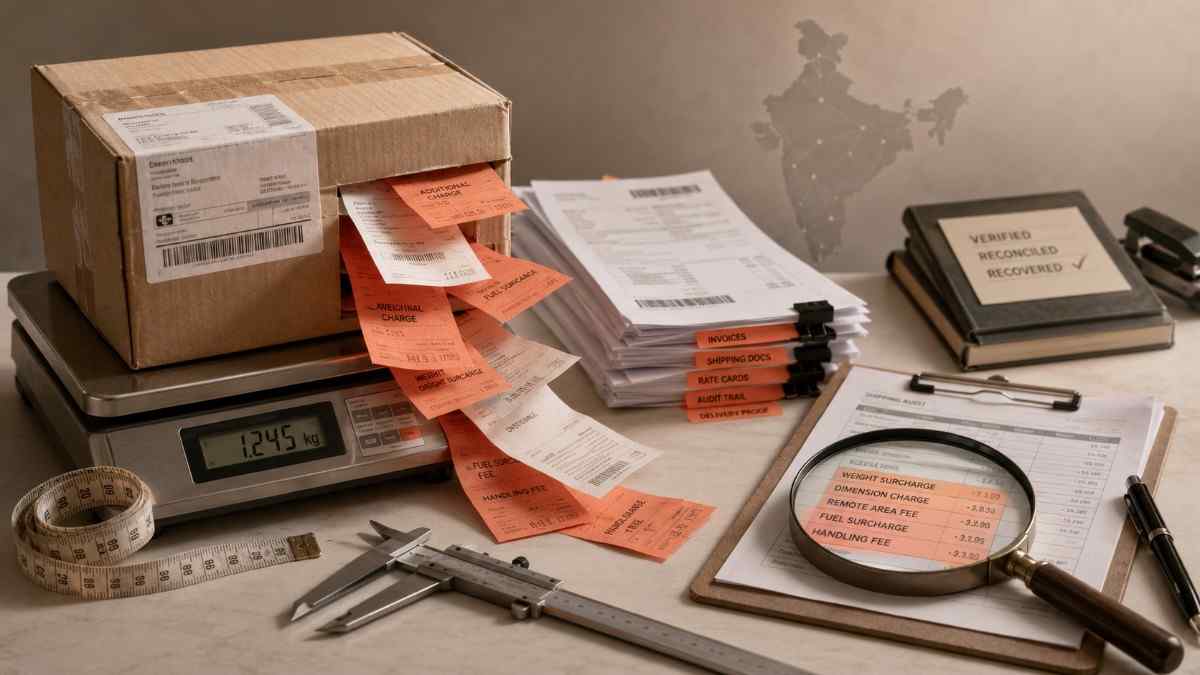
Nobody was cheating them. The cushions and curtains they sell are light but bulky, packed in roomy boxes with filler. The courier was billing on volumetric weight, not the number on the scale. That gap, 600 grams declared versus 1.5 kg charged, was costing them roughly ₹55 extra per order. Across 3,200 orders, about ₹1.7 lakh a month they had never put in their unit economics.
This is the most misunderstood line in Indian D2C shipping. Founders price their freight off the product weight they know, then get billed on a number they have never calculated. The difference is volumetric weight, and for a lot of catalogues it is the single biggest hidden cost in fulfilment.
The good news: volumetric weight is not a mystery or a scam. It is a fixed formula, the same one every courier uses, and once you can calculate it you can predict your bill, price your shipping correctly, and cut the overpayment with a smaller box.
This post explains what volumetric weight is, why couriers use it, the one number (the divisor) that decides how much it inflates your bill, and a full worked example so you can run your own SKUs. No jargon, no spreadsheet required to follow along.
Actual vs Volumetric Weight, in Plain English
There are two weights for every parcel. You usually only think about one of them.
Actual weight (also called dead weight) is the physical weight of the packed parcel on a scale. Your 0.5 kg jar of face cream in a box is maybe 0.6 kg of actual weight after packaging. Simple.
Volumetric weight (also called dimensional weight, or DIM weight) is a weight worked out from the parcel size, not its mass. It answers a different question: how much space does this parcel take up in a truck or aircraft?
A courier vehicle fills up on space long before it fills up on weight. A box of pillows weighs almost nothing but hogs as much room as a box of books that weighs ten times more. If couriers billed only by mass, light bulky parcels would ride for free while taking up paid space. So they charge by whichever is higher.
The one rule that matters:
Chargeable weight = the HIGHER of (actual weight, volumetric weight)
The chargeable weight is what you actually pay for. Not the scale reading. The higher of the two.
For a dense product, actual weight wins and volumetric weight is irrelevant. A 2 kg bag of protein in a snug pouch has low volume, so its volumetric weight is well under 2 kg, and you are billed on the real 2 kg. No surprise.
For a bulky-light product, volumetric weight wins, and that is where the overpayment lives. The whole game is knowing which of your SKUs are in which camp, and that takes one calculation.
Why Couriers Bill by Volume, Not Just Mass
This is not an Indian quirk or a courier inventing fees. Volumetric weight is the global standard for air and surface freight, used by every major carrier worldwide, because the economics of moving parcels is about space as much as weight.
Picture a Delhivery surface vehicle running Jaipur to Bangalore. It has a fixed cargo volume and a fixed weight limit. On a route full of apparel and homeware, the truck runs out of room while still well under its weight limit. Every cubic foot of that truck has a cost, whether it carries a feather or a brick.
Volumetric weight is how that space cost gets passed to the shipper. A parcel that takes up the space of a 1.5 kg item pays like a 1.5 kg item, even if it weighs 600 grams. That is fair from the courier side. It only feels unfair when you have not accounted for it.
The takeaway for a seller is not to resent the system. It is to realise that you control your volumetric weight. You cannot argue the formula, but you decide the box. Packaging is the one lever, and most brands never pull it because they have never run the number that shows what it is costing them.
The Divisor Is Where the Money Hides
Here is the formula every Indian courier uses:
Volumetric weight (kg) = (Length × Breadth × Height in cm) / DIVISOR
The length, breadth, and height are yours, fixed by your box. The one variable you do not control is the divisor, and it quietly decides how heavy your parcel looks on paper.
A smaller divisor produces a larger volumetric weight for the exact same box. That is the whole trick. The divisor is set by the courier and the service, and it is the number most sellers have never looked at.
| Divisor | Who uses it (typical) | Effect on the same box |
|---|---|---|
| 5000 | Standard. Delhivery (surface & express), Bluedart, most domestic | Baseline |
| 4000 | Some couriers / service types | 25% heavier on paper |
| 6000 | Air cargo, India Post, many international services | 17% lighter on paper |
Delhivery confirms 5000 for both its surface and express delivery in its own documentation, and the chargeable weight is max(dead weight, L×B×H/5000). Bluedart also works on 5000. So for most domestic D2C shipping, 5000 is the number to use.
But it is not universal, and the gap matters. The same 30 × 25 × 10 cm box is 1.5 kg at a 5000 divisor and 1.875 kg at 4000, which after slab rounding becomes 2 kg. That is a full extra half-kilo slab on every single order, created entirely by the divisor.
Action: find the divisor on your contracted rate card before you do anything else. If it is not written, ask your account manager and get it in writing. You cannot predict or audit your freight without it.
Run the Numbers: A Worked Example
Let us do this end to end with a real parcel, so you can repeat it for any SKU in your catalogue. Pull a tape measure and a kitchen scale. This takes two minutes per SKU.
Step 1: Measure the packed box in centimetres
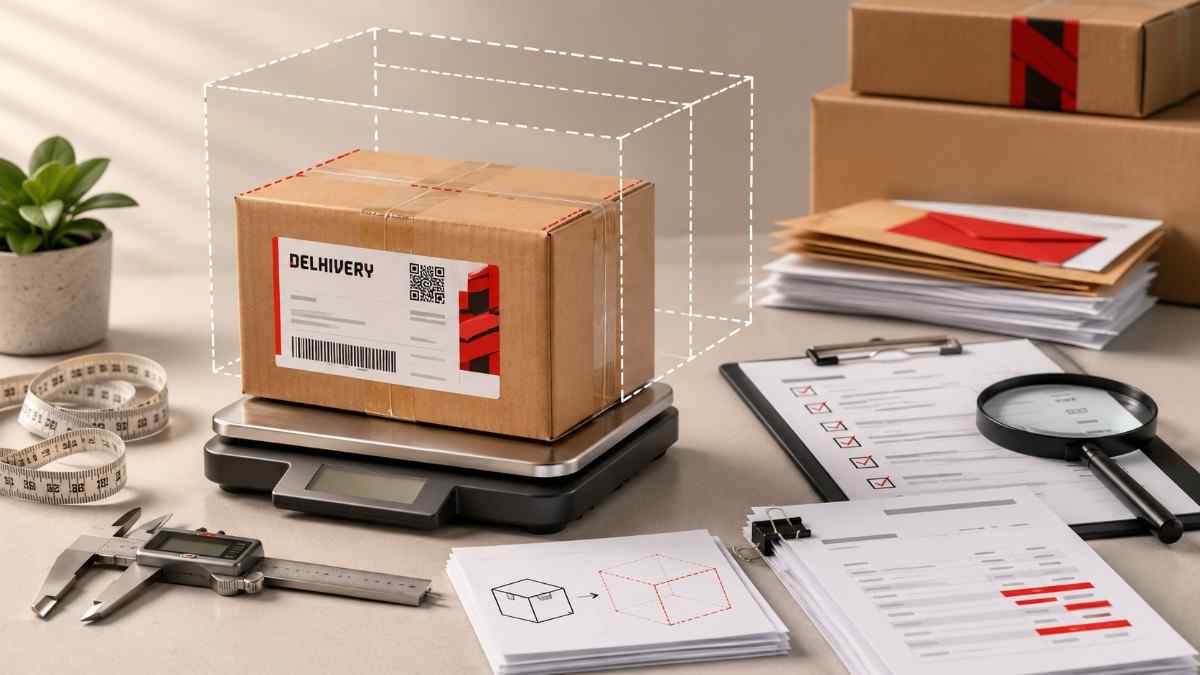
Measure the box as it actually ships, with the product inside, bubble wrap on, filler in, flaps closed. Round each dimension up to the next whole centimetre, because couriers do. Say our homeware parcel measures 30 cm long, 25 cm wide, 10 cm high.
Measure the shipped box, not the bare product. The product might be 24 cm but the box you put it in is 30 cm, and the courier measures the box.
Step 2: Get the volume
Volume = 30 × 25 × 10 = 7,500 cubic cm
Step 3: Divide by your divisor
Volumetric weight = 7,500 / 5,000 = 1.5 kg
At a 5000 divisor, this box has a volumetric weight of 1.5 kg.
Step 4: Weigh the parcel for actual weight
On the scale, the packed parcel reads 0.6 kg. That is the actual weight.
Step 5: Take the higher, then round to the slab
Actual weight = 0.6 kg
Volumetric weight = 1.5 kg
Chargeable weight = max(0.6, 1.5) = 1.5 kg
After slab rounding (0.5 kg steps) = 1.5 kg
You ship a 600-gram parcel and pay for 1.5 kg. You are billed on 2.5 times the actual weight. At a typical Zone-B surface rate, that is the difference between roughly ₹38 and ₹95 per parcel, depending on courier and zone.
Now do the smaller-box version
Suppose you right-size the packaging. Same product, a snug box at 24 cm long, 18 cm wide, 6 cm high.
Volume = 24 × 18 × 6 = 2,592 cubic cm
Volumetric weight = 2,592 / 5,000 = 0.52 kg
Chargeable weight = max(0.6, 0.52) = 0.6 kg
After slab rounding = 1 kg
The smaller box flips the parcel from volumetric-billed to actual-weight-billed. Chargeable weight drops from 1.5 kg to 1 kg, a half-kilo slab saved on every order of this SKU, just from cardboard. On 3,200 orders a month at ₹28 per slab, that is roughly ₹90,000 a month. From a box change.
The quick mental check for any SKU
You do not need the full calc every time. A fast rule: if your box volume in cubic centimetres divided by 5000 is bigger than the scale weight, you are paying volumetric and packaging is your lever. If it is smaller, you are paying actual weight and the box is not your problem.
Run this once across your top 20 SKUs by order volume. You will usually find a handful that are bleeding, and those are where right-sizing pays back fastest. The deeper mechanics of how these charges show up and get disputed are covered separately.
Which Products Bleed the Most
Volumetric weight does not hit every catalogue equally. It is a tax on air. The more empty space and filler in your parcels, the more you pay.
Hit hardest (bulky-light):
- Apparel and ethnic wear in large poly bags or boxes. Light fabric, lots of volume. Routinely billed at 2 to 3 times actual weight.
- Home furnishing like cushions, curtains, bedsheets, and soft furnishings. Almost pure volume.
- Footwear in oversized branded boxes. The shoe is light, the box is big, and the box is what gets measured.
- Soft toys and plush. The worst offenders. Near-zero mass, maximum volume.
- Anything over-packed with thermocol, air pillows, or crumpled paper to fill a box that is too big.
Barely affected (dense):
- Supplements and nutrition. Heavy for their size, billed on actual weight.
- Books and stationery. Dense, compact, actual-weight territory.
- Electronics and accessories. Usually small and dense relative to their box.
- Glassware and ceramics. Heavy enough that mass beats volume even with protective packing.
The takeaway: if you sell in the first list, volumetric weight is probably your largest controllable shipping cost, and packaging design is a margin lever, not just a branding one. If you sell in the second list, do the check once to confirm, then stop worrying about it.
Benchmarks: What Good Looks Like
There is no published industry benchmark for volumetric overpayment in Indian D2C, so treat these as operator targets rather than sourced figures.
| Signal | Bleeding | Decent | Tight ops |
|---|---|---|---|
| Volumetric-to-actual ratio (bulky-light SKUs) | 2.5x+ | 1.5–2x | Under 1.3x |
| SKUs with locked packed dimensions | None | Top sellers | Top 80% of volume |
| Box sizes in use | 1–2 generic | 3–4 | Right-sized per SKU group |
| Freight priced on chargeable weight | No (priced on actual) | Roughly | Yes, per SKU |
| Filler used to fill oversized boxes | Heavy | Some | Minimal, box fits product |
The number that matters most is the volumetric-to-actual ratio on your bulky-light SKUs. If a SKU bills at 2.5 times its actual weight, more than half its freight is paying for air. Getting that ratio under 1.3 with better packaging is usually a quick win that touches every future order of that product.
The second tell is whether you price freight on chargeable weight at all. Brands that price shipping off the product weight they remember are structurally under-charging themselves and quietly eating the gap. Price on chargeable weight, per SKU, and the leak becomes visible in your own numbers.
How to Stop Overpaying
Three moves, in order of payback.
1. Right-size your packaging. For every bulky-light SKU, find the smallest box the product safely ships in. Even dropping one dimension by a few centimetres can cross a slab boundary downward. This is the single biggest lever, and it pays back on every order forever, not once.
2. Lock packed dimensions into your catalogue. Measure each high-volume SKU once, packed, and store the real length, breadth, height, and weight in your order system. Now every shipment declares accurately, your courier reweighs rarely disagree, and you stop generating weight discrepancies in the first place.
3. Reconcile what you were actually billed. Even with clean packaging and accurate declarations, couriers mis-measure and mis-bill. Match your courier invoice against expected chargeable weight, AWB by AWB, and dispute the gaps inside the window. This is where overpayment that already happened gets recovered.
That third step is ongoing work, and it is easy to let slide when the windows are short and the team is busy. This is the kind of audit-and-recover a service like OneflowAI runs for you, matching every shipment against what it should have cost, flagging the volumetric and weight-discrepancy overcharges, and filing the disputes so the money comes back instead of quietly leaving.
But start with the box. Most brands can cut their volumetric overpayment substantially with packaging alone, before they recover a single rupee through disputes. Cardboard is the cheapest margin you will find this quarter.
Frequently Asked Questions
What is volumetric weight?
A weight derived from parcel size rather than mass: (L × B × H in cm) / divisor, in kilograms. Couriers use it because bulky-light parcels take up paid space. You are billed on the higher of volumetric and actual weight.
How do I calculate it in India?
Measure the packed box in cm, multiply the three dimensions, divide by 5000 (the standard divisor). A 30 × 25 × 10 cm box is 7,500 / 5,000 = 1.5 kg. Measure the box as it ships, including packaging.
5000 or 4000, which divisor applies?
5000 is standard. Delhivery (surface and express) and Bluedart use 5000. Some couriers or services use 4000 (heavier), and air or India Post often 6000 (lighter). Confirm the divisor on your rate card.
Why is my volumetric weight higher than actual?
The parcel is bulky and light. High volume relative to mass means volume divided by the divisor beats the scale reading, so you are billed on the larger volumetric figure.
What is chargeable weight?
The weight you actually pay for: the higher of actual and volumetric, after rounding up to the next 0.5 kg slab. Not the scale reading.
Does a smaller box reduce cost?
Yes, for bulky-light parcels billed on volumetric weight. Less empty space lowers volume, lowers volumetric weight, and can drop you a slab. It does nothing for dense items already billed on actual weight.
Why charge in 0.5 kg slabs?
Rate cards use weight bands, not per-gram pricing. Chargeable weight rounds up to the next 0.5 kg, so 0.51 kg bills as 1 kg. A few grams over a boundary costs a full half-kilo slab.
Same volumetric weight for surface and air?
Not always. Delhivery uses 5000 for surface and express, but air and international often use 6000. The service you book can change the figure for the same box.
Can I dispute a volumetric charge?
Only a wrong measurement, not a correct calculation. If the courier logged bigger dimensions than your real box, dispute with a tape-measure photo in-window. If the box genuinely computes higher, the fix is a smaller box.
Which products are hit hardest?
Bulky-light: apparel, cushions, curtains, footwear in big boxes, soft toys, over-packed parcels. Dense items like supplements, books, and electronics are billed on actual weight and barely affected.
The Short Version
Every parcel has two weights, and couriers bill the higher one. For dense products that is the scale reading and there is nothing to fix. For bulky-light products it is the volumetric weight, a number set by your box size divided by a divisor, usually 5000.
Run the calculation on your top SKUs once. Where volumetric weight beats actual weight, you are paying for air, and a smaller box is the cheapest margin improvement available to you. Lock your packed dimensions, price freight on chargeable weight, and reconcile what you were actually billed.
The formula is fixed. The box is yours. That is the whole lever.
- Shiprocket volumetric weight calculator
- Delhivery volumetric weight help doc

Omkar Kamble builds the courier billing audit and recovery engine behind OneflowAI, so these guides come from real courier billing data, not theory. Figures we cannot independently verify are flagged.
Published 22 June 2026 Last reviewed 22 June 2026 14 min read