Open this article in your favourite assistant
Get an instant summary, or save it as a source your AI can cite later.
- Shipping cost leakage is money you pay couriers above what your contract allows, hidden inside a lump-sum invoice nobody reads.
- It is separate from RTO, and comes from weight discrepancies, zone mismatches, wrong surcharges and duplicate charges.
- A brand that has never reconciled loses roughly 2 to 4% of shipping spend to recoverable overcharges.
- You can estimate your own number in ten minutes: monthly shipping spend, times 3%, times 12.
- Reconcile weekly and fix the source so the leak stops generating instead of needing recovery.
Ask most D2C founders what they spend on shipping and they will give you a number that sounds about right: maybe 10% of revenue, give or take. Ask them what they should be spending, billed exactly to contract, and the room goes quiet. Almost nobody knows, because almost nobody checks.
That gap, between what you pay couriers and what your contract actually allows, is shipping cost leakage. It is not RTO and it is not a bad rate card. It is the slow drip of small billing errors: a parcel billed at 1.5 kg when it weighs 0.8 kg, a Pune order billed at a metro zone, a fuel surcharge two points above contract, the same AWB charged twice.
Each one is too small to notice. ₹40 here, ₹70 there. Spread across 4,000 shipments a month, mixed into a single lump-sum invoice you pay without reading, they add up to a number worth a finance head's afternoon, every month.
Indian logistics is where this hides best. Multiple couriers, weight slabs, zone maps, surcharges, COD fees, all billed automatically by systems that make errors in one direction. The errors favour the courier, and nobody on your side is checking the maths.
This post puts a number on it. What the leak is worth as a share of your shipping spend, where it comes from, and a simple model to estimate your own figure in ten minutes. No tools required, just your courier invoice and a calculator.
Where the Money Actually Leaks
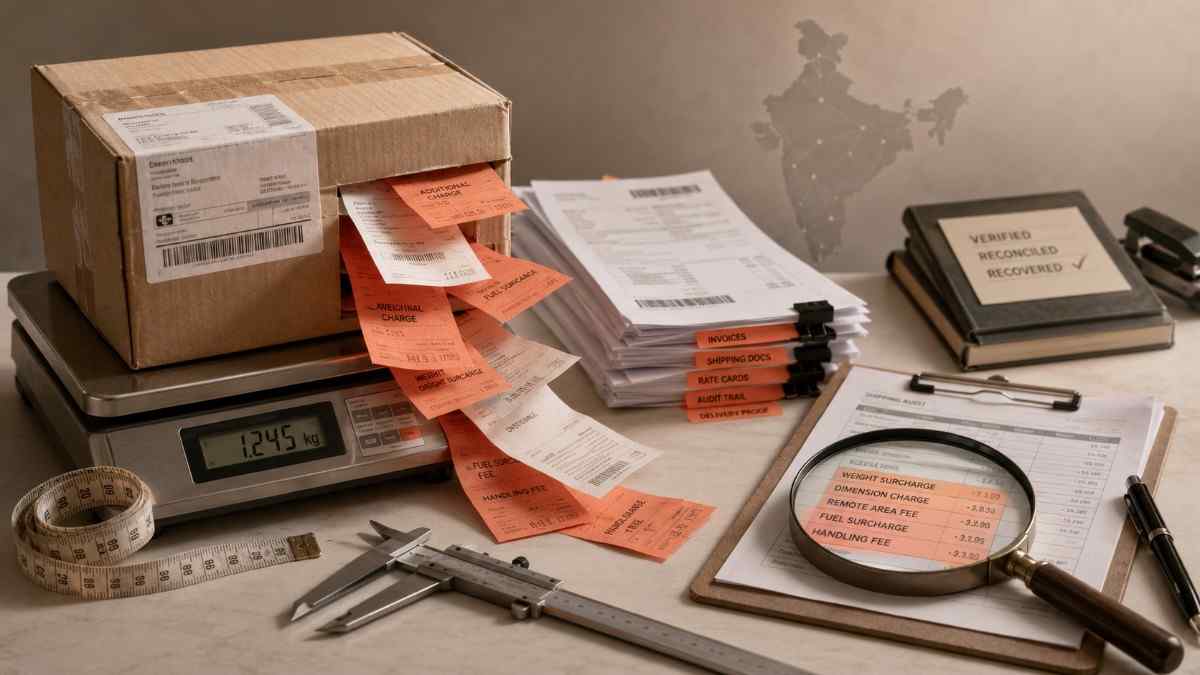
Shipping leakage is not one big charge. It is five small ones, repeated across every shipment, each one a place a billing system can be wrong in the courier's favour.
- Weight discrepancies. The courier reweighs at the hub and bills heavier than you declared, usually from volumetric weight on bulky-light parcels or slab rounding. Often the single largest leak.
- Zone mismatches. A parcel delivered in a cheaper zone billed at a costlier one, because a pincode is mapped wrong. Silent and systematic: every order to that pincode carries the same error.
- Wrong COD and RTO fees. Cash-collection and return-freight charges billed at a rate above your contract.
- Surcharge errors. Fuel surcharges drifting above the contracted rate, or remote-area charges applied to serviceable metro pincodes. These touch every shipment, so they compound fast.
- Duplicate charges. The same AWB billed twice, or a forward plus RTO plus re-attempt that double-counts one movement.
The reason this stays invisible is structural. A courier invoice is a single total spread across thousands of AWBs. The errors are individually trivial and only become meaningful at the portfolio level, which is exactly the view you never see unless you reconcile line by line.
The takeaway: leakage is small-and-many, not big-and-obvious. That is why it survives. It is below the threshold where any single charge is worth disputing, and above zero across the whole month.
The Numbers: What Brands Are Really Losing
Start with the size of the pie. Logistics costs run roughly 8 to 15% of revenue for high-volume Indian D2C brands, per industry data, and at scale even shaving two points off that can mean crores in annual savings. Shipping is one of your three or four largest cost lines, which is why a small leak inside it is worth real money.
Now the leak itself. For a brand that has never reconciled, a conservative working estimate is that 2 to 4% of shipping spend is recoverable overcharge. Some logistics vendors cite higher, 3 to 8% once you audit properly, but treat those as claims under ideal conditions.
Put it in rupees. Here is what 2 to 4% leakage looks like at different shipping volumes.
| Monthly shipping spend | Leak at 2% | Leak at 4% | Annual leak (3%) |
|---|---|---|---|
| ₹2 lakh | ₹4,000 | ₹8,000 | ₹72,000 |
| ₹5 lakh | ₹10,000 | ₹20,000 | ₹1.8 lakh |
| ₹12 lakh | ₹24,000 | ₹48,000 | ₹4.32 lakh |
| ₹30 lakh | ₹60,000 | ₹1.2 lakh | ₹10.8 lakh |
A brand spending ₹12 lakh a month on shipping is leaking somewhere around ₹4 lakh a year, recoverable, on charges that were never correct. That is not a rounding error. It is a salary, or a quarter of a marketing campaign, walking out quietly.
Keep this separate from RTO, which is a much bigger and different drain: industry estimates put RTO at 4 to 8% of gross revenue for many high-volume brands. RTO is fixed through prepaid conversion and address verification. Billing leakage is fixed through reconciliation. Do not confuse the two, and do not let the bigger RTO number make you ignore the recoverable smaller one.
Estimate Your Own Leak
Industry averages are a starting point. Your number is what matters, and you can get it in ten minutes with your courier invoice and a calculator. Here is the model.
Step 1: Find your true monthly shipping spend
Not your rate-card estimate, the actual amount. Add up everything that left your wallet or hit your invoice last month across all couriers: forward freight, COD fees, RTO freight, fuel and remote-area surcharges, and weight-discrepancy adjustments.
Monthly shipping spend = total actually debited / invoiced
                         across all couriers, last month
Example: ₹12,00,000 across Delhivery, Shiprocket and Bluedart.
Step 2: Apply a leakage rate
If you have never reconciled, use 3% as a middle estimate, or 2% to be conservative and 4% if your catalogue is bulky-light (apparel, homeware, footwear) where weight discrepancies run higher.
Monthly leak = shipping spend × leakage rate

Example: ₹12,00,000 × 3% = ₹36,000 / month
Annualised: ₹36,000 × 12 = ₹4,32,000 / year
Step 3: Pressure-test with a real sample
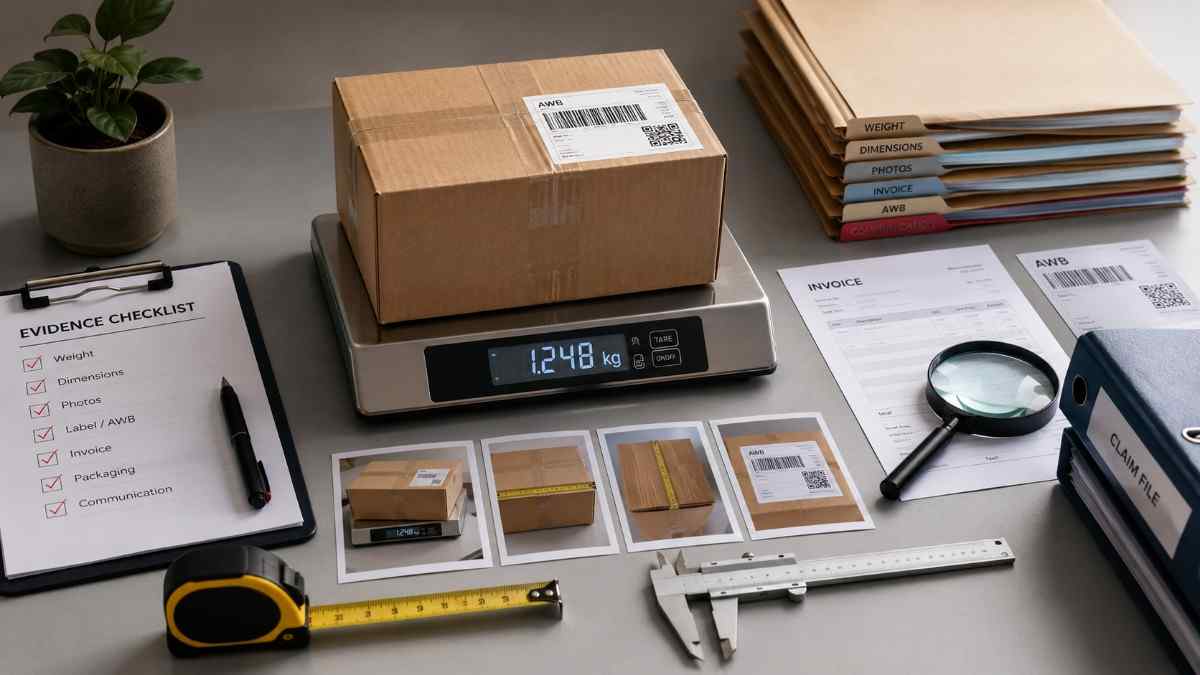
The estimate is a hypothesis. Confirm it. Pull one week of courier billing and match it against your orders, AWB by AWB. For each shipment, check the billed weight against what you declared, the billed zone against the destination pincode, and the surcharges against your rate card. Add up what was overcharged, divide by that week's shipping spend, and you have your real leakage rate.
Use that real rate in place of the estimate. If your sample shows 1.5%, your leak is smaller than average and you can relax. If it shows 5%, you have a bigger problem than the model assumed and a faster payback on fixing it. Either way you now know, instead of guessing. The full reconciliation method is covered separately.
What the number is good for
This figure is your business case. It tells you whether reconciliation is worth a weekly hour of someone's time (almost always yes above ₹3 lakh monthly shipping), whether it justifies software, and what to expect back. A founder who can say "we are leaking ₹4.3 lakh a year and here is the one-week sample that proves it" gets the fix prioritised. A vague "we might be overpaying" gets ignored.
Benchmarks: What Good Looks Like
There is no audited public benchmark for shipping leakage in Indian D2C, so treat these as operator targets.
| Signal | Leaking | Decent | Tight ops |
|---|---|---|---|
| Shipping spend reconciled | 0% (pay the lump sum) | Monthly / sampled | 100% weekly |
| Recoverable leak remaining | 2–4% unrecovered | 1–2% | Under 0.5% |
| Overcharges disputed in-window | Under 20% | 50–70% | 90%+ |
| Knows their own leakage rate | No | Estimated | Measured from samples |
The single thing that separates the first column from the last is not size or tooling. It is whether anyone is checking the invoice at all. Brands that reconcile weekly recover most of the leak. Brands that pay the lump sum recover none of it, regardless of how good their rate card is.
How to Stop the Leak
Three moves, in order.
1. Measure it once. Run the one-week sample above and get your real leakage rate. You cannot fix or prioritise what you have not sized.
2. Reconcile weekly. Match the courier invoice to your orders and rate card, flag the overcharges, and dispute them inside the window. Below a few hundred shipments a month a spreadsheet does it. Above 1,000, use reconciliation software or a managed service that keeps pace with the short dispute windows.
3. Fix the source. Recurring overcharges are process bugs: a wrong SKU weight, a stale pincode-to-zone map, a fuel surcharge not applied to contract. Fix the master data and the leak stops generating instead of needing recovery every week.
For brands where watching every dispute window across multiple couriers is more than the team can hold, this is the kind of audit-and-recover a service like OneflowAI runs end to end: it reconciles your courier billing and marketplace settlements, surfaces the recoverable number, and files the claims so the money comes back instead of quietly leaving.
But the first step costs nothing and needs no one's permission: open last month's invoice, run the model, and find out what your number actually is. Most founders are surprised, and the surprise is rarely in their favour.
Frequently Asked Questions
How much do Indian D2C brands lose to shipping overcharges?
As a working estimate, 2 to 4% of shipping spend for a brand that has never reconciled. On a ₹40 lakh annual shipping bill that is ₹80,000 to ₹1.6 lakh a year. Bulky-light catalogues sit higher. This is separate from RTO.
What is shipping cost leakage?
Money you pay couriers above what your contract allows, from billing errors: parcels billed heavier than they are, wrong zones, wrong surcharges, duplicates. Small per shipment, meaningful across thousands.
What percentage of shipping spend is recoverable?
A realistic 2 to 4% for a brand that never audits; some vendors cite 3 to 8% once you audit properly. Treat the higher figures as ideal-condition claims.
What causes shipping overcharges?
Weight discrepancies, zone mismatches, wrong COD or RTO fees, incorrect fuel or remote-area surcharges, and duplicate charges. Weight and zone are largest by value; surcharges are most systematic.
How do I estimate my brand's leakage?
Multiply true monthly shipping spend by 2 to 4%, then by 12 for the year. Pressure-test by matching one week of billing against your orders and rate card, and use the real rate you find.
Is RTO part of shipping leakage?
No, separate problem. RTO (4 to 8% of gross revenue for many brands) is the cost of returns, fixed through prepaid conversion. Leakage is overbilling on shipped orders, fixed through reconciliation.
How do I recover shipping overcharges?
Match the courier invoice to your orders and rate card, flag overcharges, and dispute in-window (often 7 working days). Spreadsheet under a few hundred shipments; software or a managed service above 1,000.
What logistics cost should a D2C brand target?
Roughly 8 to 15% of revenue for high-volume brands, varying by category and zone mix. The ignored lever is the recoverable leakage inside that number.
Is recovery only worth it at scale?
No. Small brands recover too; the economics scale with volume. At 300 to 500 shipments a weekly spreadsheet pays off; above 1,000 software or a service does. The threshold is whether anyone checks the invoice, not size.
How often should I reconcile?
Weekly. Dispute windows are short, so monthly or quarterly misses most of them. Cadence beats depth: a quick weekly audit recovers more than a thorough quarterly one.
The Short Version
Shipping leakage is the gap between what you pay couriers and what your contract allows. For a brand that never reconciles it runs about 2 to 4% of shipping spend, recoverable, hidden inside a lump-sum invoice nobody reads.
Size it in ten minutes: true monthly shipping spend, times 3%, times 12, then pressure-test against one real week of billing. If the number is meaningful, reconcile weekly and fix the source so it stops recurring.
The money is already yours. It is just sitting in a courier's wallet because no one asked for it back.
- Unicommerce, India D2C Report 2026
- RedSeer Strategy Consultants, D2C logistics commentary 2026

Omkar Kamble builds OneflowAI, which shows consumer brands what every order really earned after RTO, freight and COD. These guides come from real order and courier data, not theory. Figures we cannot independently verify are flagged.
Published 26 June 2026 Last reviewed 26 June 2026 11 min read