Open this article in your favourite assistant
Get an instant summary, or save it as a source your AI can cite later.
It is Tuesday morning and your ops person opens Shiprocket to find 63 shipments flagged as NDR overnight. Forty-one from Monday, twenty-two from the day before that someone missed in the weekend backlog. They start calling. By 11am they have reached maybe fifteen customers, left voicemails on eight, gotten two confirmed reattempts, and spent three hours that were supposed to go to other things.
The other 61 shipments are now 18 to 36 hours past the NDR event. Recovery probability on most of them has dropped below 15%. The courier will run its automatic reattempt today at roughly the same time as the original failed attempt, the same time when most of those customers were also unavailable yesterday.
This is not a failure of effort. Your ops person worked hard. It is a structural problem: manual NDR management is built around people reviewing dashboards, and dashboards get reviewed hours after the NDR event. The recovery window does not care about your ops schedule.
The case for automated NDR follow-up in Indian D2C is not primarily about reducing headcount. It is about responding inside the window where recovery is actually possible, and doing it at a cost that scales with your order volume instead of against it.
This post runs the direct comparison: time, cost per resolution, recovery rate, and what each approach looks like in practice. Numbers are drawn from industry data across Shiprocket, ClickPost, eShipz, and BeePragma operational benchmarks. Where data is estimated rather than published, it is marked.
The Real Ops Cost of Manual NDR Management
Most D2C founders think of manual NDR management as "free" because it is handled by existing ops staff. It is not free. It has a real cost that most brands never calculate.
Direct cost per manual NDR resolution
An ops person handling NDR calls in India earns roughly ₹18,000 to ₹28,000 per month. At 8 hours a day, that is ₹75 to ₹115 per hour. A manual NDR call, finding the contact, dialling, explaining the situation, collecting information, updating the dashboard, takes 5 to 10 minutes per attempt when it connects. When it does not connect (very common), you still spend 2 to 3 minutes per attempt before logging the result and moving on.
With a connection rate of roughly 40 to 50% on NDR calls, you make 2 to 2.5 attempts for every successful resolution. That is 15 to 20 minutes of ops time per resolved NDR. At ₹90/hour average, staff cost alone is ₹22 to ₹30 per resolution, before adding any supervisor cost, call charges, or the platform time spent logging results.
Dedicated call centre operations for NDR, which larger brands use, cost ₹150 to ₹200 per resolved NDR including agent cost, telephony, and management overhead.
The hidden cost: the recovery window
The number most brands miss is the revenue cost of late response. An NDR event that could have been resolved at 55% probability at 30 minutes has a 10 to 15% probability by the time your ops team touches it the next morning. Every unrecovered NDR that becomes an RTO costs ₹300 to ₹450 in combined forward shipping, reverse logistics, and handling.
For a brand doing 4,000 orders a month with 20% NDR rate: that is 800 NDRs per month. Manual recovery at 20% = 160 deliveries salvaged. Automated recovery at 45% = 360 deliveries salvaged. The 200-delivery gap at ₹700 average order value is ₹1.4 lakh per month in recovered revenue. That is before counting avoided reverse logistics cost.
The scalability ceiling
Manual NDR handling hits a hard ceiling around 500 NDR events per day. For most D2C brands, this ceiling arrives well before that in practice, because NDR handling is one of many things an ops person manages, not their full-time job. At 4,000 orders a month with 20% NDR rate, you are at 27 NDR events per day. That is manageable but already consuming meaningful ops bandwidth that grows linearly with order volume.
Automation does not hit this ceiling. The same setup that handles 27 NDRs a day handles 270 with no additional cost or headcount.
How Manual NDR Follow-up Works (and Where It Breaks)
The typical manual NDR flow at an Indian D2C brand doing 2,000 to 8,000 orders a month looks like this:
Step 1: Discovery (morning ops review). The ops team opens the Shiprocket, ClickPost, or courier dashboard each morning. They filter for NDR status and export a list. This happens between 9am and 11am for most brands.
Step 2: Prioritisation. Someone decides which NDRs to call first, usually by order value or by age. High-value COD orders tend to get priority. But with 30 to 60 NDRs to process in a day, the prioritisation itself takes time.
Step 3: Calling. The ops person or a dedicated caller dials the customer number. Connection rate varies by time of day and customer segment, urban customers during working hours are often unreachable. A successful call takes 3 to 5 minutes. An unsuccessful attempt takes 1 to 2 minutes before logging a "no answer" status.
Step 4: Updating the AWB. If the customer confirms a reattempt slot, someone needs to update the courier's AWB with the new instruction. This step often gets delayed or skipped, which means the courier runs its default automatic reattempt regardless of what was confirmed on the phone.
Step 5: Logging and follow-up. Results need to be logged somewhere, Shiprocket dashboard, a spreadsheet, or a CRM. For NDRs where the customer did not respond, someone needs to decide whether to try again or let it lapse.
Where it breaks: Step 1. By the time discovery happens, 8 to 18 hours have passed since the NDR event. The courier may have already scheduled its default automatic reattempt. The customer has no idea why their delivery failed. And the recovery window, where the probability of resolution is highest, has already passed for same-day NDRs.
The other break point is Step 4. Many brands do the calling but do not update the AWB with confirmed reattempt instructions. The courier runs its default anyway, often at the same time of day as the original failure. So the "confirmed" reattempt produces the same result.
The structural problem: Manual NDR is a batch process in a real-time problem. NDR events happen continuously; recovery probability decays continuously. Batching the response to morning review destroys most of the recoverable value.
How Automated NDR Follow-up Works
Automated NDR follow-up replaces the morning ops review with a real-time webhook-triggered flow. Here is what the same scenario looks like with automation in place.
Trigger (0 minutes): The courier scans the shipment as "delivery attempted, failed" and pushes a webhook event to your logistics platform (Shiprocket, ClickPost, Shipway, or direct Delhivery webhook). This happens within 5 to 15 minutes of the courier raising the NDR.
Reason-code routing (1 to 5 minutes): Your automation reads the NDR reason code from the webhook payload and routes it to the appropriate message template. Customer not available goes to the reattempt confirmation template. Address not found goes to the address collection template. Phone unreachable goes to a WhatsApp message (WhatsApp works when calls do not).
WhatsApp sent (5 to 30 minutes after NDR): The customer receives a specific message on WhatsApp, with their order number, the address on the AWB, and the reason for non-delivery in plain language. The message includes quick-reply options: confirm evening delivery, request a different time, update address.
Response handling (customer-paced): When the customer replies, the automation parses the response and takes action: updates the AWB via the courier's NDR action API with the confirmed slot, sends a confirmation to the customer, and logs the outcome. No ops person needs to be involved for a straightforward confirmation.
No-response fallbacks (automated): If no WhatsApp response after 6 hours, an SMS fires. If no response after 12 hours, the system defaults to an evening reattempt window and releases the AWB hold. If still unresolved at 18 hours, it flags for ops team escalation with context already populated.
The ops team only touches NDRs in two cases: escalation-flagged items (high-value COD, repeat-NDR customer, address change to different pincode) and edge cases the automation could not categorise. Industry data suggests this is roughly 30 to 40% of NDR volume, which means the ops team spends their NDR time on the 30% of cases that actually need human judgment, not the 70% that can be resolved with a WhatsApp confirmation.
BeePragma published data suggesting their automation setup returns 48 to 57 hours per week of ops bandwidth back to D2C teams, time previously spent on manual NDR calls, dashboard reviews, and AWB update logging.
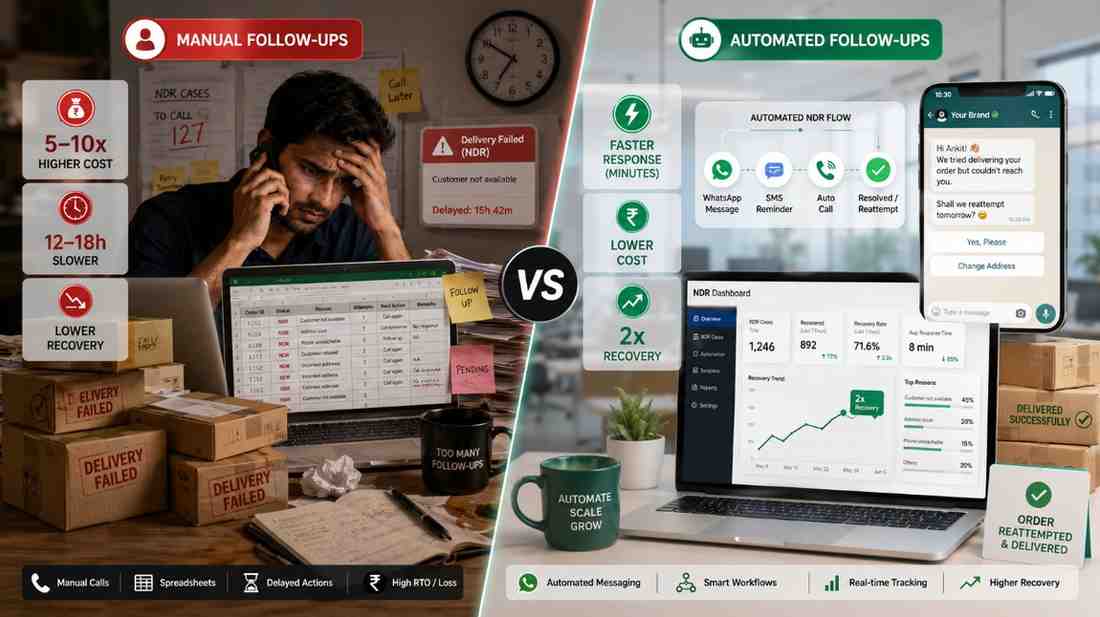
Side-by-Side Comparison
| Factor | Manual follow-up | Automated follow-up |
|---|---|---|
| Response time after NDR | 12 to 24 hours (next morning ops review) | 5 to 30 minutes (webhook-triggered) |
| Cost per resolved NDR | ₹150 to ₹200 (call centre) or ₹22 to ₹30 (in-house ops time) | ₹15 to ₹35 (BSP fees + platform cost) |
| Recovery rate | 15 to 25% | 40 to 55% with proper setup |
| Scalability | Linear with headcount; breaks under volume | Flat cost structure; scales with no additional staff |
| Reason-code handling | Same call script for most reason codes | Separate template per reason code; routed automatically |
| AWB update reliability | Manual step; often missed or delayed | API call from automation; happens in same transaction as customer confirmation |
| Language support | Depends on ops team language skills | English + Hinglish templates approved and sent automatically by pincode |
| Ops team involvement | Every NDR requires ops action | Only escalation-flagged cases (~30–40% of NDR volume) |
| Working hours constraint | Only during office hours; weekend backlogs common | Runs 24/7; weekends and after-hours NDRs handled automatically |
| No-response fallback | Usually none; shipment defaults to automatic courier reattempt | SMS at 6h, evening default at 12h, ops flag at 18h |
| Setup requirement | None (already running) | Webhook setup, BSP integration, template approval (3–5 days basic; 2–3 weeks full setup) |
| Viable order volume | Under 1,500 orders/month before it strains ops | Any volume |
The response time row is the most important. Every other advantage in the automated column exists because you are responding inside the recovery window, not after it has closed. A slower automated system that takes 3 hours to fire would capture most of these advantages because it would still be faster than a next-morning manual review.
The recovery rate gap in rupees
For a brand doing 4,000 orders a month with 20% NDR rate (800 NDR events/month):
| Manual (20% recovery) | Automated (45% recovery) | Difference | |
|---|---|---|---|
| NDRs resolved as delivery | 160/month | 360/month | +200 deliveries |
| Recovered revenue (₹700 AOV) | ₹1,12,000 | ₹2,52,000 | +₹1,40,000 |
| Avoided RTO cost (₹380/RTO) | ₹24,320 saved | ₹54,720 saved | +₹30,400 |
| Cost of follow-up (per NDR) | ₹30 × 800 = ₹24,000 | ₹25 × 800 = ₹20,000 | -₹4,000 |
| Net monthly advantage | ~₹1.66 lakh/month |
The setup cost for basic automation, BSP onboarding, webhook connection, template creation, is typically a one-time ₹15,000 to ₹30,000 in developer time plus ₹8,000 to ₹15,000/month in platform fees. Payback at the numbers above is measured in weeks, not months.
When Manual NDR Follow-up Still Makes Sense
Automation is not the right answer for every NDR type, and saying "automate everything" misses the cases where a human actually recovers more.
High-value COD above ₹2,000
For COD orders above ₹2,000 with no response after 6 to 8 hours of automated outreach, a real call from an ops person recovers more than another automated message. The customer who ordered a ₹3,500 skincare kit is more likely to re-confirm with a human on the line than with a third WhatsApp. The ROI of a 5-minute call on a ₹3,500 order is clear; the same call on a ₹399 product is not.
Address changes to a different pincode
When a customer replies with an address in a different pincode from the original AWB, the shipment may need to be recalled and re-dispatched rather than re-attempted. This is a courier ops decision that requires a human. Automation cannot make this call, it should detect the pincode mismatch and escalate to ops immediately.
Repeat-NDR customers
A customer who has NDR-ed on two or more previous orders is exhibiting a pattern, buyer's remorse, chronic unavailability, or address problems that keep recurring. Sending them the standard automated flow for a third time may not be the best use of a reattempt. An ops review of the customer's order history usually clarifies whether to attempt delivery, offer a cancellation with a retention credit, or flag for fraud review.
Brands under 1,000 orders a month
At under 1,000 orders a month with a 20% NDR rate, you are handling roughly 7 NDR events per day. A founder or ops generalist can handle this manually without it being a major time sink. The timing issue is real but the dollar impact is small enough that basic automation (Shiprocket's built-in NDR dashboard) plus a WhatsApp BSP is usually sufficient without custom webhook work.
Making the Switch: What You Actually Need
Switching from manual to automated NDR follow-up is not a big infrastructure project. Here is the practical sequence.
Step 1: Audit where your time and money is actually going
Before changing anything, run a 30-day NDR audit. Track: how many NDR events per day, how long your ops team spends on NDR calls per day, what your current NDR-to-delivery recovery rate is, and what your average time between NDR raised and first customer contact is. This gives you the before-state baseline. Without it, you cannot measure whether automation is working.
Step 2: Connect to a courier webhook
This is the single most important technical step. Everything else depends on getting real-time NDR events rather than polling a dashboard.
Shiprocket users: Go to Settings > Webhooks in your Shiprocket dashboard. Add an endpoint URL for NDR status events. This covers all couriers in the Shiprocket network, Delhivery, Bluedart, Ekart, XpressBees, through one endpoint.
ClickPost users: ClickPost's unified NDR webhook normalises reason codes across couriers and pushes to your endpoint. This is the cleanest option if you are running multiple couriers directly.
Delhivery direct: Contact your Delhivery tech account manager for NDR webhook registration. Typical latency from courier scan to webhook delivery is 5 to 15 minutes.
Shipway: Shipway's NDR dashboard exposes webhook events for all couriers it connects. Their setup documentation covers endpoint registration clearly.
Step 3: Choose a WhatsApp BSP and build your templates
The major options for Indian D2C brands: Interakt, WATI, AiSensy, and Gupshup. All four support WhatsApp Business API, template messaging, and webhook-triggered sends. Pricing varies but runs approximately ₹4,000 to ₹12,000 per month for most D2C scales.
Build templates for each reason code before you need them. Template approval takes 24 to 72 hours, do not start this process after you have already connected your webhook. Build at minimum: customer not available (English + Hinglish), address not found (English), phone unreachable (English + Hinglish), and a retention offer for refused deliveries.
WhatsApp Business API templates require pre-approved content. You cannot edit them on the fly. Get them right the first time: include the order number, the address from the AWB, the reason in plain language, and one specific action with a quick-reply button.
Step 4: Build reason-code routing
Your webhook payload includes an NDR reason code from the courier. Map each code to its template. The mapping varies by courier, Delhivery reason codes differ from Shiprocket's normalised codes, which differ from ClickPost's standardised taxonomy. If you are using an aggregator like ClickPost or Shipway, they normalise this for you, which is one of the main reasons to use an aggregator over direct courier integration.
The minimum viable mapping: customer not available → reattempt slot template. Address issue → address correction template. All other reasons → generic specific template (not fully generic, still include order number and reason). Refused → retention template, then cancellation if declined.
Step 5: Add AWB hold + confirmed slot logic
This step is what separates an NDR flow that works from one that just sends messages. When you ask the customer to confirm a reattempt time, you need to simultaneously hold the automatic courier reattempt, otherwise the courier runs its default timing before you get a response, and your WhatsApp message is asking the customer to confirm a slot that the courier has already used.
Delhivery NDR Package Action API, Shiprocket's NDR action endpoint, and ClickPost's reattempt instruction call all support AWB holds. When the customer confirms a slot, push the confirmed time to the AWB in the same step as sending the confirmation WhatsApp.
Step 6: Set escalation rules before go-live
Define which NDR events skip the automated flow entirely and go straight to ops, and which ones escalate after failing in the automated flow. At minimum:
- COD orders above ₹2,000 with no response after 6 hours → ops call queue
- Customer reply requests address change to different pincode → ops decision
- Customer has two or more previous NDRs in the last 90 days → ops review before reattempt
- No response after 18 hours from any channel → ops escalation with full NDR context populated
The escalation queue needs a clearly defined SLA. Two-hour response during business hours works for most cases. NDRs escalated after 6pm can roll to next morning without material impact because courier reattempts rarely run past 7pm.
Step 7: Measure before you optimise
Run for 30 days without changing anything. Track: trigger latency (time from NDR event to WhatsApp sent), WhatsApp response rate within 2 hours, recovery rate by reason code, and ops escalation volume. The first 30 days will tell you exactly where the flow is leaking, and it almost always leaks in one specific place rather than everywhere.
Common 30-day finding: Most brands discover their trigger latency is above 60 minutes due to webhook reliability issues or processing delays. Fix this first before optimising templates or fallback logic.
Where the Checkout Problem Connects
NDR automation reduces the cost of recovering failed deliveries. But a large share of NDRs, particularly refused deliveries, start as low-intent COD orders where the customer was never fully committed. The most efficient version of NDR management is not recovering those orders. It is not shipping them in the first place.
Platforms like OneflowAI work on this problem upstream: nudging high-risk COD buyers toward prepaid at checkout, validating addresses before dispatch, and reducing the pool of orders that enter the NDR funnel in the first place. Fewer NDRs mean better recovery rates even with the same automation setup, because you are concentrating recovery effort on genuinely recoverable orders rather than diluting it across impulse-purchase refusals.
FAQ: Manual vs Automated NDR Follow-up
What is the cost difference between manual and automated NDR follow-up in India?
Manual NDR resolution through an ops team costs roughly ₹22 to ₹30 per resolved NDR in staff time. A dedicated call centre operation costs ₹150 to ₹200 per resolution. Automated WhatsApp follow-up costs ₹15 to ₹35 per resolution in BSP fees and platform costs. The difference is 5 to 10x, and it widens further when you include the revenue impact of higher recovery rates with automation.
How much faster is automated NDR follow-up?
Automated: 5 to 30 minutes after the courier raises the NDR. Manual: 12 to 24 hours on average (next morning ops review). The timing gap is the primary reason for the recovery rate difference, not quality of follow-up or effort, just timing.
What recovery rate should I expect from automated NDR follow-up?
40 to 55% with a properly set up flow, webhook trigger, specific templates per reason code, AWB hold + confirmed slot logic, and no-response fallbacks. Manual ops follow-up typically produces 15 to 25%. The "customer not available" category, the largest recoverable bucket, goes from around 20% recovery with manual to 55 to 70% with automation.
Can I automate NDR follow-up without a developer?
For brands under 1,000 orders a month: yes. Shiprocket's built-in NDR management panel plus Interakt or WATI handles the basics without custom code. For brands above 2,000 orders a month, reason-code routing and AWB hold logic typically need 5 to 10 hours of one-time developer work. This is a low technical bar, the hardest part is WhatsApp template approval, not the engineering.
At what order volume should I switch from manual to automated NDR?
The economic case for automation is clear from around 1,500 orders a month. That generates roughly 300 NDR events per month at a 20% rate, or about 10 per day. At that volume, the timing advantage of automation (and the recovery rate gap it produces) is worth the setup cost many times over in the first month. Many founders make the switch too late, at 3,000 to 4,000 orders a month after manual processes have already become a visible bottleneck.
Does automated follow-up work for COD customers in Tier-2 cities?
Yes, with Hinglish templates. WhatsApp penetration in Tier-2 cities like Nashik, Kanpur, Rajkot, and Indore is high enough that the channel works. The response rate on Hinglish templates is meaningfully higher than English templates in these markets, build both and segment by pincode tier.
How long does it take to set up automated NDR follow-up?
Basic setup (Shiprocket + off-the-shelf BSP): 3 to 5 days including template approval. Full setup with reason-code routing, AWB hold, fallbacks, and escalation rules: 2 to 3 weeks including testing. Template approval through the WhatsApp BSP is usually the longest part. Build and submit templates in the first 24 hours of starting the project.
Is there a risk of annoying customers with too many WhatsApp messages?
Yes. The right cadence: one WhatsApp within 30 to 60 minutes of the NDR, one SMS fallback at 6 hours if no response, one final WhatsApp at 12 hours before defaulting to evening reattempt. That is a maximum of two WhatsApp messages and one SMS per NDR event. More than this risks getting your number blocked, which damages delivery for all future messages. Quality and specificity of each message matters more than volume.
What is the ROI calculation for switching to automated NDR?
At 4,000 orders/month, 20% NDR rate, ₹700 AOV: moving from 20% manual recovery to 45% automated recovery means 200 additional deliveries per month. That is ₹1.4 lakh in recovered revenue plus roughly ₹30,000 in avoided reverse logistics costs. Setup is a one-time ₹15,000 to ₹30,000 plus ₹8,000 to ₹15,000/month in BSP and platform fees. Payback in 2 to 4 weeks.
Should I fully replace manual NDR with automation?
No, replace the high-volume, repeatable cases (customer not available, address not found, unreachable) with automation. Keep manual review for high-value COD, repeat-NDR customers, address changes to different pincodes, and any response the system cannot parse. A well-designed system routes roughly 60 to 70% of NDR volume through automation and escalates the remaining 30 to 40% to ops with full context already populated. That is where ops time delivers the most value.
The gap between manual and automated NDR follow-up in Indian D2C is not subtle. It is 12 to 18 hours of response timing, a 5 to 10x cost difference per resolution, and a 20 to 30 percentage point gap in recovery rate. At 4,000 orders a month, that gap is worth ₹1.5 to ₹2 lakh per month in recovered revenue and avoided costs.
The setup is not expensive or technically complex. The harder part is usually deciding to prioritise it, which most brands do after manual processes have already become a visible problem rather than before. Running the numbers above on your own order volume takes about 10 minutes and usually makes the decision obvious.
- BeePragma D2C playbook
- Delhivery developer documentation
- WhatsApp BSP comparison India

Omkar Kamble builds OneflowAI, which shows consumer brands what every order really earned after RTO, freight and COD. These guides come from real order and courier data, not theory. Figures we cannot independently verify are flagged.
Published 2 June 2026 Last reviewed 2 June 2026 12 min read