Open this article in your favourite assistant
Get an instant summary, or save it as a source your AI can cite later.
Every ops head running COD in India knows the Monday feeling. You open the courier remittance, start matching it against last week's dispatches, and the RTO column keeps growing. Three in ten COD parcels are coming back. Not because the product was wrong, but because the buyer never picked up, the address was half-written, or the pincode was one you already knew was trouble.
At 4,000 orders a month with roughly half on COD, that is 2,000 COD shipments. A 30% RTO rate means 600 parcels making a round trip they should never have made. You paid the forward leg, you are paying the return leg, your warehouse has to receive and re-shelve each one, and the SKU sat blocked in transit for eight days instead of selling. You also never collected a rupee of revenue on any of them.
Put a number on it and the mood changes. RedSeer pegs the annual loss to Indian ecommerce from RTO and failed deliveries at over ₹20,000 crore. For a single brand, a rough ₹350 all-in cost per RTO on 600 parcels is more than ₹2 lakh gone in a month, before you count the working capital stuck in returns.
RTO is not a courier problem you have to accept. Most of it is decided before the parcel leaves your warehouse, which means most of it is yours to fix. This is a working playbook for cutting COD RTO without killing the COD conversion that still drives a big share of Indian D2C revenue.
- COD orders return at 20–40% in India versus under 2% for prepaid. The payment method alone moves the return rate by an order of magnitude.
- One RTO on a ₹1,200 order costs ₹350–₹700 once you count both freight legs, handling, and blocked stock, and you never earned the revenue either.
- Three of the four reasons a COD parcel comes back, intent, address, and pincode, are visible at checkout before you spend a rupee on freight.
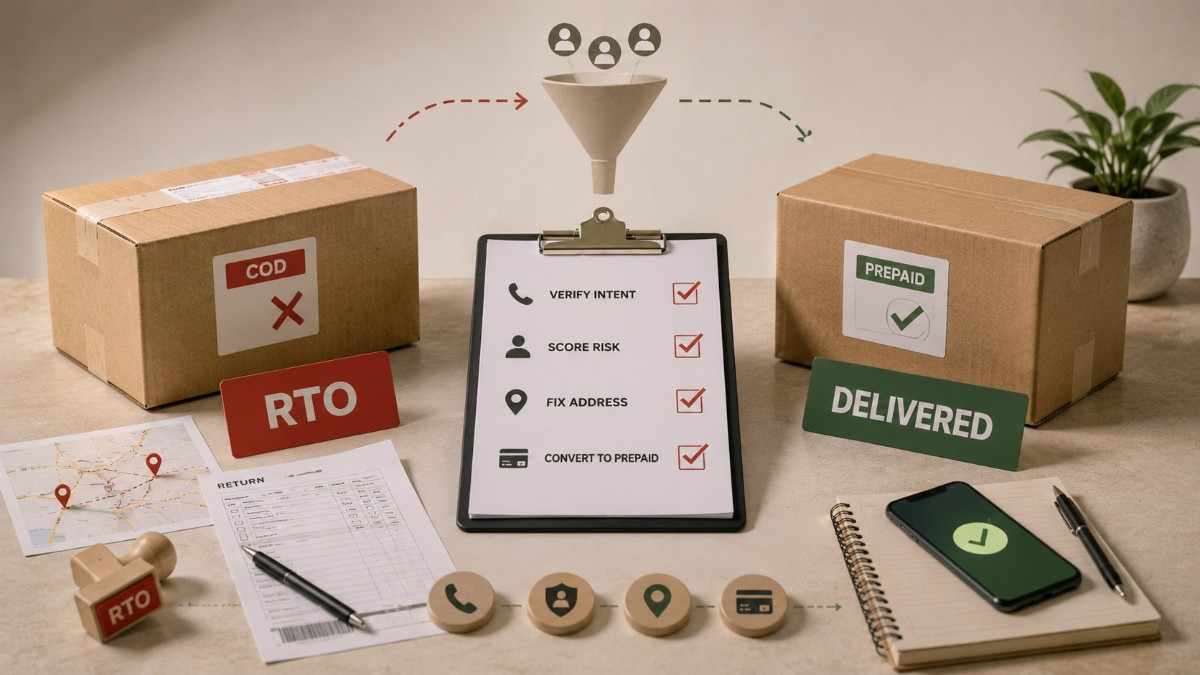
- The highest-return sequence is verify intent, score the order, fix the address, then nudge to prepaid, in that order.
- A brand at 30% COD RTO can realistically reach 12–15% within a quarter without hurting conversion.
What an RTO actually costs you
RTO stands for Return to Origin. It is what happens when a shipment cannot be delivered and comes back to you instead of reaching the customer. The buyer refused it, was unreachable, gave a wrong address, or simply did not pay the cash at the door.
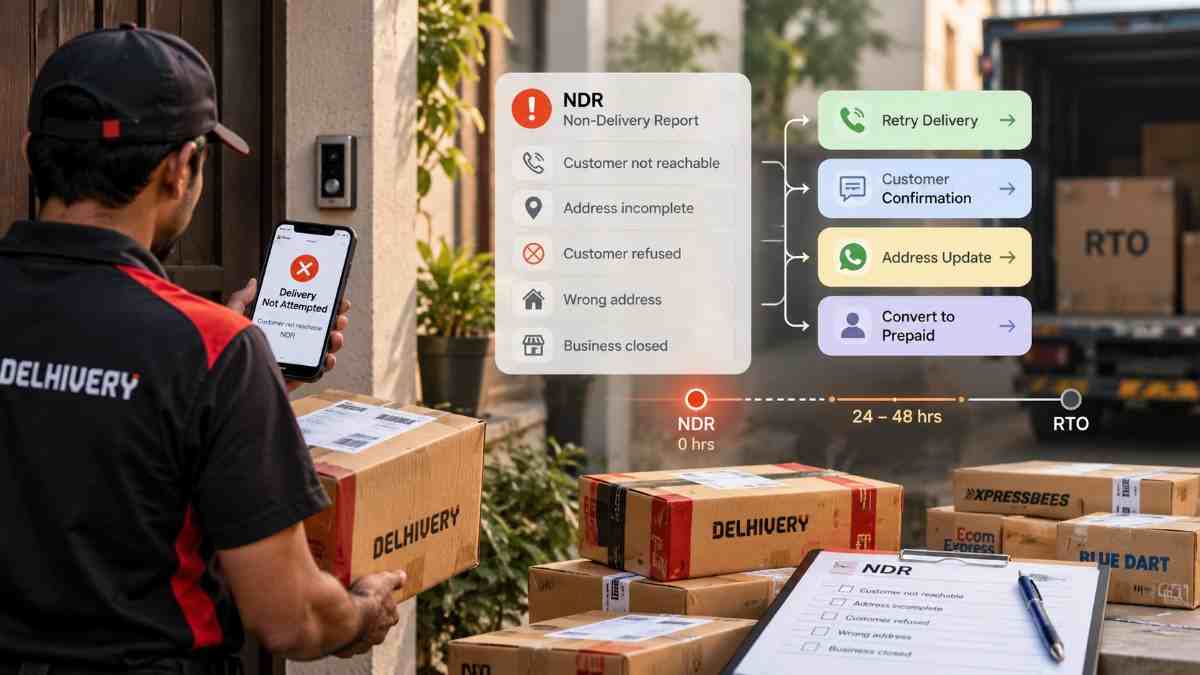
Two terms sit next to it. COD is cash on delivery, where the buyer pays at the doorstep instead of online. NDR is a non-delivery report, the status a courier raises after a failed delivery attempt. Every RTO starts as one or more NDRs. How you handle those NDRs in the 24 to 48 hours after they fire decides whether the parcel gets delivered on a reattempt or turns into an RTO.
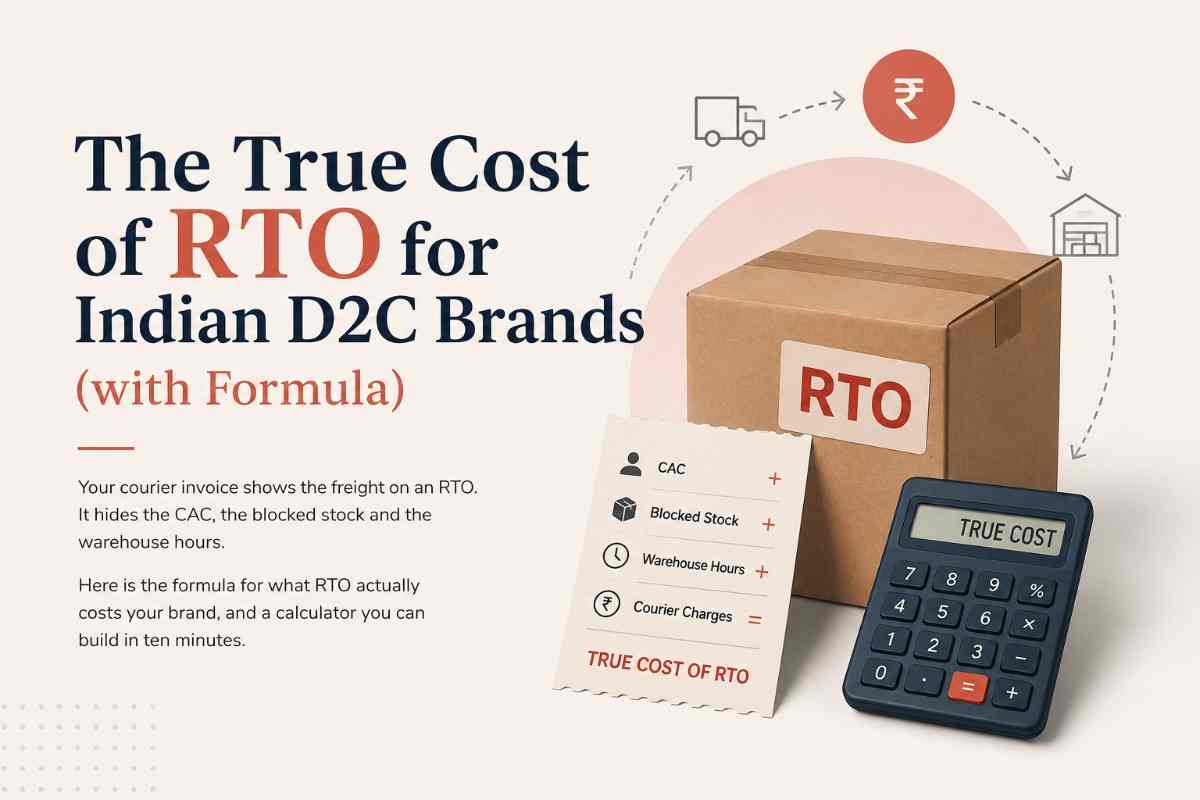
The cost is not one line item. It stacks. You pay forward freight when the parcel ships, typically ₹50 to ₹120 depending on weight, zone and courier. You pay the return leg when it comes back, usually 70 to 90% of the forward charge. There is a receiving and quality-check cost at the warehouse, because a returned parcel has to be opened, inspected and re-shelved before it can sell again. The unit is also out of stock for the full round trip, so any demand in those days is lost or backordered.
Add it up and a single RTO on a ₹1,200 order costs ₹350 to ₹700. On low-margin categories, two or three RTOs wipe out the contribution profit from a delivered order. RTO is a margin problem before it is a logistics one.
Why COD orders come back
If you want to reduce RTO for COD orders, you have to be honest about why they come back. In practice it is four things, and only one of them is really the courier's fault.
The first is intent. A share of COD orders are placed on impulse, in a hurry, or by someone comparison shopping who will buy from whoever ships fastest. By the time the parcel arrives three days later, the intent is gone. Cash on delivery makes walking away free, so they do. There is no card charge to dispute, no money already spent. This is the single largest driver, and it is why verifying intent before dispatch moves the needle more than anything else.
The second is address quality. Indian addresses are messy. Half a landmark, a missing floor, a wrong pincode, a phone number with a digit transposed. The delivery agent cannot find the house, cannot reach the buyer, and marks it undelivered. Bad address data at checkout becomes an NDR three days later, then an RTO the following week.
The third is geography. A small set of pincodes account for a disproportionate share of failed deliveries and refusals. Some are genuinely hard to service. Some have a local pattern of COD refusal. Either way, if you already know a pincode returns 45% of its COD orders and keep shipping COD there unchecked, that is a decision you are making.
The fourth is the delivery experience. A courier that attempts once at 2pm on a weekday when the buyer is at work and does not try again will manufacture RTOs that a courier attempting twice at sensible hours would have delivered. First-attempt timing and reattempt discipline vary a lot across Delhivery, Bluedart, Shiprocket-brokered partners and Ekart. Our NDR recovery playbook covers how to stop weak reattempts turning into RTOs.
Three of those four are decided at or before checkout. Intent, address and pincode are all knowable the moment the order is placed. That is the whole opportunity.
Find your real RTO rate
You cannot manage what you have not measured properly, and most brands measure RTO too coarsely. A single blended number hides where the problem actually lives.
Start with the honest overall figure. Take a full month of dispatched orders, count how many returned as RTO, and divide. Do it separately for COD and prepaid. If your blended RTO is 18% but COD RTO is 33% and prepaid is 1.5%, the blended number was telling you nothing useful.
Then cut the COD RTO rate three ways. By pincode: rank your top 100 pincodes by volume and look at RTO rate for each. You will find a cluster, often 10 to 20 pincodes, with RTO rates two to three times your average. By category and cart value: fashion and footwear return harder than consumables, very low cart values return harder because the buyer has little at stake, and first-time buyers return harder than repeat customers who have paid you before. By courier: compare RTO rate for the same pincode band across couriers. If Delhivery delivers a 400xxx Mumbai cluster at 88% and a Shiprocket-brokered partner delivers the same cluster at 71%, that gap is a routing decision you can change.
Do this once and you will usually find that a small slice of your COD orders, high-risk pincode plus low cart value plus first-time buyer, is producing a large slice of your RTOs. That slice is where you concentrate the tactics below, instead of adding friction to every order and hurting conversion across the board.
The RTO-reduction playbook
This is the part that moves the number. The sequence matters. Verify intent first, because it catches the largest driver. Then score, fix addresses, and convert to prepaid. Working in that order gets you most of the result with the least friction added.
1. Verify COD intent before you dispatch
The highest-return single tactic is confirming the buyer actually wants the order before you ship it. Send an automated WhatsApp, IVR, or OTP confirmation within minutes of the order, ask a plain yes-or-no, and only dispatch confirmed orders on your normal timeline. Orders that go unconfirmed after a couple of nudges get held, downgraded to prepaid-only, or cancelled.
Done well, verification takes 5 to 10 percentage points off the COD RTO rate. Do not do it on every order, or you will annoy good repeat buyers and slow dispatch. Apply it to the segment that needs it: first-time buyers, high cart values, and known high-RTO pincodes. WhatsApp confirmation converts far better than a phone call because people actually read it, and it gives you a written record of intent.
The trap here is treating no-response as no-intent. Plenty of genuine buyers ignore the message. Hold for 12 to 18 hours, send one reminder, and only then act. Auto-cancelling on first silence will cost you real orders.
2. Score every COD order for RTO risk at checkout
Move the decision to the moment of order, before a single rupee is spent on freight. An RTO risk score reads the signals that predict a return: the pincode's historical RTO rate, whether the buyer has paid you before, address completeness, cart value, and order velocity from that number or device.
Brands running this well see COD RTO in the 8 to 14% band, while brands with no verification layer sit at 28 to 40%. The score does not have to block anything on its own. It routes. Low-risk orders flow straight through on COD. Medium-risk orders get intent verification. High-risk orders get COD disabled and shown prepaid only, or held for manual review if they are high value.
You can build a crude version yourself in a spreadsheet from your own historical data, scoring on pincode and buyer history alone, and still get real value. A dedicated tool adds device and velocity signals and scores in real time at checkout, which a spreadsheet cannot.
3. Fix address quality at the point of entry
Every RTO caused by a bad address was preventable at checkout. Validate the pincode against the city and state as the buyer types, so a 560001 that claims to be in Chennai gets caught. Flag addresses that are suspiciously short or missing a house or floor number, and prompt for a landmark. Verify the phone number format, because a 9-digit or clearly fake number is a near-guaranteed NDR.
For your high-risk segment, add a second touch. A WhatsApp message that shows the address back to the buyer and asks them to confirm or correct it catches the transposed digit and the missing floor before the parcel ships, not after it fails. Address correction after an NDR is possible with most couriers but slow and unreliable, so fixing it at checkout is worth far more. See address validation for D2C for the pincode and address checks that catch this.
4. Convert the right COD orders to prepaid
Prepaid returns at under 2%, so every COD order you move to prepaid is an RTO you will almost certainly never see. The goal is not to force prepaid on everyone, which tanks conversion in a market where COD still carries close to half of D2C orders. The goal is to make prepaid the easier, slightly better-rewarded choice for the buyers most likely to flake.
A small prepaid incentive works: ₹50 off, free shipping, or an extra day of delivery speed for paying online. Show it prominently at checkout, especially to your high-risk segment. Partial COD is the other lever. Ask for a small advance, say ₹100 to ₹200, collected online, with the balance in cash at the door. A buyer who has put even ₹100 down is far less likely to refuse the parcel, and the advance itself covers a chunk of your RTO cost if they still do. Our guide to COD to prepaid conversion breaks down the nudges that actually move buyers.
Sequence the offer. Show the prepaid nudge first. If the buyer still selects COD and they are high-risk, then offer partial COD. Save the full COD block for only the worst pincodes.
5. Set pincode-level rules from your own data
Once you know which pincodes return worst, apply rules instead of hoping. For the top tier of high-RTO pincodes, disable full COD and offer prepaid or partial COD only. For the next tier, keep COD but force intent verification. Leave the rest alone.
Brands that apply pincode risk rules and verification typically see refusal-driven and fraud-driven RTO drop 35 to 40% within about 60 days. Review the rules monthly, because pincode behaviour drifts and a blanket permanent block will quietly cost you good orders in an area that has improved. Use RTO analytics by pincode to keep the list current.
6. Tighten NDR handling and courier routing
Not every RTO is set at checkout. Some are manufactured after dispatch by weak delivery attempts. When an NDR fires, reach the buyer fast, on WhatsApp, with the tracking link and a one-tap way to confirm the address or reschedule. Hold the reattempt until they respond or a set window passes, rather than letting the courier auto-attempt at the same bad time and fail again.
Route by performance, not habit. If your data shows one courier delivering a pincode band materially better than another, send that band to the better performer. Keep the comparison live, because courier performance on a given lane shifts over quarters.
What good looks like: benchmarks
Targets keep the work honest. These are realistic bands for Indian D2C, not aspirational marketing figures.
| Metric | Struggling | Average | Good | Best-in-class |
|---|---|---|---|---|
| Blended RTO rate | 25%+ | 15–20% | 10–14% | Under 10% |
| COD RTO rate | 35%+ | 25–33% | 12–18% | Under 12% |
| Prepaid RTO rate | 4%+ | 2–3% | 1–2% | Under 1.5% |
| COD share of orders | 60%+ | 45–55% | 35–45% | Under 35% |
| COD intent confirmed pre-dispatch | None | Ad hoc | High-risk segment | All COD, data-driven |
The bands draw on Unicommerce's 2026 report across 410M+ shipments and 6,000+ brands, and GoKwik's merchant data. Unicommerce reports brands cutting RTO from roughly 39% to 21% after tightening verification and pincode rules.
The pattern is consistent: brands with a real pre-dispatch verification layer sit in the 8 to 14% COD RTO band, and brands running COD raw sit at 28 to 40%. The gap is not the courier. It is whether you act on what you already know at checkout.
Where this gets easier
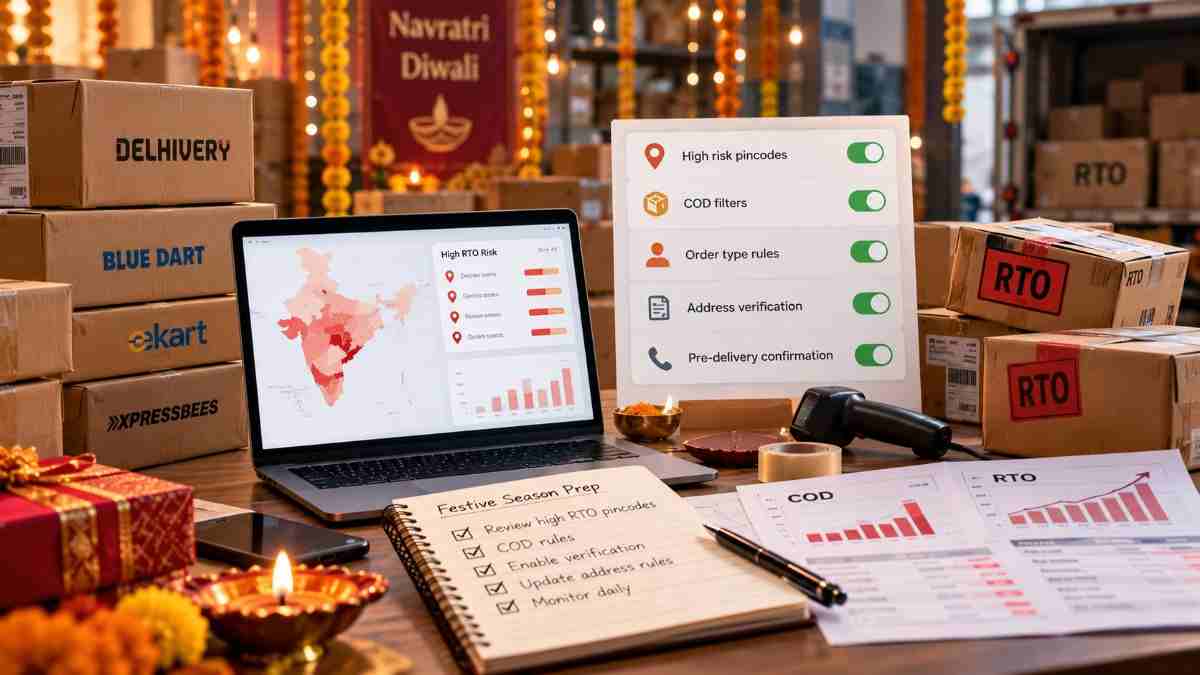
Most of this playbook can be started manually. You can rank your pincodes in a spreadsheet, wire up a WhatsApp confirmation, and add a prepaid nudge at checkout this quarter without buying anything.
The ceiling on the manual version is real-time scoring. A spreadsheet cannot read device and velocity signals or score an order in the second it is placed, and it cannot route thousands of orders a day through different rules without someone babysitting it.
That is the layer Oneflow handles. Oneflow is checkout infrastructure for Shopify D2C brands that scores every COD order for RTO risk as it is placed, verifies intent before dispatch, and nudges the right buyers to prepaid without adding friction for everyone else. The point is not to block COD. It is to stop shipping the parcels that were never going to be paid for, while leaving your good COD conversion untouched. See how COD verification on Shopify works in practice.
FAQ
What is a good RTO rate for COD orders in India?
A good COD RTO rate is 12 to 18%, and best-in-class brands hold it under 12%. The Indian average sits around 25 to 33% for COD because prepaid pulls the blended number down while COD carries most of the returns. If your COD RTO is above 30%, you have clear room to act on intent verification and pincode rules.
Why is COD RTO so much higher than prepaid RTO?
Prepaid buyers have already paid, so walking away means chasing a refund, which most do not bother with. COD buyers have spent nothing, so refusing costs them nothing. That single difference takes prepaid returns to under 2% while COD returns run 20 to 40%.
How much does one RTO actually cost?
Between ₹350 and ₹700 on a typical ₹1,200 order once you count forward freight, return freight, warehouse handling, and inventory blocked in transit. On low-margin categories that is often more than the profit on a delivered order, so even a few points of RTO reduction move your bottom line.
Will forcing prepaid reduce my RTO?
It reduces RTO but can also reduce orders, because COD still carries close to half of D2C demand in India. The better approach is selective: push prepaid to your high-risk segment through incentives and partial COD, and leave low-risk repeat buyers on the payment method they prefer.
Does OTP or WhatsApp confirmation really reduce RTO?
Yes, by roughly 5 to 10 percentage points on the COD RTO rate when applied to the right orders. WhatsApp works better than a phone call because people read it and you get a written confirmation. Apply it to first-time buyers, high cart values, and high-RTO pincodes rather than every order.
How do I find my high-RTO pincodes?
Take three to six months of COD orders, group by 6-digit pincode, and calculate the RTO rate for each pincode with meaningful volume. Rank them. You will usually find 10 to 20 pincodes returning at two to three times your average. Those get prepaid-only or verification rules first.
What is partial COD and does it help?
Partial COD collects a small advance online, often ₹100 to ₹200, with the balance paid in cash at delivery. A buyer who has put money down is far less likely to refuse, and if they do, the advance covers part of your RTO cost. It keeps conversion while cutting refusals.
Can my courier reduce RTO for me?
Only partly. Couriers control attempt timing and reattempt discipline, so routing high-risk lanes to better-performing partners helps. But intent, address quality and pincode risk are decided at your checkout, not theirs.
How quickly can I bring RTO down?
The pre-dispatch changes act fast. Intent verification and pincode rules typically show a 35 to 40% reduction in refusal-driven RTO within about 60 days. Address and prepaid changes compound over the next quarter. A brand starting at 30% COD RTO can realistically reach 12 to 15% within a quarter without hurting conversion.
RTO on COD orders feels like something that happens to you. It is not. Three of the four reasons a COD parcel comes back, intent, address, and pincode, are visible at checkout, before you have spent a rupee on freight. The brands holding COD RTO under 15% are not luckier with couriers. They act on what they already know at the moment the order is placed.
Start with the number. Pull your true COD RTO rate, cut it by pincode, and find the small slice of orders producing most of your returns. Then work the sequence: verify intent, score the order, fix the address, and move the right buyers to prepaid. You do not need all of it live in week one.
If you want a faster read on where your COD RTO is leaking and which pincodes are driving it, book a call and we will map it against your last 90 days of orders. No commitment.
- Unicommerce — India D2C Report 2026 (RTO, COD vs prepaid benchmarks)
- GoKwik — How to Reduce RTO in Ecommerce (COD verification, COD share)
- HillTeck — True Cost of RTO for Indian D2C Brands
- HillTeck — RTO Trends 2026 for Indian D2C
- BePragma — Pincode Clusters with High RTO Risk

Omkar Kamble builds OneflowAI, which shows consumer brands what every order really earned after RTO, freight and COD. These guides come from real order and courier data, not theory. Figures we cannot independently verify are flagged.
Published 25 July 2026 Last reviewed 25 July 2026 11 min read