Open this article in your favourite assistant
Get an instant summary, or save it as a source your AI can cite later.
A D2C athleisure brand in Bengaluru was running 4,200 orders a month. 68% were COD. Their COD RTO rate was sitting at 29%, which meant roughly 840 orders a month were coming back. The logistics cost alone, forward and reverse, was ₹1.8 to ₹2.2 lakh per month on returned orders.
They ran one change: added a ₹49 discount displayed at checkout for prepaid orders, and a WhatsApp message within 8 minutes of COD placement offering the same incentive with a payment link and a 2-hour window. In 45 days, their COD share dropped from 68% to 52%. Their RTO rate went from 29% to 21%. Monthly logistics savings: roughly ₹70,000.
The incentive cost: ₹49 per converted order, on roughly 340 converted orders per month. Total incentive spend: ₹16,660. Net saved after incentives: over ₹53,000 per month.
This is the COD-to-prepaid conversion opportunity for Indian D2C brands. Not a marginal improvement, a structural shift in your logistics economics from one pricing test and one WhatsApp message.
India's D2C market still runs 60 to 65% of orders on COD, even with UPI penetration above 350 million users. The gap between COD and prepaid RTO rates is enormous, 26% versus under 2%. And the tools to bridge that gap are straightforward once you understand the conversion mechanics.
This post covers the full playbook: why customers choose COD, which touchpoints move them, what incentives work for which categories, how GoKwik and BeePragma run these flows at scale, and what the numbers look like when it works.
The Math on COD vs Prepaid
Before the tactics, the numbers. Because the conversion investment decision depends on understanding what you are actually buying with each converted order.
| Metric | COD order | Prepaid order |
|---|---|---|
| Average RTO rate | 26% (Shipway ShipNotes) | Under 2% |
| Expected RTO cost per order (₹380/RTO) | ₹99 | ₹7.60 |
| Payment settlement timing | 7–14 days after delivery | T+2 days |
| Fraud / non-payment risk | Present (customer can refuse) | None after payment confirmation |
| Inventory blocked in transit risk | High (RTO takes 7–14 days to return) | Minimal |
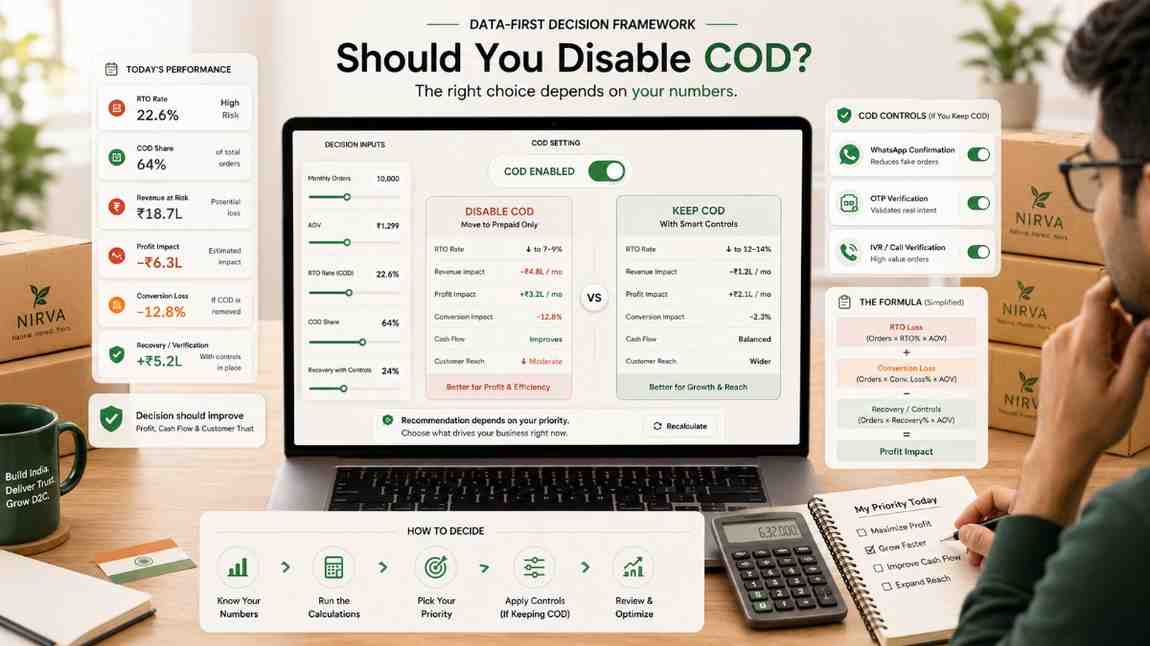
The expected RTO cost difference per order, ₹99 for COD versus ₹7.60 for prepaid, is your conversion budget per order. Any incentive below ₹99 that successfully converts a COD order to prepaid has positive expected value.
At scale: a brand doing 3,000 COD orders a month at ₹700 AOV, converting 15% to prepaid, moves 450 orders from 26% RTO risk to under 2% RTO risk. That is 108 fewer expected RTOs per month. At ₹380 per RTO avoided, that is ₹41,040 in monthly savings. Incentive cost at ₹50 per converted order: ₹22,500. Net monthly gain: roughly ₹18,500, before counting improved cash flow from faster payment settlement.
The settlement timing piece is underappreciated. COD remittance from most courier aggregators, Shiprocket, Delhivery, Ekart, takes 7 to 14 days. Prepaid settles in 2 days. For a brand doing ₹30 lakh a month in COD GMV, the working capital impact of that 10 to 12 day difference is material. Converting COD to prepaid improves your cash cycle, not just your RTO rate.
Why Customers Choose COD (and What Actually Moves Them)
Blanket nudges fail because they treat all COD customers the same. A customer in Kochi choosing COD out of habit has a different conversion barrier than a first-time buyer in Meerut choosing COD because they do not trust the brand will deliver.
Understanding the reason matters because different reasons need different responses.
Habit
A significant share of COD orders, especially in Tier-2 and Tier-3 cities, come from customers who always pay COD regardless of the brand or product. UPI is on their phone but COD is the mental default. These customers are the most convertible with a simple price incentive. They have no trust issue. They just need a reason to change the habit.
For habit-driven COD customers, ₹30 to ₹50 off is often enough. The friction is low; the incentive clears it.
Trust deficit
First-time buyers from social media ads often choose COD because they have never ordered from your brand and do not know whether the product will arrive, match the description, or be easy to return. They are not price-sensitive, they are risk-averse. Offering ₹40 off for prepaid does not fix a trust problem.
For trust-driven COD customers, the right intervention is reassurance: "Easy 7-day returns on prepaid orders," "Instant refund to your UPI if you change your mind," or "Delivered by Bluedart within 3 days, tracked." Pair this with a small incentive and conversion improves significantly.
Payment friction
Some customers select COD because the prepaid payment flow is slow, complex, or failed on a previous attempt. Mobile checkout with multiple OTP steps, payment pages that do not render correctly on older Android phones, or UPI apps that time out, all of these push customers to COD by default.
For friction-driven COD customers, the fix is not incentive, it is checkout speed. A one-click prepaid option that pre-fills their phone number, remembers their UPI ID, and completes in 2 taps converts better than any discount. This is where checkout infrastructure matters as much as the incentive.
Genuine preference
A small percentage of customers genuinely prefer to pay cash. Elderly customers, customers without digital payment access, or customers in areas where UPI connectivity is unreliable. These customers are the hardest to convert and the ones where forced prepaid-only checkout leads to cart abandonment. Do not spend conversion effort on this segment, accept COD and manage the RTO risk with verification.
Segment before you nudge. A price incentive for a trust-deficit customer will not work. A trust signal for a habit customer is unnecessary. Identify the dominant reason your COD customers choose COD, your brand, category, and traffic source tell you most of what you need to know.
The Three Conversion Touchpoints
COD-to-prepaid conversion can happen at three points in the customer journey. Each has different characteristics and conversion rates.
Touchpoint 1: At checkout, before COD is selected
The highest-leverage point. The customer is on the payment selection page and has not committed to COD yet. Display the prepaid incentive prominently, next to the prepaid option, not buried in fine print. The message format that works: "[UPI / Card], Save ₹40 instantly" shown as a highlight or badge on the prepaid payment option, with the COD option shown without the badge.
This does not require any follow-up infrastructure. It is a static checkout change. And because you are catching the customer before they commit to COD, there is no "switching cost", they just select a different option on the same screen.
Conversion rates at this touchpoint: 8 to 15% of COD-intending customers switch to prepaid when shown a relevant incentive. Category matters significantly, fashion and personal care convert higher here than electronics, where customers may be more deliberate about payment choice.
Touchpoint 2: WhatsApp post-order, within 10 minutes
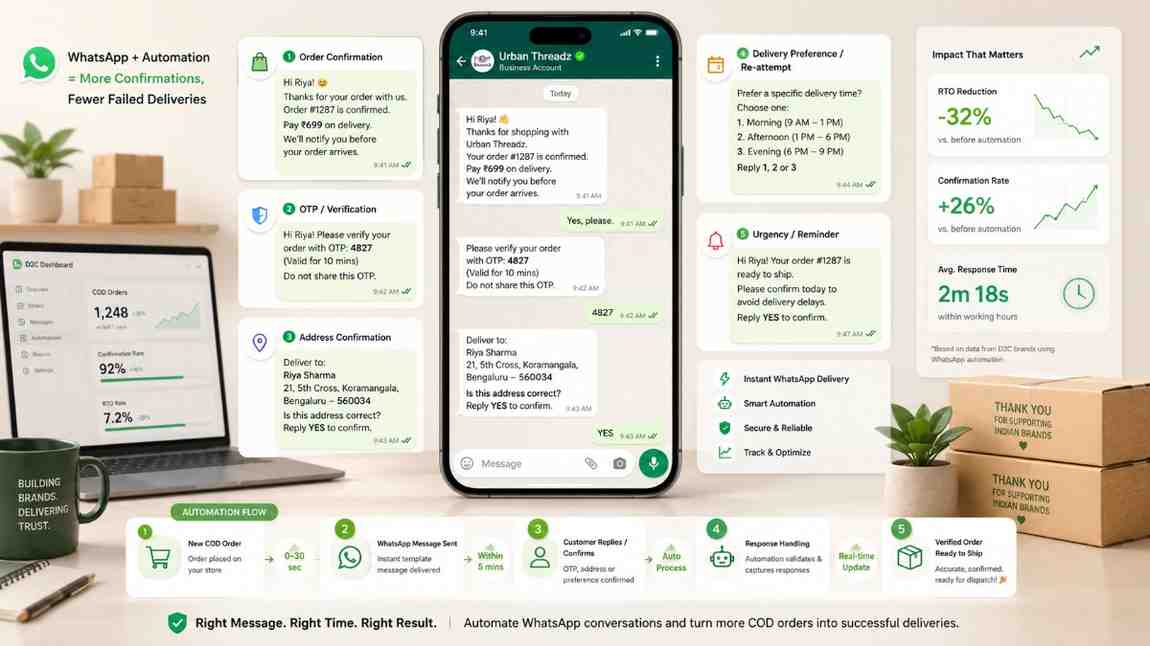
For customers who placed a COD order, a WhatsApp message within 5 to 10 minutes offering a prepaid conversion link. The message must be short, specific, and include a payment link and deadline:
"Hi Priya! Your order #12847 is confirmed (₹699 COD). Want to switch to prepaid and save ₹35? Pay here: [link]. Offer valid for 2 hours."
This touchpoint catches customers who saw the checkout incentive but did not act on it, or who came through a checkout flow where the incentive was not displayed. The customer is still fresh from the order, the intent is at its peak.
Conversion rates here: BeePragma reports 12 to 15% of COD orders convert via this type of flow. Timing is the biggest variable, messages sent after 30 minutes convert at roughly half the rate of messages sent within 10 minutes.
Touchpoint 3: Pre-dispatch nudge, 12 to 24 hours after order
A second attempt at conversion before the order is dispatched. The message shifts from incentive-led to urgency-led: "Your order ships tomorrow. Switch to prepaid now and get priority dispatch today instead." Or a slightly different framing: "We noticed you chose COD. Prepaid orders in your area have a 98% delivery rate vs 74% for COD, want to switch?"
Conversion at this touchpoint is lower (3 to 6% of remaining COD orders) because the customer has already confirmed their payment preference twice. But for orders in high-RTO pincodes where the urgency framing applies, it is worth the message. Do not send a third prepaid nudge, two is the limit before it becomes annoying.
Incentive Playbook: What Works for Which Category
Incentive size and type vary significantly by category, AOV, and customer profile. Here is what the data shows:
Discount incentives
The most direct and most commonly used approach. GoKwik recommends 5% off for prepaid as a starting point for most D2C categories. In absolute terms, this typically means:
| AOV range | Recommended discount | Expected conversion uplift |
|---|---|---|
| ₹300–₹600 (low-AOV fashion, accessories) | ₹20–₹30 | 8–12% of COD orders |
| ₹600–₹1,200 (mid-AOV fashion, personal care) | ₹40–₹60 | 10–15% of COD orders |
| ₹1,200–₹2,500 (higher-AOV wellness, electronics) | ₹80–₹120 or 5–8% | 12–18% of COD orders |
| Above ₹2,500 (premium, large electronics) | ₹150–₹200 or free shipping | 15–20% of COD orders |
The ceiling on discount incentives is the expected RTO cost you are avoiding. For a ₹700 COD order with 26% RTO probability and ₹380 per RTO cost, the expected RTO cost is ₹99. Any discount below ₹99 that converts the order to prepaid has positive expected value. Most brands find the effective conversion threshold is well below this ceiling.
Delivery speed incentive
"Prepaid ships today, COD ships in 24 to 48 hours." This only works if the delivery speed difference is real and consistently delivered. Fake urgency destroys trust faster than any incentive builds it. If your warehouse can genuinely prioritise prepaid dispatch, this is a powerful conversion lever, especially for categories where delivery timing matters (gifting, occasion purchases, restocking essentials).
Brands that run this effectively typically set a same-day dispatch cutoff for prepaid orders (e.g., orders before 2pm ship the same day) and clearly communicate it at checkout.
COD fee
Adding a ₹25 to ₹60 COD surcharge flips the incentive structure: instead of rewarding prepaid, you are penalising COD. This converts roughly the same number of customers but also increases cart abandonment from customers who neither want to pay the fee nor switch to prepaid.
The net effect varies by category. For categories with high repeat purchase rates (personal care, health supplements), COD fees cause less abandonment because the customer is already brand-loyal. For categories with high impulse-purchase share (fashion, accessories from social ads), COD fees can materially hurt order volume. Test on a pincode segment before applying broadly.
Trust signals instead of incentives
For trust-deficit first-time buyers, incentives alone convert poorly. The right approach combines a small incentive with explicit trust signals at the prepaid selection step:
- "Instant refund to your UPI if you are not satisfied", addresses the biggest fear (losing money)
- "3,47,000 orders delivered this year, 98% on time", social proof on delivery reliability
- "Easy 7-day returns, no questions asked", addresses the "what if it doesn't fit" concern
- Visible Razorpay or Cashfree payment security badge, addresses payment safety concern
BeePragma's analysis of COD vs prepaid conversions in Indian D2C stores shows that trust signals combined with a modest discount convert first-time buyers at roughly 1.5x the rate of discount alone.
Channel Setup: Checkout, WhatsApp, Post-Order
Practical setup for each touchpoint.
Checkout nudge setup (Shopify)
On standard Shopify: use a checkout extension or theme customisation to display the discount badge next to the prepaid payment option. The Shopify Payment customisation API (available in Shopify Plus) lets you reorder payment methods and add descriptive text, put your prepaid option first with the incentive label.
For non-Plus Shopify stores: apps like GoKwik, Cashfree CODFIRM, and COD King can inject prepaid incentive display at checkout without Plus. Each app handles this differently, verify exactly how the incentive is displayed before going live. An incentive that is only visible on desktop but not on mobile is worth nothing for most Indian D2C stores where 85%+ of traffic is mobile.
On GoKwik's checkout: their layer replaces or supplements the Shopify native checkout with a faster one-click experience that pre-fills user details from their shopper network of 200 million+ users. The prepaid incentive is embedded in this checkout flow. For brands that qualify for GoKwik, this is the most seamless implementation.
WhatsApp post-order flow setup
You need a WhatsApp BSP (Interakt, WATI, AiSensy, or Gupshup) and a payment link infrastructure (Razorpay Payment Links, Cashfree Payment Links, or PayU). The flow:
- COD order placed on Shopify → webhook triggers
- Your system generates a unique payment link for the order via your payment gateway
- WhatsApp BSP sends the conversion message with the link within 5 to 10 minutes
- Customer pays → payment gateway webhook fires → your system marks the order as prepaid, updates Shopify order tags, and cancels the original COD fulfillment instructions
- Customer receives a prepaid confirmation WhatsApp with the discount confirmed
The payment link generation and order update steps require developer work, roughly 8 to 15 hours for a clean implementation. HillTeck and DelightChat both offer this as an out-of-box feature for Shopify, removing the need for custom development.
WhatsApp template approval: build and submit the conversion message template before you start development. Approval takes 24 to 72 hours through the BSP. The template must include the order number, incentive amount, and payment link placeholder. Do not start the development timeline without the template already in approval.
COD suppression setup
For high-RTO pincodes where you want to remove COD entirely rather than nudge:
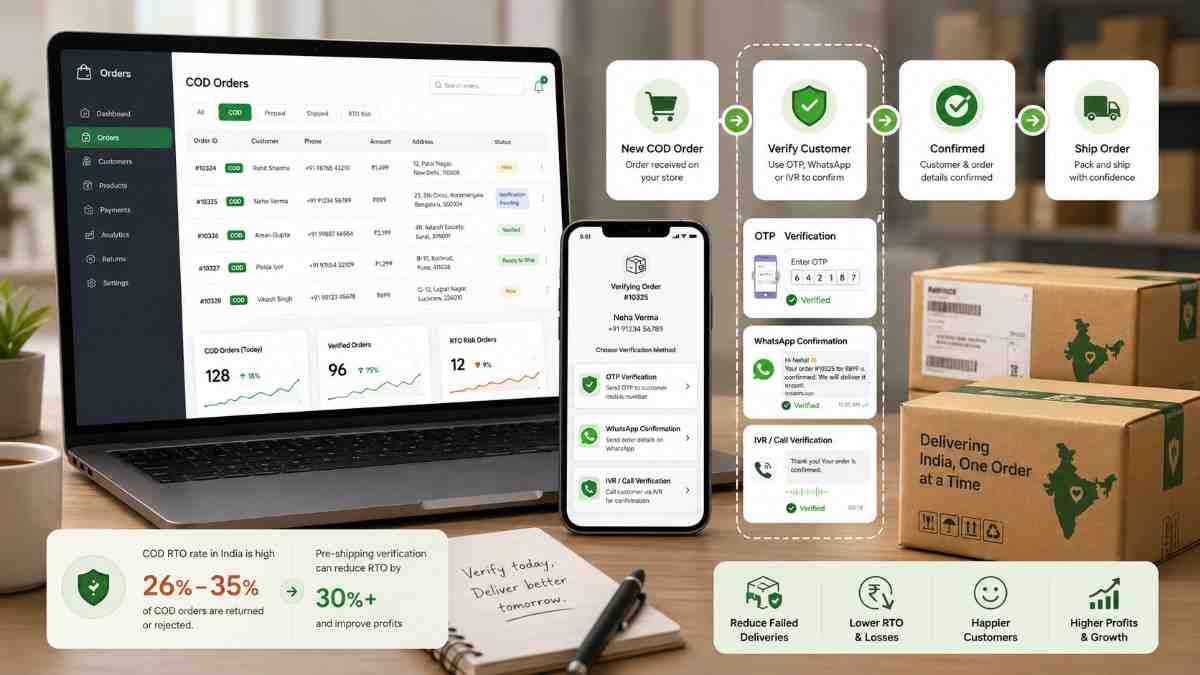
On Shiprocket: their COD availability check can be set by pincode. Orders to suppressed pincodes will not show COD at checkout if Shiprocket is handling the checkout-to-logistics connection. On GoKwik: pincode-level COD suppression is a built-in feature with a dashboard to manage the suppressed list. On Shopify standalone: a third-party app is required, RTO Shield, HillTeck, or COD King all support pincode-based suppression.
Update your suppression list monthly. High-RTO pincodes from Q1 may have improved by Q2 if courier coverage or last-mile performance changed. Keeping outdated pincodes suppressed unnecessarily blocks legitimate customers.
Benchmarks: What 25–35% Conversion Looks Like
The 25 to 35% figure referenced in this post's title is the uplift in overall prepaid share, not the per-order conversion rate at a single touchpoint. Here is how those numbers stack up across the funnel:
| Metric | Baseline | After 30 days | After 90 days | Source |
|---|---|---|---|---|
| Prepaid share of orders | 30–35% | 40–45% | 50–60% | GoKwik / BeePragma benchmarks |
| Checkout nudge conversion (COD → prepaid at checkout) | 0% | 8–12% | 10–15% | Industry estimate |
| WhatsApp post-order conversion rate | 0% | 8–12% | 12–15% | BeePragma |
| Overall COD RTO rate | 26–35% | 20–25% | 16–22% | Unicommerce platform data |
| Monthly RTO logistics cost | ₹X | ₹0.75X | ₹0.55X | Derived from RTO rate change |
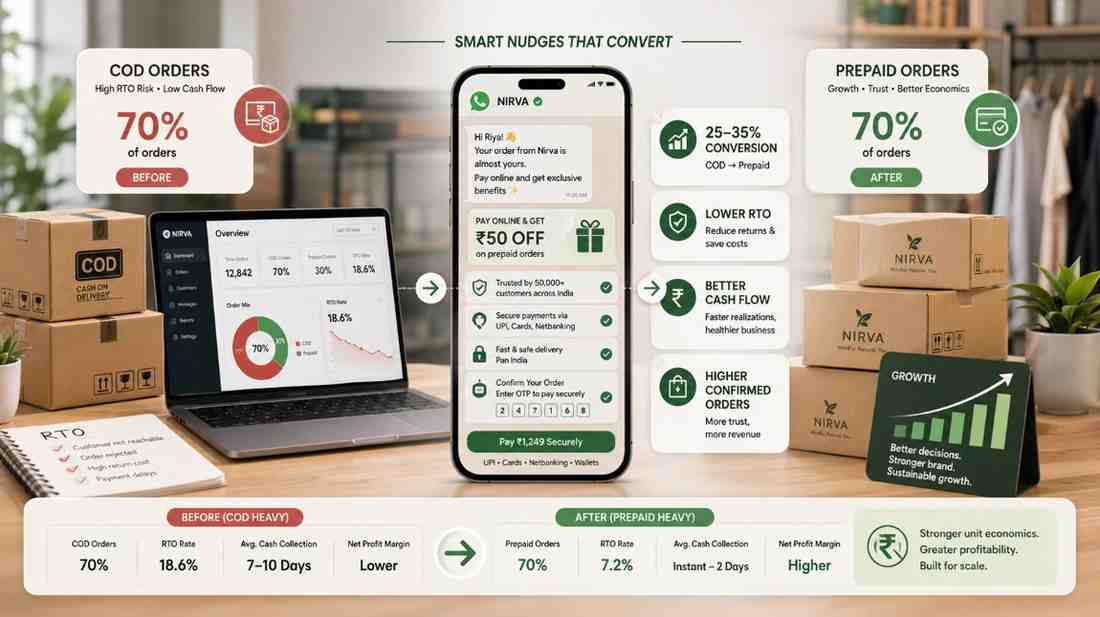
GoKwik's published data shows a specific brand shift from 70% COD / 30% prepaid to 35% COD / 65% prepaid, a 35 percentage point improvement in prepaid share. Pepe Jeans achieved 20% uplift in prepaid share of wallet; Newman's increased prepaid orders by 30%. These outcomes required GoKwik's full checkout layer, not just a WhatsApp nudge.
For brands starting with a lighter-touch setup (checkout badge + WhatsApp nudge without a full checkout replacement), realistic 90-day outcomes are 12 to 20 percentage point improvement in prepaid share. Getting from 35% prepaid to 50% prepaid is achievable in 3 months with consistent execution. Getting to 65% prepaid typically requires more complete checkout infrastructure changes.
What good looks like at different order volumes
| Monthly orders | COD volume (60%) | Converted to prepaid (13%) | RTOs avoided/month | Monthly logistics saving |
|---|---|---|---|---|
| 1,000 orders | 600 COD | 78 orders | ~19 RTOs | ~₹7,200 |
| 3,000 orders | 1,800 COD | 234 orders | ~57 RTOs | ~₹21,700 |
| 5,000 orders | 3,000 COD | 390 orders | ~95 RTOs | ~₹36,100 |
| 10,000 orders | 6,000 COD | 780 orders | ~191 RTOs | ~₹72,600 |
Assumptions: 60% COD share, 13% WhatsApp conversion rate, 24% RTO reduction per converted order (from 26% to 2%), ₹380 per RTO avoided. Incentive cost (₹50/converted order) not deducted, add that back to get net savings.
At 5,000 orders a month with the setup above, gross logistics savings from prepaid conversion are roughly ₹36,000 per month. Incentive cost: ₹19,500. Net: ₹16,500 per month. Plus improved cash flow from faster payment settlement on 390 additional prepaid orders per month.
Where Checkout Infrastructure Changes the Ceiling
A WhatsApp nudge and a checkout badge can get you to 12 to 15% conversion of COD orders to prepaid. Getting beyond that, to the 30 to 35% prepaid share improvement that GoKwik shows in their best-case data, requires changes at the checkout layer itself: faster payment completion, pre-filled user details, fewer payment steps, and smarter risk-based COD display logic.
Platforms like OneflowAI are built for exactly this: checkout infrastructure for Indian D2C Shopify brands that identifies high-risk COD buyers and presents the prepaid option with the right framing and incentive at the moment of maximum intent, before the order is placed, not after. Combined with post-order WhatsApp flows, this covers both the checkout conversion and the post-order recovery of COD orders that still get through.
FAQ: COD to Prepaid Conversion
What is COD to prepaid conversion for D2C brands?
Moving customers who placed or intended to place a COD order to paying online before shipment, via a checkout incentive or a WhatsApp post-order flow. The goal is reducing RTO risk: prepaid orders return under 2% vs 26% for COD.
What COD to prepaid conversion rate should I target?
8 to 15% of COD orders converting to prepaid via WhatsApp nudge in the first 90 days is realistic for most brands. The 25 to 35% figure refers to overall prepaid share uplift, e.g., going from 35% prepaid to 60 to 65% prepaid, which requires both checkout and post-order interventions working together over 3 to 6 months.
What incentives work best?
Discounts of ₹30 to ₹80 depending on AOV work for habit-driven COD customers. Free express shipping works for categories where delivery timing matters. Trust signals (instant refund, easy returns) work better than discounts for first-time buyers with a trust deficit. GoKwik recommends starting with 5% off for prepaid as a baseline test.
When should I send the WhatsApp conversion message?
Within 5 to 10 minutes of COD order placement. Response rates drop sharply after 30 minutes. Include a 2-hour deadline on the offer. After that window, move the order to standard COD verification flow.
How does GoKwik help with COD to prepaid conversion?
GoKwik's checkout layer shows prepaid incentives at payment selection and uses ML risk scoring (200+ signals, 200M+ shopper network) to selectively suppress or restrict COD for high-risk orders. Reported outcomes include Pepe Jeans 20% uplift in prepaid share and Newman's 30% increase in prepaid orders. Their guarantee model absorbs some RTO cost on approved COD orders.
Should I add a COD fee instead of a prepaid discount?
A COD fee converts similar numbers but increases cart abandonment, customers who will not pay the fee and will not switch to prepaid simply leave. Test COD fees on high-RTO pincode segments first. Fashion and impulse-purchase categories tend to see more abandonment than electronics or health categories when COD fees are added.
Can I suppress COD entirely for some customers?
Yes. For high-RTO pincodes, first-time buyers from paid social traffic, or orders in the highest-RTO value band, removing COD entirely and showing prepaid-only checkout produces 100% conversion for that segment at the cost of some cart abandonment. Monitor abandonment rate in suppressed segments closely in the first 30 days.
What is the RTO difference between COD and prepaid?
Prepaid orders return under 2% vs 26% for COD (Shipway ShipNotes). In high-risk categories like fashion and footwear, COD RTO can reach 35 to 40%. Converting 100 COD orders at ₹700 AOV to prepaid moves expected RTOs from 26 to 2, avoiding 24 returns at ₹380 each = ₹9,120 in logistics savings on those 100 orders.
Which tools help with COD to prepaid conversion on Shopify?
GoKwik Kwik COD (full checkout layer, risk scoring, prepaid nudge), HillTeck (WhatsApp post-order conversion + verification), Cashfree CODFIRM (WhatsApp with one-click prepaid switch), DelightChat (automated WhatsApp COD-to-prepaid flows), and TheBotMode. Each approaches it differently, GoKwik is checkout-layer, others are primarily post-order WhatsApp.
How much should I offer as a prepaid discount?
The economic upper bound is the expected RTO cost you avoid: ₹380 × 26% = ₹99 per order. In practice, most categories convert at ₹30 to ₹80, well below this ceiling. Start at ₹40 to ₹50, measure conversion rate for 2 to 3 weeks, then adjust up or down. Do not start at your maximum; you may not need it.
COD-to-prepaid conversion is not a single tactic, it is a funnel with three touchpoints, multiple incentive types, and different approaches for different customer segments. The brands getting 25 to 35% prepaid share improvement are not doing one thing well. They have a checkout incentive, a WhatsApp post-order flow, and suppression logic for their worst-performing pincodes all running simultaneously.
Start with one touchpoint: the checkout badge with a ₹40 to ₹50 incentive. Measure for 30 days. Then add the WhatsApp post-order flow. Measure for another 30 days. By month three, you will have real data on what is driving conversion in your specific category and customer base, and a much cleaner picture of where the remaining opportunity is.
- GoKwik Kwik Checkout documentation
- DelightChat COD to prepaid automation documentation
- GoKwik case studies

Omkar Kamble builds OneflowAI, which shows consumer brands what every order really earned after RTO, freight and COD. These guides come from real order and courier data, not theory. Figures we cannot independently verify are flagged.
Published 4 June 2026 Last reviewed 4 June 2026 13 min read