Open this article in your favourite assistant
Get an instant summary, or save it as a source your AI can cite later.
You have 4,200 orders this month. 2,700 are COD. RTO came in at 27%. That is 729 orders that shipped, failed delivery, and came back. At ₹210 per RTO in forward and reverse freight, you burned ₹1.53 lakh on orders that were never sold.
Someone on the team says: just turn off COD. Your finance head nods. Your growth head goes pale. They are both reacting to half the picture.
Disabling COD is not a logistics decision. It is a revenue call with logistics consequences, and it cuts both ways. Brands that get this wrong either bleed RTO losses for months while postponing the decision, or disable COD, watch GMV drop 18%, and turn it back on three weeks later.
This post runs the actual math. You need four numbers from your Shopify dashboard and courier report: monthly COD order count, your RTO rate on COD, your average order value, and your approximate contribution margin. We walk through three scenarios and give you a decision matrix at the end.
What we cover: the true cost of a COD order (not just the handling fee), the revenue you would lose by going prepaid-only, which three brand profiles should consider disabling COD, the controls that let you keep COD without the losses, and the benchmarks that tell you whether your COD operation is a manageable cost or a structural problem.
What a COD Order Actually Costs
Most brands calculate COD cost wrong. They look at the COD handling fee on the courier rate card, typically ₹35 to ₹65 extra per shipment on top of forward freight, and stop there. That is the fee for the payment collection service. It is not the cost of COD as a fulfillment model.
The actual cost has five components, and three of them are regularly missed.
| Cost component | Typical range | Usually missed? |
|---|---|---|
| Forward freight | ₹55–₹90 | No |
| COD handling fee | ₹35–₹65 | No |
| RTO probability cost (26% national avg × reverse freight) | ₹40–₹65 per COD order | Yes |
| Remittance lag (7–10 days working capital at 18% cost of capital) | ₹8–₹18 per order | Yes |
| Ops overhead (calls, repack, verification, team time) | ₹20–₹40 per order | Yes |
Add it up: a COD order costs ₹158 to ₹278 to fulfill versus ₹55 to ₹90 for prepaid. The gap is larger than most brands model in their unit economics.
The RTO probability cost deserves its own line. Nationally, COD orders return at 26% on average, per Shipway's ShipNotes logistics report covering 410 million-plus shipments. For fashion and footwear, that number sits at 35–45%. For electronics and health products, it runs lower at 12–18%. Prepaid orders across categories average 2–4% RTO. That differential is where the money is.
Quick sanity check on your own numbers: if your COD RTO rate is above 30%, the logistics cost per shipped COD order exceeds the contribution margin on most AOVs under ₹800. That is the threshold where the math starts breaking badly.
The Revenue Risk of Disabling COD
Here is what nobody mentions in the same breath as RTO horror stories: COD is why customers trust you enough to order in the first place.
Sixty to sixty-five percent of Indian D2C orders are COD as of early 2026. In Tier-2 and Tier-3 cities, that share runs 58–64%. These are customers who have been burned by non-delivery before, or who are ordering from a brand they have never touched. COD is a trust mechanism, not a payment preference.
Brands that have disabled COD without preparation report GMV drops of 15 to 30% within the first month. Most of that is not fraud risk walking away. It is genuine customers who preferred the assurance of paying on delivery and did not switch to prepaid when forced. They left without completing the purchase.
The categories most sensitive to COD removal:
- Fashion and ethnic wear: buyers want to see the product before paying. COD removal drops conversion by 20–25% in this category
- New brands under 2 years with few reviews: COD is the only trust signal on cold traffic. Removing it tanks conversion significantly
- Tier-3 pincodes: UPI and card penetration is lower in smaller towns. COD is genuinely the only practical option for a share of buyers there
- Gifting products: the recipient is not the buyer. The buyer wants confirmation of physical delivery before paying, especially for high-ticket gifts
Categories less sensitive to COD removal:
- High-ticket items (AOV ₹3,000+): customers have researched before buying. Prepaid conversion holds better because the consideration cycle was longer
- Subscription or high-repeat-purchase products: returning customers already trust you. Prepaid is not a barrier after the second order
- Brands with strong Instagram or community presence: brand trust substitutes for payment-method trust among engaged audiences
Run the Calculator: Should You Disable COD?
This is a 15-minute exercise. Pull your courier report for the last 60 days and your Shopify analytics. You need: monthly COD order count, COD RTO rate, AOV, and an estimate of how many COD customers would switch to prepaid versus leave entirely.
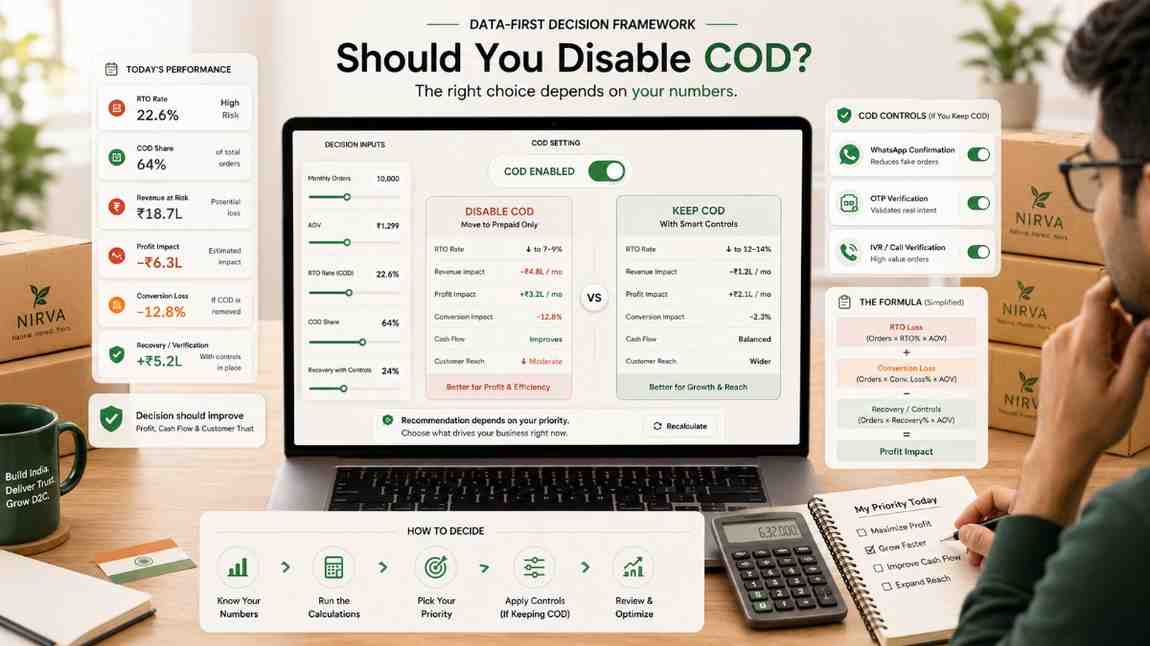
Step 1: Calculate Your Monthly COD Loss
Formula:
Monthly COD loss = Monthly COD orders × RTO rate × per-RTO cost

Per-RTO cost = Forward freight + Reverse freight + COD handling fee
              + Repackaging (~₹30) + Ops time (~₹25)
Example: 3,000 COD orders × 28% RTO × ₹240 per RTO = ₹2.02 lakh/month in direct losses
Benchmark per-RTO cost by courier: Delhivery surface: ₹180–₹215 total. Shiprocket panel (aggregated): ₹200–₹270 depending on zone and weight slab. Bluedart: ₹240–₹295. Ekart: ₹160–₹200. Shadowfax: ₹170–₹210.
This is only the direct logistics loss. It does not count revenue permanently lost when a product gets damaged on the return, or the holding cost of inventory that has shipped and is in transit for 7–14 days.
Step 2: Calculate Your Prepaid Revenue Risk
If you disable COD, what share of your COD customers will switch to prepaid versus leave without ordering? Industry data suggests 35–55% convert when given a prepaid incentive (cashback, discount, free shipping). Without any incentive, cold conversion is 20–30%.
Formula:
Revenue at risk = Monthly COD GMV × (1 - expected prepaid conversion rate)

Monthly COD GMV = Monthly COD orders × AOV
Example: 3,000 COD orders × ₹950 AOV = ₹28.5 lakh COD GMV. If 70% convert to prepaid, you retain ₹19.95 lakh. Revenue permanently at risk: ₹8.55 lakh/month.
Step 3: Net Decision Calculation
Net benefit of disabling COD:
(COD RTO cost saved + COD logistics premium saved)
minus (Lost GMV × your contribution margin)
If the result is positive: disabling COD saves you more than it costs. If negative: disabling COD loses you more margin than the RTO bleed.
For most Indian D2C brands below ₹5 crore monthly GMV, the number is negative. The RTO bleed is real but smaller than the revenue drop from customers who will not switch to prepaid. The exception is brands with very high RTO rates (35%+) in very low-margin categories where each returned order eliminates all profit on 2–3 sold orders.
| Scenario | COD orders/mo | RTO rate | Loss saved | Revenue at risk | Decision |
|---|---|---|---|---|---|
| Brand A, fashion, Tier-2 heavy | 2,000 | 32% | ₹1.54 lakh | ₹7.2 lakh GMV | Keep COD, add controls |
| Brand B, health supplements | 800 | 14% | ₹22k | ₹3.1 lakh GMV | Keep COD, no action urgent |
| Brand C, fashion, 38% RTO, Metro-only | 1,200 | 38% | ₹1.09 lakh | ₹2.6 lakh GMV (Metro) | Disable COD in Metro, keep for Tier-2 |
Brand C is the rare case where the math flips. Metro customers have much higher prepaid conversion when nudged, UPI, card, and wallet penetration is high. The revenue risk is manageable. The RTO savings are meaningful. For Tier-2, that same brand keeps COD open because the revenue drop would be severe.
Who Should Actually Disable COD
Three narrow profiles where disabling COD pencils out, based on the calculation above.
Profile 1: High RTO + Low Margin + Metro-Heavy
RTO above 35%, contribution margin below 15%, and 60%+ of orders from Metro pincodes, Delhi (110xxx), Mumbai (400xxx), Bangalore (560xxx), Hyderabad (500xxx). Metro customers have higher prepaid conversion when pushed. If your expected drop-off from removing COD in these four cities is 20–25% and your RTO savings are ₹1.5 lakh per month, the net math is positive.
Action: disable COD for Metro pincodes only using a Shopify payment method app or Shipeasy's pincode rules. Keep COD on for everything else. Do not go sitewide.
Profile 2: Repeat-Purchase Category With Strong LTV
If you sell something customers reorder every 30–60 days, protein supplements, skincare, baby products, and your repeat purchase rate is above 40%, disabling COD for returning customers makes sense. First order stays COD to build trust. All subsequent orders push toward prepaid with a loyalty-tier discount or cashback.
Returning buyers already trust you. COD on their third order is a habit, not a requirement. Offer ₹50–₹80 cashback on prepaid reorders and most returning customers convert within two order cycles.
Profile 3: Fraud-Heavy Pincodes Driving Outsized RTO
This is not disabling COD, it is surgical pincode-level blocking. Some pincodes have COD RTO rates of 60–80% driven by serial returners or prank ordering patterns. Identify them: filter your courier report by pincode, sort by RTO rate, flag anything above 50% on 20 or more orders in 90 days.
These pincodes should have COD blocked entirely. The revenue risk is negligible, if 80% of orders from a pincode return, the "revenue" from that pincode is already mostly fictional. Delhivery's AI-powered RTO Predictor and Shiprocket's risk scoring both flag high-risk pincodes automatically. You do not need to build this yourself.
The COD Controls Playbook: The Middle Path
For the 80% of brands where disabling COD loses more than it saves, here is the operational path: keep COD, but build a verification and filtering system that makes your COD orders behave closer to prepaid. The target: 25–35% RTO reduction within 60 days without touching the toggle.
Tactic 1: OTP at Checkout
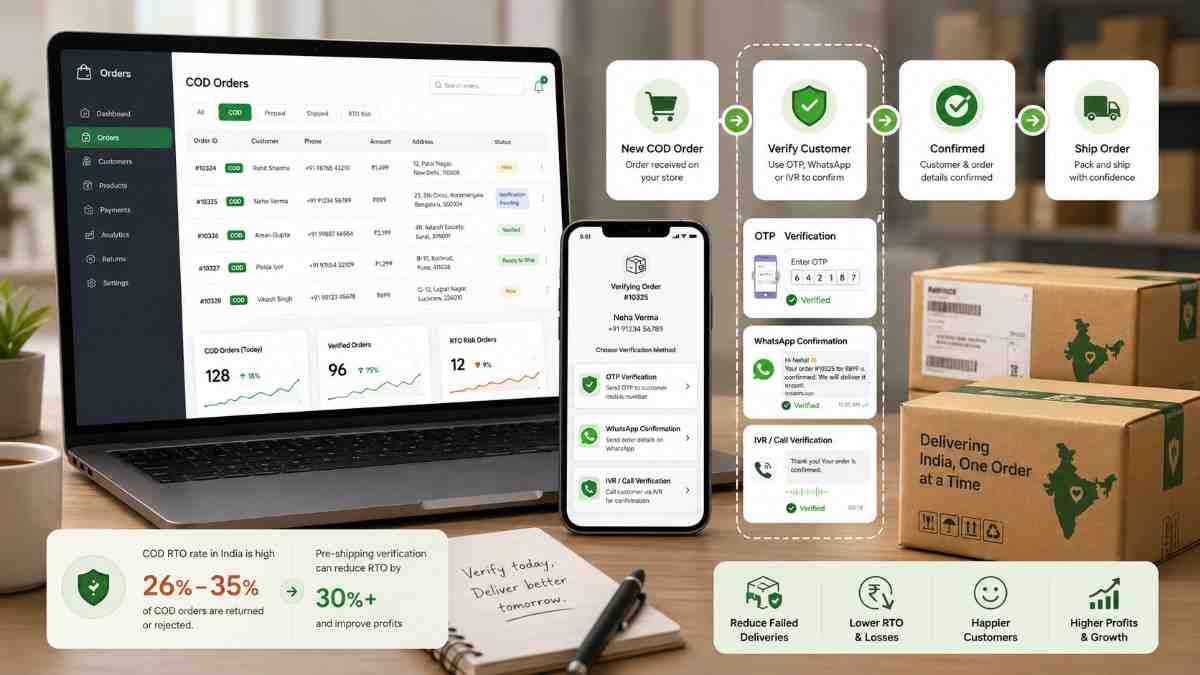
The first layer. Before the order is placed, verify the phone number is real. A COD OTP sends a one-time password to the customer's mobile. If they do not enter it within 5 minutes, the order does not go through. This filters 30–40% of prank or fraudulent COD orders before they enter your dispatch queue.
Shopify apps that handle this: HillTeck COD OTP, COD Advanced, CODBot. Setup takes under an hour. Cost: ₹2,000–₹5,000 per month depending on order volume. Works on Shopify's standard checkout and Shopify Plus checkout extensibility.
Important distinction: OTP at checkout verifies the phone number is real and the buyer is present. It does not verify the customer still wants the order 3 hours later. For that, you need the next tactic.
Tactic 2: Post-Order WhatsApp Confirmation
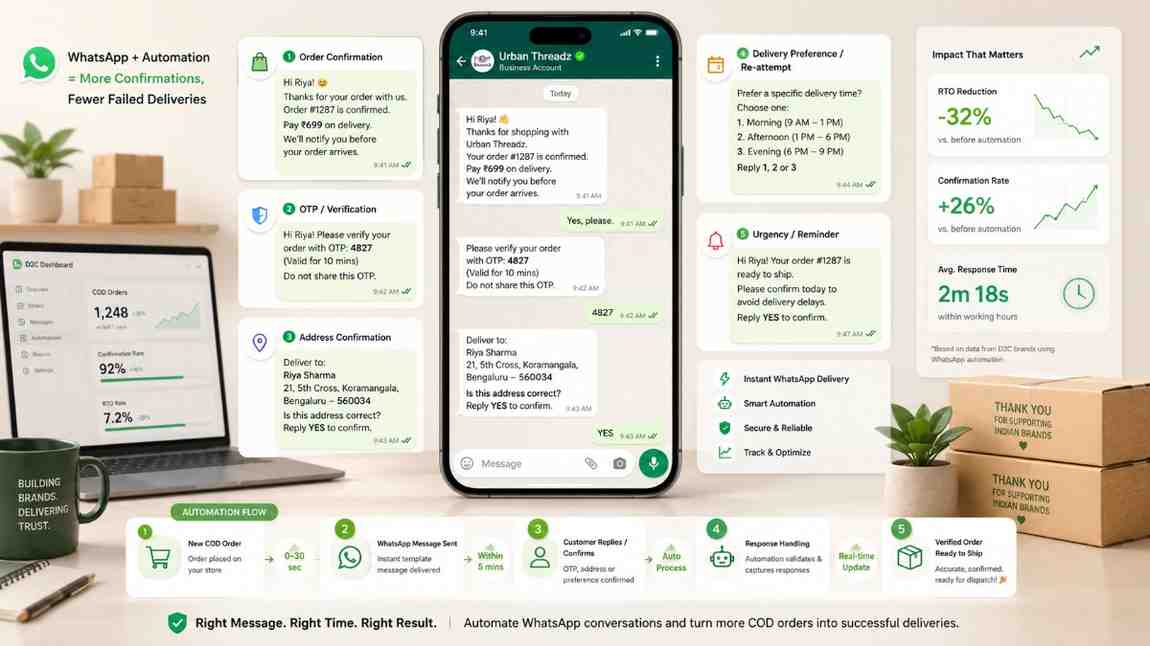
Send a WhatsApp template message within 5 minutes of order placement. Include two quick reply buttons: Confirm Order and Cancel Order. If the customer confirms, tag the order and prioritise for packing. If they cancel, hold the order for ops review before pulling it from the queue. No response in 4 hours: send one follow-up, then route to IVR call as fallback.
WhatsApp open rate runs at 85% within the first 3 minutes. Response rate on COD confirmation messages sits at 55–65% in the first 24 hours. Among those who respond, confirmation rate is typically 85–90%. Brands running this report RTO dropping 30–40% in the first 30 days.
Tools that integrate with Shopify: Wati, Interakt, AiSensy, DelightChat, HillTeck. Platform cost: ₹2,500–₹8,000 per month plus ₹0.50–₹0.70 per WhatsApp utility conversation. One WhatsApp conversation covers all messages in a 24-hour window, a 3-message verification flow costs ₹0.70 total. One RTO costs ₹225–₹260.
For Tier-3 pincodes and rural areas where WhatsApp non-installation rates can run 15–25%, set IVR as an automatic fallback for undelivered messages. IVR pickup is 5–8% but it covers the gap. WhatsApp first, IVR fallback, not IVR primary.
Tactic 3: Pincode-Level COD Eligibility
Run your last 90 days of courier data through a pivot table: pincode column, order count column, RTO count column, RTO rate column. Any pincode with 20+ COD orders and an RTO rate above 50% is a problem zone. Block COD there.
Beyond fraud pincodes, apply serviceability logic. Some pincodes are surface-only (5–7 day delivery), which correlates with higher RTO because customers forget they ordered. Either block COD for these or require WhatsApp confirmation before dispatch, do not ship on surface mode without a confirmation.
Shopify apps: Shipeasy, Pincode COD Checker. Delhivery's merchant portal exports RTO-by-pincode monthly. Shiprocket's analytics section has the same. Pull it quarterly and update your blocked list.
Tactic 4: Risk-Based COD Fee
Instead of blanket removal, charge for COD selectively. A ₹30–₹50 COD fee applied to orders below ₹500 AOV, or to new customers from high-risk pincodes, converts 12–18% of borderline COD buyers to prepaid without driving away genuine customers.
The mechanism: serious buyers pay ₹30 without blinking. Prank buyers and casual impulse orderers drop off at that friction. It is natural self-selection, not customer rejection.
Where to apply: high-risk pincodes, orders below ₹500, and first-time customers from cold paid traffic, not from email or returning customer segments. Apply blanket COD fees and you will penalise genuine buyers in lower-income markets who are not higher risk, just lower AOV.
Tactic 5: Pre-Dispatch Prepaid Conversion Nudge
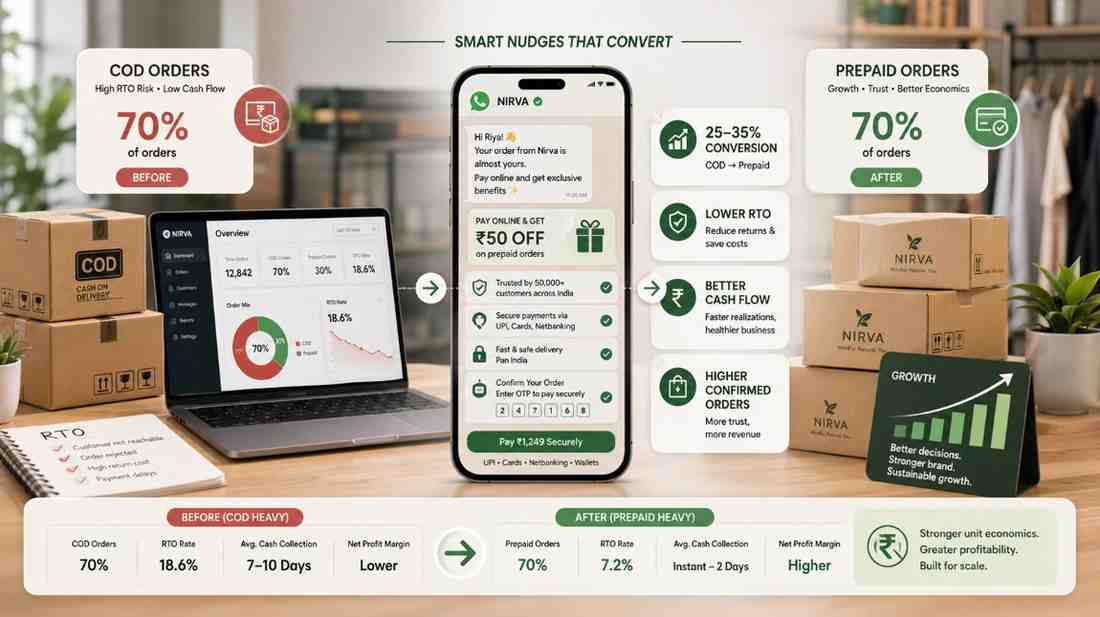
After a COD order is confirmed via WhatsApp, send a separate message with a time-limited offer to switch to prepaid: "Pay now and save ₹75, offer valid for 2 hours." Include a direct payment link. This is not COD verification. It is COD-to-prepaid conversion for customers who have already proven their intent by confirming.
Brands running this consistently convert 10–20% of confirmed COD orders to prepaid. For every 1,000 COD orders per month, a 12% conversion at ₹850 AOV is ₹1.02 lakh shifting from COD to prepaid, improving cash flow, eliminating COD handling fees, and reducing residual RTO risk simultaneously.
Timing is the variable that matters most: send within 30 minutes of confirmation. At dispatch time, the customer has moved on mentally.
Tactic 6: RTO Risk Scoring Per Order
Both Delhivery and Shiprocket now provide RTO risk scores per order based on historical data from millions of shipments, customer delivery history, pincode patterns, order value, and device signals. High-risk orders get flagged before dispatch.
What to do with high-risk orders: auto-route to WhatsApp confirmation (block dispatch until response received), apply COD fee, or block COD entirely for that order. Low-risk orders ship without friction. This gives you COD coverage for customers where the data supports it, while applying controls only where the signal says you need them.
Delhivery's RTO Predictor is available to merchants on their platform. Shiprocket has a built-in risk score in its dashboard. Third-party tools Clickpost and Shipway offer risk scoring across multiple courier partners if you are on Ekart, Shadowfax, or another carrier not covered by native scoring.
Benchmarks: What Good COD Metrics Look Like
Before running your own numbers, here is where the industry sits after Unicommerce's 2026 report covering 6,000+ brands and 410 million-plus shipments. National average COD RTO dropped from 39% at the festive peak to 21% by February 2026, driven by brands adding verification layers, not disabling COD.
| Metric | Good | Acceptable | Red flag |
|---|---|---|---|
| COD RTO rate | Under 15% | 15–25% | Above 30% |
| COD share of total orders | Under 40% | 40–60% | Above 70% in Metro |
| COD-to-prepaid conversion rate (with nudge) | Above 15% | 8–15% | Under 5% |
| WhatsApp COD confirmation response rate | Above 60% | 45–60% | Under 40% |
| RTO gap: COD vs prepaid (percentage points) | Under 15 pp | 15–25 pp | Above 25 pp |
| OTP checkout drop-off rate | Under 5% | 5–10% | Above 15% (UX problem) |
The most diagnostic number is the RTO gap between COD and prepaid. If your COD RTO is 28% and prepaid is 3%, the 25-point gap tells you the problem is buyer intent and verification, not delivery execution or product quality. Controls fix that. If both COD and prepaid RTO are above 20%, the problem is in your product, packaging, or delivery experience. Disabling COD will not fix a logistics problem.
For context on what brands that have run controls can achieve: a verified confirmation flow with WhatsApp plus pincode filtering typically brings COD RTO from 30–35% down to 18–22% within 60 days. That alone shifts the unit economics enough to make COD net positive for most categories above ₹700 AOV.
How Oneflow Handles This
Oneflow is checkout and post-checkout infrastructure built for Indian D2C Shopify brands. It handles COD OTP at checkout, post-order WhatsApp verification, risk-based COD eligibility, and prepaid conversion nudges in a single layer, without running three separate apps with separate dashboards. If you are managing OTP, WhatsApp BSP, and pincode rules through different tools, the ops overhead of reconciling them across a 3,000-order month becomes its own problem.
FAQ: COD, Verification, and the Disable Decision
My RTO rate is 32%. Should I just disable COD?
Run the Step 3 calculation first. For most brands at 32% RTO, the revenue lost from the GMV drop exceeds what you save in logistics. The typical first move: WhatsApp verification plus pincode filtering brings RTO from 32% to 18–20% within 60 days. Do that for 90 days. If RTO stays above 28% after sustained controls, then revisit the disable decision, and consider blocking only the pincodes driving the high rate, not going sitewide.
What share of Indian D2C orders are COD right now?
Approximately 60–65% nationally as of early 2026, down from around 70% in 2023. In Tier-2 and Tier-3 markets, COD still runs at 58–64% of order volume. Metro cities are trending toward 40–50% COD as UPI adoption grows.
How much does a single RTO actually cost?
Using Delhivery as a baseline: forward freight ₹65–₹85 + COD fee ₹45 + return freight ₹65–₹80 = ₹175–₹210 in direct logistics. Add ₹30 repackaging and ₹20 ops time: ₹225–₹260 per RTO. Bluedart adds another ₹40–₹60 on top. These figures exclude product damage from double-handling and the working capital cost of inventory in transit for 7–14 days on the return cycle.
Can I disable COD for specific pincodes only?
Yes, and this is the recommended approach for most brands. Shopify's payment method settings allow restricting COD by shipping rate, and apps like Shipeasy and Pincode COD Checker give you granular pincode control. Block COD for your top 20 highest-RTO pincodes, those are typically driving 40–50% of total RTO volume while representing a small share of total orders.
Will adding a COD fee hurt conversion?
A flat ₹30–₹50 fee does not measurably hurt conversion for genuine buyers in most categories. It drops prank and impulse orders, which is the intent. A/B test it on a pincode or traffic segment before rolling sitewide. Fashion in Tier-2 markets sees slightly higher drop-off from COD fees. Apply it selectively by pincode risk level and order value, not blanket.
What WhatsApp COD confirmation response rate should I target?
Aim for 55–65% of COD orders responding within 24 hours. Among those who respond, 85%+ confirmation is achievable with a well-written template. If response rate is below 40%, the issue is almost always timing (message not sent within 5 minutes of order) or template length (too long, truncating in preview). Fix timing first, it has the largest impact on response rate.
Does OTP at checkout cause cart abandonment?
Expect 5–12% additional drop at OTP entry. This is acceptable because the drop is nearly all fake or impulsive orders that would have returned. If OTP drop-off is above 15%, check: phone field placement, OTP delivery speed (under 10 seconds is required), and whether the OTP modal is mobile-optimised. Fix those before attributing the abandonment to OTP itself.
Should I disable COD during festive season sales?
No. Festive season is when COD matters most for new customer acquisition. Brands that restrict COD during sales miss first-time buyers who would become repeat customers. The festive COD RTO rate is higher, it hit 58% at peak during Q4 2025, but the solution is stricter verification and faster confirmation, not removal. Block COD only for pincodes with documented high RTO history, not as a blanket festive policy.
At what monthly COD order volume does verification tooling make sense?
At 300+ COD orders per month, a WhatsApp BSP costing ₹3,000–₹5,000 monthly pays back in under two weeks from avoided RTO. Below 300 orders per month, one ops person doing 15 minutes of daily verification covers the volume without tooling. Above 1,000 COD orders per month, automation is necessary, manual processes will always lag behind order velocity during spikes.
How did brands like Snitch reduce their COD share to under 20%?
Over 2–3 years, through consistent prepaid incentives, brand-building, and an audience that skews younger and digitally native with higher prepaid adoption to begin with. It was not a quick switch. If your audience is in the 30–45 age range ordering from Nashik, Coimbatore, or Patna, replicating that shift in 12 months is not realistic. The achievable target is 5–10 percentage points of COD reduction per quarter with disciplined nudging.
The Decision in One Paragraph
Disabling COD makes financial sense for fewer than 10% of Indian D2C brands, specifically those with RTO above 35%, Metro-heavy order mix, and a product category where prepaid conversion holds under pressure. For everyone else, the math favours keeping COD open and building a system around it: OTP at checkout to block fake orders, WhatsApp confirmation post-order to verify intent, pincode-level blocking for fraud zones, and a prepaid nudge for customers on the fence. That combination cuts RTO by 30–45% in 60–90 days without losing a single genuine customer.
Run the three steps above on your own numbers before touching the toggle. Most brands that do the calculation discover the disable option costs more than the RTO it eliminates. The ones who skip the math make the decision on instinct and scramble to reverse it a month later.
Fix the system around COD. Keep the option.
- Shipway ShipNotes RTO data via Mediabrief
- Unicommerce India D2C Report 2026
- Delhivery AI RTO predictor
- COD King OTP verification case study

Omkar Kamble builds the courier billing audit and recovery engine behind OneflowAI, so these guides come from real courier billing data, not theory. Figures we cannot independently verify are flagged.
Published 14 June 2026 Last reviewed 14 June 2026 16 min read