Open this article in your favourite assistant
Get an instant summary, or save it as a source your AI can cite later.
A Shopify store selling ethnic wear out of Surat was doing 3,000 orders a month. About 900 of those were COD. Roughly 280 were coming back every month as RTO, refused delivery, fake address, customer unavailable. The founder was spending ₹55,000 to ₹70,000 a month in combined forward and reverse shipping on orders that were never going to be received.
The pattern was consistent: most of the returns came from a cluster of pincodes in UP and Bihar, on orders in the ₹499 to ₹799 range, placed through Instagram ads. The customers had placed the order, decided they did not want it, and simply refused delivery when the Delhivery agent showed up 5 days later.
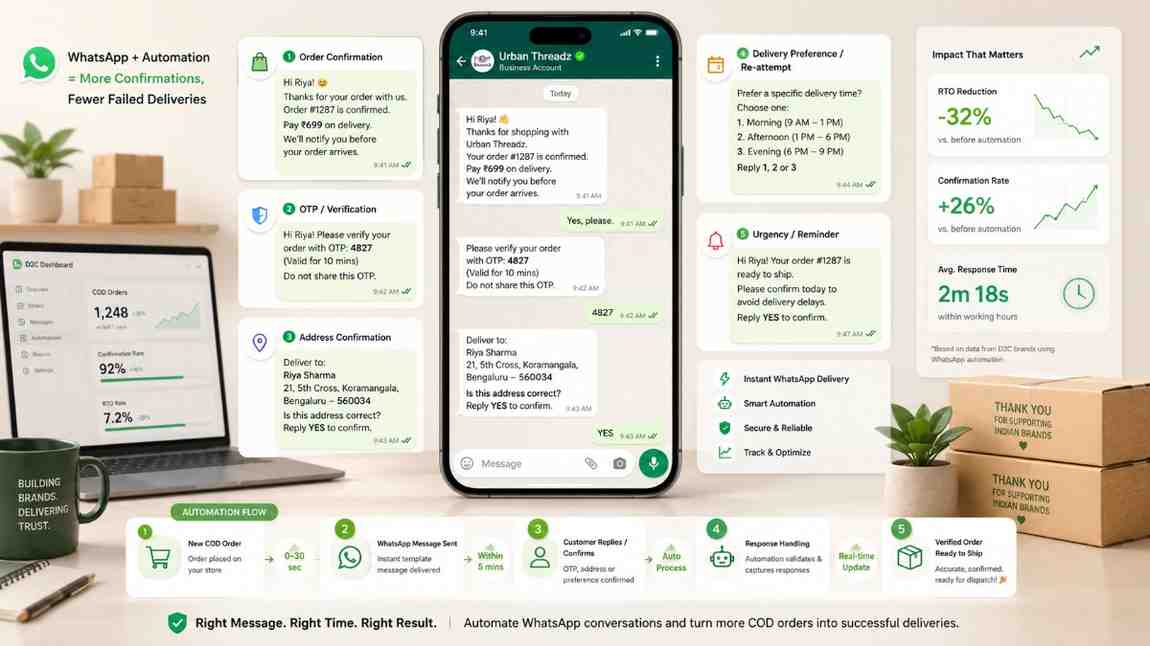
They added WhatsApp COD verification, a single message sent within 5 minutes of order placement asking the customer to confirm. Customers who did not confirm within 3 hours had their orders auto-cancelled. In the first month, RTO dropped from 31% to 19%. The ₹55,000 to ₹70,000 monthly burn dropped to under ₹35,000.
The intervention cost: one Shopify app, ₹2,500 a month in platform fees, and two hours of setup. The first month ROI was clear.
This is the COD verification problem for Indian D2C on Shopify in 2026. COD is still 42 to 55% of orders for most D2C brands. Shopify discontinued its Advanced COD app this year, removing the tool many brands had used for COD management. And national COD RTO rates are running at 26% per Shipway ShipNotes data, hitting 40%+ in fashion, footwear, and impulse-purchase categories.
This guide covers the exact setup: what COD verification is, which channel works best, which Shopify apps to use, how to target selectively, and what the numbers look like when it works.
Why COD Verification Matters Now
Three things converged in 2025 and 2026 to make COD verification more urgent for Shopify brands in India.
Shopify killed the Advanced COD app. Many Indian D2C brands had been using Shopify's Advanced COD app for basic COD management, tagging high-risk orders, blocking specific pincodes, adding fees. That app was discontinued, and brands relying on it now need a replacement. This triggered a wave of brands actively re-evaluating their COD verification setup.
Social commerce is generating higher-risk COD orders. A significant share of D2C COD orders now come from Instagram and Meta ads, where the purchase decision is impulsive and the customer has not researched the product. These orders RTO at higher rates than search or email-driven purchases because the intent is shallower. The pincodes driving the most fraud and refusals are often the same pincodes where social commerce penetration is highest.
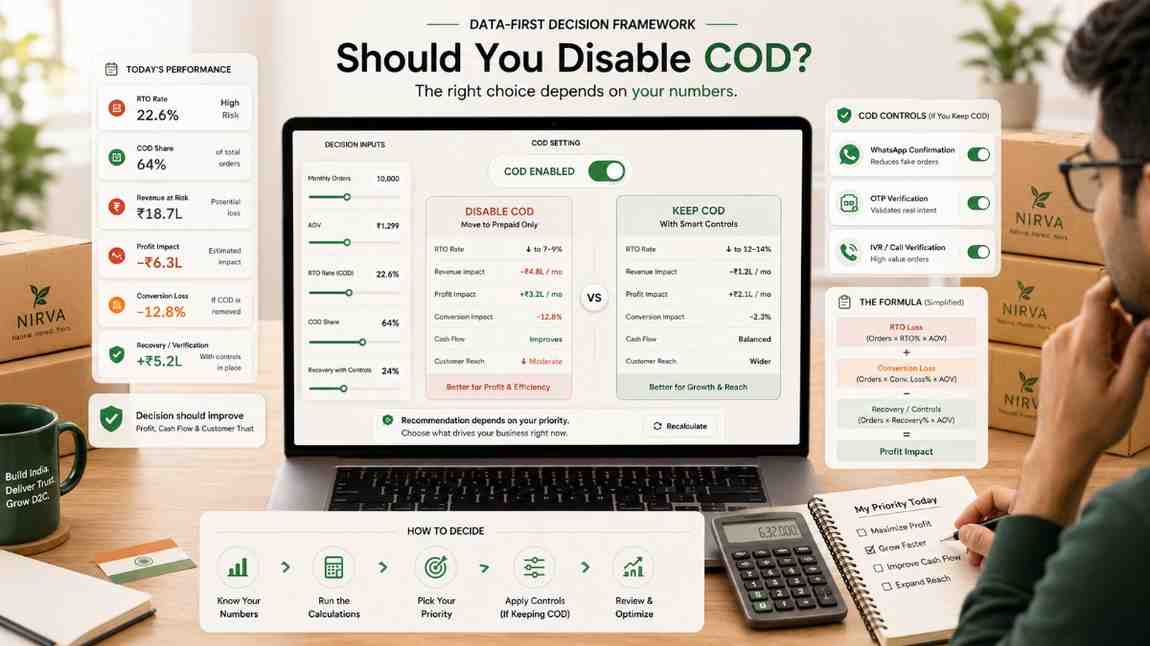
COD RTO costs are compounding. At ₹180 to ₹240 per returned order in combined shipping and handling, a 30% COD RTO rate on 1,000 monthly COD orders costs ₹54,000 to ₹72,000 per month, before you count the CAC that produced those orders, the inventory tied up in transit, or the ops time managing the returns. These costs scale directly with order volume. Brands that ignore COD RTO management at 1,000 orders a month are dealing with a much larger problem at 5,000 orders a month.
What COD Verification Actually Does
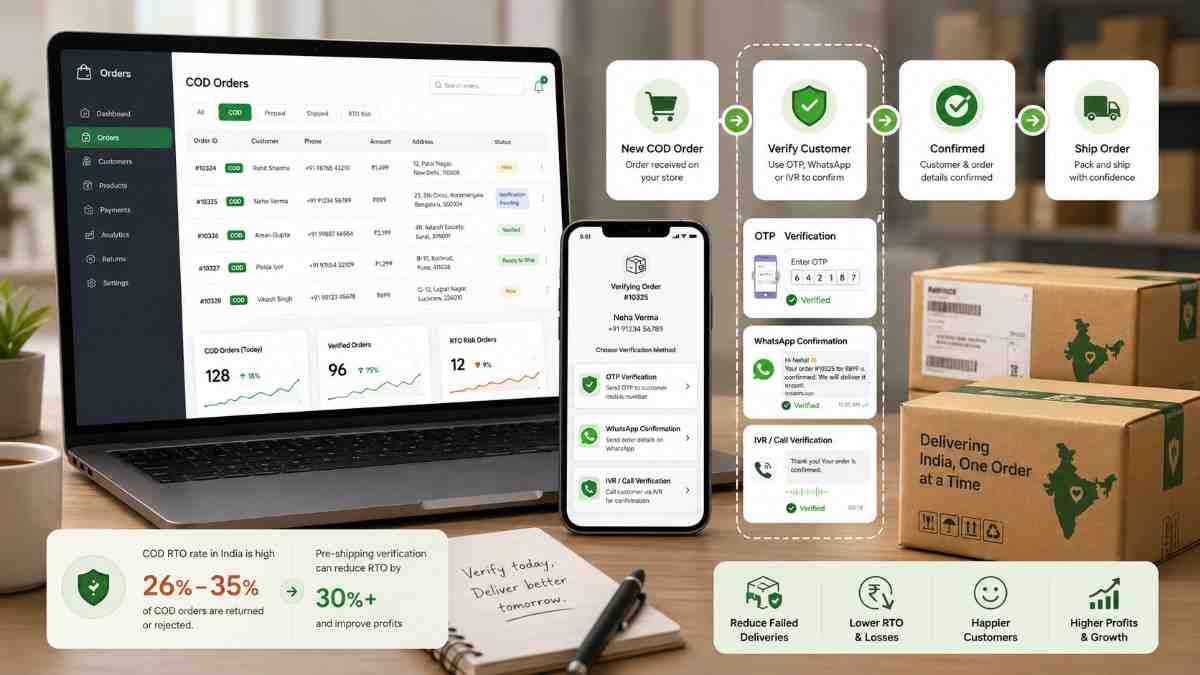
COD verification is a confirmation step that happens between order placement and shipping. The customer places a COD order on your Shopify store. Before you print the label and hand it to Delhivery or Shiprocket, the customer must confirm the order is genuine through an OTP, WhatsApp message, or automated call.
Unverified orders, those where the customer does not complete the confirmation step within your defined window, are either auto-cancelled or held for manual review.
What it filters out:
- Bot-placed orders. Bots can fill out a Shopify checkout form. They cannot respond to a WhatsApp OTP or a dynamic verification code sent to a real phone number. A bot-placed COD order that never verifies gets cancelled before it enters your fulfillment queue.
- Impulse purchases the customer will refuse. The customer who placed a ₹599 kurta order at 11pm while scrolling Instagram, thought better of it overnight, and will refuse delivery five days later, that customer will not go out of their way to respond to a verification message the next morning. Auto-cancel removes this order from your shipping queue.
- Wrong phone numbers. If the number given at checkout does not receive the OTP or WhatsApp, the verification fails. This catches address-and-contact-data problems before they become NDR events.
- Competitor sabotage. Placing fake COD orders on a competitor's store is a known tactic in some Indian D2C categories. Verification requires a real, accessible phone number, which makes bulk fake-order attacks significantly harder.
What it does not filter out: genuine customers who are in a low-connectivity area when the verification fires, elderly customers unfamiliar with OTP flows, and customers with poor WhatsApp access. This is why targeted verification, applied to high-risk segments rather than every COD order, is better than blanket verification.
The core logic: A prepaid customer proved intent by entering payment details. A COD customer has not proven anything. Verification creates a lightweight intent-proof for COD orders before you spend money shipping them.
Verification Methods: OTP, WhatsApp, IVR
Three channels. Each has a different use case, completion rate, and cost.
WhatsApp (recommended for most Indian D2C brands)
A WhatsApp message sent within minutes of order placement, asking the customer to confirm. Can include a numeric code, a quick-reply button, or a link. WhatsApp has 98% open rate in India, with most messages read within 3 minutes. The two-way nature means you can include a COD-to-prepaid conversion offer in the same message thread, something you cannot do with OTP or IVR.
The main requirement: your business needs a WhatsApp Business API account through a BSP (Interakt, WATI, AiSensy). Most Shopify COD verification apps either include this or integrate with your existing BSP. Template approval takes 24 to 72 hours, factor this into your setup timeline.
Best for: brands where the customer base is urban and Tier-1 to Tier-2. Works well for fashion, personal care, health, and electronics categories.
OTP via SMS (lightweight, no two-way interaction)
A 4 to 6 digit OTP sent via SMS immediately after order placement. The customer must enter the OTP on a verification page (either a link in the SMS or back on your Shopify store). Simpler than WhatsApp, no BSP required, and works for customers who do not have WhatsApp.
The limitation: SMS OTP is one-directional. You can verify the phone number is real and accessible, but you cannot have a conversation, cannot offer prepaid conversion, and SMS open rates (~19%) mean some genuine customers will miss the message. SMS works as a fallback channel when WhatsApp fails, not as the primary channel for most Indian D2C brands.
Best for: brands with a diverse customer base including non-WhatsApp users, or as a fallback after a failed WhatsApp delivery.
IVR (automated voice call)
An automated outbound call to the customer's number, playing a recorded message asking them to press a key to confirm the order. Some systems use AI-generated voice. IVR pickup rates in India are 5 to 8% for unknown numbers, significantly lower than WhatsApp or SMS open rates.
IVR is most useful for Tier-3 pincodes and older customer segments where WhatsApp penetration is lower and phone calls are the more natural interaction. For these segments, IVR often outperforms WhatsApp. HillTeck's app supports IVR as a primary or fallback channel, which is one reason it is popular for brands with diverse pincode coverage.
Best for: Tier-3 pincodes, older demographics, categories like ayurvedic health products or agricultural tools where customer WhatsApp usage is lower.
| Channel | Open / pickup rate | Two-way | Prepaid conversion | Best for |
|---|---|---|---|---|
| 98% | Yes | Yes | Urban, Tier-1/2, fashion, personal care | |
| SMS OTP | ~19% | No | No | Fallback, non-WhatsApp users |
| IVR | 5–8% | Limited | No | Tier-3, older demographics |
Most brands use WhatsApp as primary with SMS as fallback. IVR is worth adding if you have significant Tier-3 pincode volume.
Shopify Apps and Setup
With Shopify's Advanced COD app gone, these are the main options for Indian D2C brands in 2026.
HillTeck, Verify COD Orders
The most comprehensive option for Indian D2C brands. HillTeck supports IVR calls, WhatsApp OTP, and SMS OTP. It includes AI-powered risk scoring that flags orders based on address history, order frequency, and pincode data. Automatic blocking of repeat-offender phone numbers and blacklisted pincodes. COD-to-prepaid nudge built into the verification flow.
Setup time: 30 to 60 minutes. The risk-scoring configuration takes the most time, you need to define your thresholds for what triggers verification versus what gets auto-approved. Available on the Shopify App Store. Pricing is usage-based, roughly ₹2,000 to ₹8,000 per month depending on order volume.
Best for: brands doing 1,000+ orders a month who want risk-scored selective verification rather than blanket confirmation.
GoKwik, Kwik COD
GoKwik uses machine-learning based risk scoring across a large network of D2C brands to classify orders as low, medium, or high risk. High-risk orders get COD disabled or a mandatory prepaid conversion prompt. GoKwik also offers a guarantee model, for brands that qualify, GoKwik absorbs a portion of the RTO cost on orders it approves.
The network effect is GoKwik's main advantage: they have seen order data across thousands of Indian D2C brands, so their blacklist of phone numbers, pincodes, and address patterns is larger than any single-brand list. They offer 70+ interventions for COD management including pincode blocking, COD fees, and partial COD options.
Best for: brands doing 3,000+ orders a month with a significant COD proportion and willingness to pay for a risk-based guarantee product.
Cashfree CODFIRM
A WhatsApp-first COD confirmation tool from Cashfree (a major Indian payment gateway). Sends a WhatsApp message after order placement with a one-click prepaid conversion option. Clean interface, Cashfree's own WhatsApp Business API infrastructure, and tight integration with Cashfree's payment stack if you use them as your gateway.
Best for: brands already on Cashfree as their payment gateway, or brands that want a straightforward WhatsApp confirmation without complex risk-scoring setup.
COD King (COD & OTP Verify)
A simpler, lower-cost option. Supports OTP verification via WhatsApp and SMS, with basic pincode and phone blacklisting. Less sophisticated than HillTeck or GoKwik but adequate for brands under 1,000 orders a month where manual risk review is still feasible. Flat-rate pricing makes it predictable for smaller volumes.
Best for: brands under 1,000 orders a month who want basic verification without the cost and complexity of a full risk-scoring platform.
Basic setup checklist regardless of app
- Install app and connect to your Shopify store
- Connect WhatsApp Business API (through app's built-in BSP or your existing one)
- Submit WhatsApp message templates for approval, allow 24 to 72 hours
- Set verification timing: trigger within 5 to 10 minutes of order placement
- Set unverified order action: auto-cancel after 2 to 4 hours for high-risk, hold for ops review for standard
- Configure targeting rules before going live
- Test with a real COD order before enabling for all traffic
Smart Targeting: Verify Selectively
Blanket verification, requiring every COD customer to confirm, adds friction for genuine customers and can reduce conversion by 5 to 10% at the verification step. Smart targeting applies verification only where the risk justifies it.
High-priority verification triggers
Pincode-based. Build a list of pincodes with above-average RTO rates from your last 90 days of data. Any COD order to these pincodes gets verification. For most brands, 20 to 30% of pincodes drive 60 to 70% of RTO. Focusing verification on this cluster catches most fake and refused orders while leaving the majority of customers unaffected. Delhivery, Shiprocket, and ClickPost all have pincode-level RTO data you can pull.
First-time buyers. A repeat customer who has received 8 previous orders without an RTO is not your problem. A customer placing their first order from a Tier-2 city on a social media click is your highest-risk profile. First-time + COD + high-RTO pincode should always trigger verification.
Impulse-purchase order value band. Per Shipway data, the ₹500 to ₹1,000 order value band has the highest COD RTO rate (~28%). Orders in this band placed via social media ad traffic are especially high-risk. Set verification to trigger automatically for this combination.
Traffic source. Orders from paid social (Meta, Instagram Reels ads) RTO at higher rates than orders from Google search, email, or direct. If your analytics can distinguish the source, apply stricter verification to social traffic. Some Shopify apps support UTM-based triggering, check whether yours does.
Blacklisted phone numbers. Any phone number that has placed an order and never received it (confirmed RTO, refused delivery) goes on a permanent verification list. Some apps maintain this automatically. GoKwik and HillTeck both have network-wide blacklists that include phone numbers flagged across thousands of brands, not just yours.
Skip verification for
- Repeat customers with two or more successful COD deliveries in the last 6 months
- Orders to metro pincodes from returning customers
- High-value orders above ₹2,500 (the customer has more skin in the game and refusal rates are lower)
- Orders where the customer is on your loyalty or subscriber list
Well-targeted verification hits 20 to 35% of COD orders while capturing 60 to 75% of the fake and impulse-refusal volume.
Using Verification to Convert COD to Prepaid
The verification step is a moment of customer engagement. The customer is on their phone, they have just received your message, and they are thinking about the order. That attention is worth more than just a confirmation.
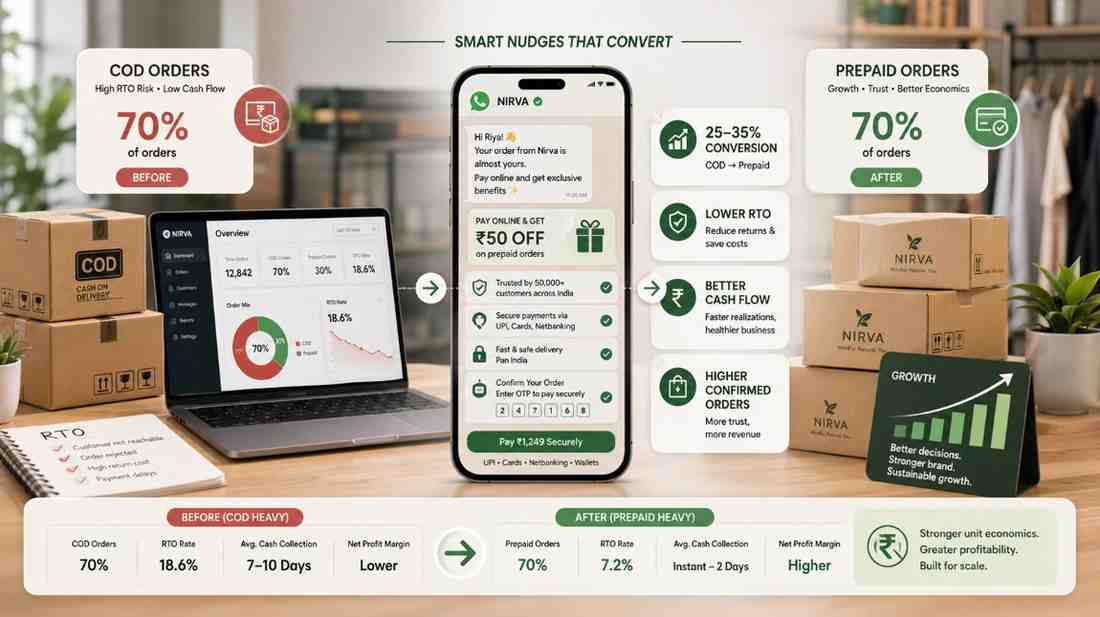
Add a prepaid conversion offer immediately after the customer confirms the COD order. The message can be a follow-up WhatsApp or part of the confirmation screen itself:
"Your COD order is confirmed! You can switch to prepaid and save ₹30, just tap below. This offer is available for the next 2 hours only."
Why this works: the customer has already said yes to the order. Switching to prepaid is a small additional step, and the incentive covers the perceived risk. The 2-hour urgency prevents them from ignoring it and coming back to it later.
The RTO math on conversions: a COD order that converts to prepaid goes from 26% RTO risk to under 2% RTO risk. At ₹700 average order value, the expected value difference from that RTO risk change is substantial even before you count the avoided reverse logistics cost.
Brands using WhatsApp COD-to-prepaid flows report 8 to 15% conversion at this step, depending on the incentive amount and category. Even at 8%, converting 80 COD orders per 1,000 to prepaid at this stage removes significant RTO risk from your fulfillment queue.
The incentive does not have to be a discount. Free express shipping, loyalty points, or a bonus gift with prepaid payment all work. Test what resonates with your customer base. The channel that works for this is WhatsApp, IVR and SMS OTP flows cannot support the prepaid link in a way that converts well.
Benchmarks: What Good Looks Like
Across brands that have implemented WhatsApp-based COD verification on Shopify in India, the outcomes cluster around these ranges:
| Metric | Before verification | After 30 days | After 90 days (tuned) |
|---|---|---|---|
| COD RTO rate | 28–35% | 18–22% | 15–20% |
| Verification completion rate | N/A | 65–75% | 70–80% |
| COD-to-prepaid conversion at verify step | N/A | 5–10% | 8–15% |
| Fake/bot order auto-cancels | N/A | 3–8% of COD volume | 2–5% (targeting refined) |
| Genuine customer impact (conversion drop) | N/A | 1–3% with smart targeting | Under 1% |
The "after 30 days" column uses Unicommerce platform data as a reference: brands implementing WhatsApp COD confirmation see RTO rates drop from 30 to 35% to 18 to 22% within the first month.
The verification completion rate of 65 to 75% on day 30 improves to 70 to 80% after you tune targeting. The improvement comes from removing low-risk orders from the verification pool, once you stop verifying your loyal repeat customers, your completion rate on the remaining high-risk pool naturally improves because those customers are more likely to be genuine intent buyers who respond.
A 40% drop in fake orders after enabling OTP verification has been documented by Shopify merchants in India. Individual results vary significantly by category and pincode mix. Fashion brands in Tier-2 cities tend to see the largest absolute drops.
North star metric: Track COD RTO rate as a percentage weekly, split by verified-and-shipped vs unverified-and-auto-cancelled. If verified orders are still RTOing at above 20%, your targeting is not catching all the high-risk orders. If unverified cancels are above 15% of COD volume, you are either targeting too aggressively or your verification UX has a friction problem.
Where Checkout Infrastructure Fits
COD verification is a post-order filter. It catches bad orders after they have been placed. A more upstream approach, showing the right checkout experience to the right customer before they place the COD order, reduces the bad order volume before it enters your funnel.
Platforms like OneflowAI work at the checkout layer: identifying high-risk COD buyers and nudging them toward prepaid with the right incentive before the order is placed. This works alongside COD verification rather than replacing it, verification catches what the checkout layer misses. Together, they address the COD RTO problem at both ends of the placement funnel.
FAQ: COD Verification for Shopify India
What is COD verification for Shopify?
A confirmation step between order placement and shipping. The customer receives an OTP, WhatsApp message, or automated call and must confirm the order. Unverified orders are cancelled or held before you spend money shipping them.
Why do Indian D2C brands need it?
COD orders RTO at 26% nationally (Shipway ShipNotes) and 35 to 40% in high-risk categories. Each return costs ₹180 to ₹240 in logistics before counting CAC. A meaningful share of RTOs are from orders that were never genuinely intended to be received, verification filters these out before they ship.
WhatsApp, OTP, or IVR, which is best?
WhatsApp for most Indian D2C brands: 98% open rate, supports two-way interaction and prepaid conversion. SMS OTP as fallback. IVR for Tier-3 pincodes and older demographics where WhatsApp penetration is lower.
What happened to Shopify's Advanced COD app?
Shopify discontinued it in 2026. Brands need third-party alternatives. Main options: HillTeck, GoKwik Kwik COD, Cashfree CODFIRM, COD King. All available on the Shopify App Store.
Which Shopify COD verification app should I use?
HillTeck for comprehensive risk scoring + IVR + WhatsApp. GoKwik for ML-based risk scoring with a network-wide blacklist and guarantee model. Cashfree CODFIRM for clean WhatsApp-first confirmation, especially if you use Cashfree as your payment gateway. COD King for brands under 1,000 orders a month who want a simpler setup.
Does verification hurt checkout conversion?
Blanket verification: yes, 5 to 10% additional drop-off at the verification step. Smart targeting (high-risk pincodes, first-time buyers, impulse value bands only): under 1 to 2% additional drop-off. Target selectively, not universally.
How quickly should the verification message go out?
Within 5 to 10 minutes of order placement. The customer is at peak intent immediately after placing the order. Response rates drop sharply if you wait 30+ minutes.
What do I do with orders that are not verified?
First-time buyer in high-RTO pincode: auto-cancel after 2 to 4 hours. Repeat customer with clean history: hold for 24-hour ops review. Do not ship unverified orders in high-risk segments, the expected cost of a return almost always exceeds the expected value of that order.
Can I use verification to convert COD to prepaid?
Yes. After the customer confirms via WhatsApp, send a prepaid offer: "Switch to prepaid, save ₹30, tap here." 8 to 15% of verifiers convert at this step. Each conversion drops RTO risk from 26% to under 2% on that order.
How much will my RTO rate drop after implementing verification?
Brands implementing WhatsApp COD confirmation see RTO rates drop from 30 to 35% down to 18 to 22% within the first month per Unicommerce platform data. One Shopify merchant reported a 40% drop in fake orders. Results vary by category and pincode mix, fashion brands in Tier-2 cities see the largest drops.
COD verification is one of the highest-ROI interventions available to Indian D2C brands on Shopify in 2026. The math is simple: filtering out fake and impulse-refusal orders before shipping costs ₹5 to ₹15 per cancelled order in platform fees. Shipping that same order and having it returned costs ₹180 to ₹240. The break-even is not complicated.
With Shopify's Advanced COD app gone, every brand is evaluating alternatives anyway. That is a good moment to set up something more thoughtful: targeted verification rather than blanket cancellation, WhatsApp rather than just SMS, and a prepaid conversion offer built into the flow. The brands that set this up correctly in the next quarter will be running meaningfully better COD economics than those that just install the lightest-touch replacement app and move on.
- Growww Tech, COD orders in 2026 after Shopify killed Advanced COD app
- HillTeck Shopify App Store listing

Omkar Kamble builds OneflowAI, which shows consumer brands what every order really earned after RTO, freight and COD. These guides come from real order and courier data, not theory. Figures we cannot independently verify are flagged.
Published 4 June 2026 Last reviewed 4 June 2026 14 min read