Open this article in your favourite assistant
Get an instant summary, or save it as a source your AI can cite later.
- RBI's Payment Aggregator rules mandate T+1 settlement and escrow, and they explicitly exclude COD. Your prepaid money is protected by regulation. Your COD money is protected only by your contract.
- Direct Delhivery tie-ups remit in 1 to 2 days. Most aggregators run 7 to 14. The gap is pure working capital.
- A brand doing ₹28.8 lakh a month in COD GMV keeps about ₹9.6 lakh permanently locked in a ten-day cycle.
- Three failure modes, and they need different follow-ups: late, short, and missing. Short remittance is the one nobody catches.
- Early COD at 0.99% works out near 45% annualised on the capital it frees. Instant COD at 5% works out near 200%. Compare both against your real cost of capital.
Where Your COD Money Actually Sits
Your Shopify dashboard says you did ₹48 lakh last month. Your bank account disagrees, and it is not close.
Some of that gap is RTO, which you expected. Some is the remittance cycle, which you half expected. But there is usually a third slice that nobody at the company can explain, and it tends to be the one that keeps showing up month after month.
Here is the ops moment most finance people will recognise. A payout of ₹4,12,880 lands from your aggregator on a Tuesday. The statement lists 340 AWBs. Nobody checks whether ₹4,12,880 is the right number for those 340 AWBs, because checking means pulling the rate card, applying the COD fee to each shipment, and summing it. That is two hours of work for a payout that looks roughly right.
So it gets marked received and the month closes. Repeat that weekly for a year and a 2% shortfall on ₹3.4 crore of COD GMV is ₹6.9 lakh you never noticed leaving.
COD is still the majority payment method for most D2C brands, though the national picture is genuinely contested. Commonly cited figures put COD at 60 to 65% of orders. One 2026 dataset puts it at 18% nationally, with metros above 70% prepaid. Both can be true depending on whether you are counting marketplace and quick-commerce volume or D2C volume from tier-2 and tier-3 pincodes.
Do not quote either number. Pull your own payment-mode split. What matters for this post is that if COD is a meaningful share of your orders, a large amount of your revenue spends its life sitting in someone else's account.
The Remittance Cycle in Plain English
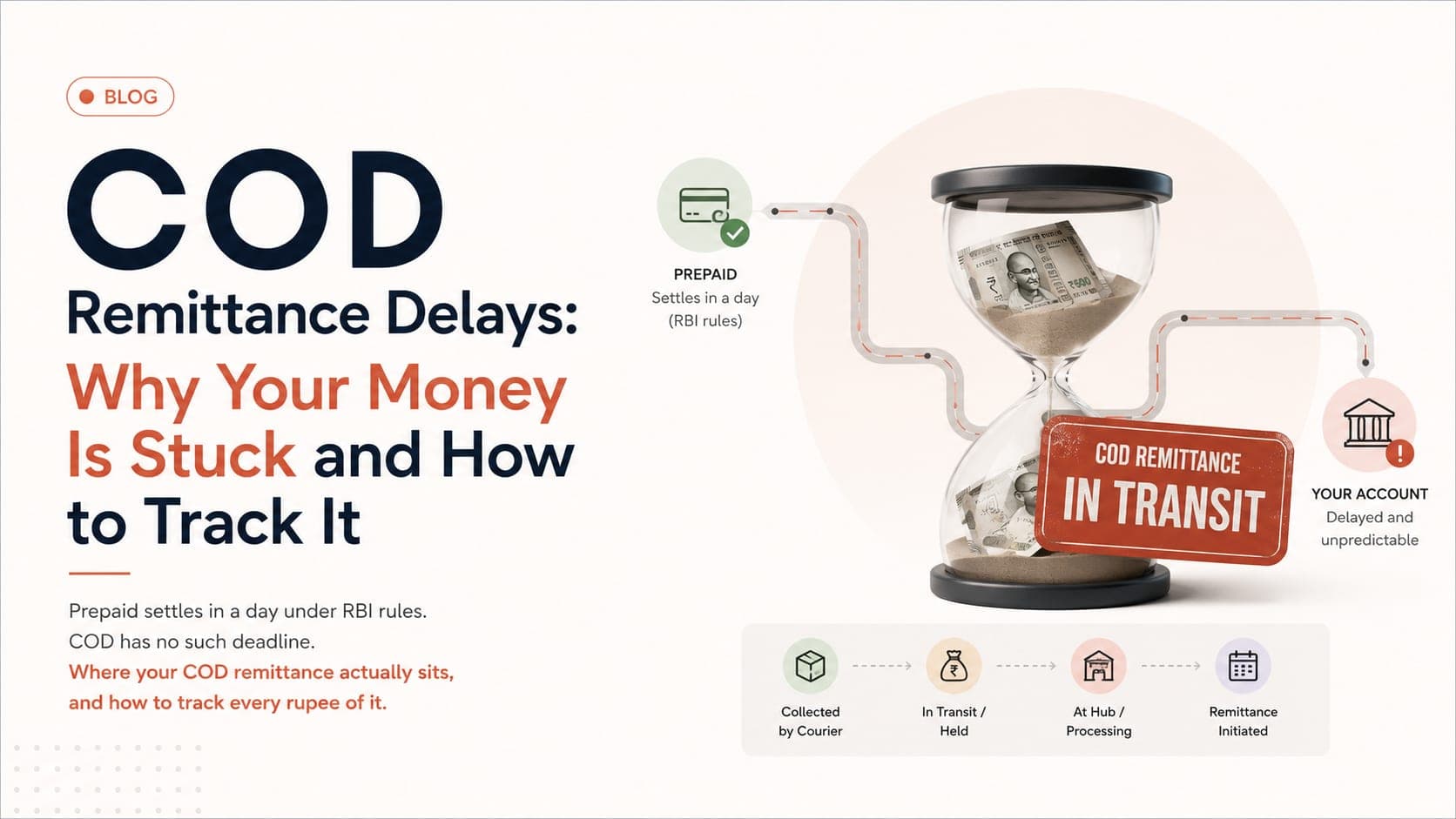
The gap between the courier collecting cash from your customer and that money reaching your bank account. Quoted as D plus a number, where D is the delivery date. D+2 means the money lands two days after delivery.
The cash physically moves through several hands. The delivery agent collects it, deposits it at a hub, the hub reconciles it to the courier's central account, the courier nets off whatever it thinks you owe, and what is left is transferred to you in a batch.
Every one of those steps is a place your money can pause. The delivery agent depositing late, the hub reconciling on a weekly rather than daily cycle, or a deduction being applied without an explanation all extend the gap.
Cycles vary widely by who you ship with.
| Partner type | Typical cycle | Note |
|---|---|---|
| Delhivery direct, Amazon Shipping | 1-2 days | Fastest available, needs a direct contract |
| Blue Dart | 3-5 days | |
| Franchise-led carriers | 5-10 days | Cash passes through a franchisee first |
| Aggregators (Shiprocket and similar) | 7-14 days | Industry standard sits at 7 to 9 business days |
| Prepaid, for comparison | T+1 | Mandated by RBI |
Note the units. Aggregators usually quote business days, not calendar days. Seven business days across a weekend and a public holiday is ten or eleven calendar days, and your working capital does not care about the distinction. When you model this, model it in calendar days.
The clock does not start when you think. The cycle starts at the delivery status timestamp in the courier's system, not when the customer received the parcel. If a delivery is marked in the system a day late, your whole cycle shifts a day and the courier is still technically within SLA.
Why COD Has No Settlement Deadline
This is the part most founders do not know, and it explains a lot.
The RBI Master Directions for Payment Aggregators, in force from September 2025, require payment aggregators to hold merchant money in an escrow account with a scheduled commercial bank, keep it separate from their own funds, and settle to the merchant within T+1.
Those directions explicitly do not apply to cash-on-delivery transactions. The escrow account cannot even be used for COD.
There is no regulator setting a deadline for COD remittance, no escrow requirement holding that cash separate from the courier's working capital, and no penalty framework if a payout runs late. If your aggregator remits on day 14 instead of day 7, your remedy is your contract.
Two things follow from this.
First, read the remittance clause before you sign. Check whether the cycle is quoted in business or calendar days, when the clock starts, what happens on a delayed payout, and what the dispute window is. Most brands discover these terms only when something goes wrong.
Second, your COD balance is an unsecured receivable from a logistics company. Treat it the way finance treats any receivable, with an ageing report and a named owner, rather than as money that will obviously turn up.
The Three Ways Remittance Goes Wrong
These get lumped together as "remittance issues" and then nobody fixes any of them, because each needs a different follow-up. Separate them.
Late: delivered, past due, no credit
The straightforward one. The AWB is delivered, the contractual due date has passed, and no money has arrived.
Usually it is a batch cycle issue, a delivery marked late in the system, or the AWB being missed in a payout run. Easy to chase once you can name the AWBs, close to impossible if all you can say is that last week felt light.
Short: money arrived, but less than it should have
This is the expensive one, and the one almost nobody catches.
The payout arrives, roughly on time, roughly the right size. But the credited amount is below COD collected minus your contracted fees, because RTO freight, a weight-discrepancy charge or an unexplained adjustment has been netted off.
Nothing alerts you. The payout looks normal. It is caught only by comparing what arrived against what you calculated should arrive, per AWB. Our guide on auditing courier invoices for hidden overcharges covers the deduction types worth checking first.
Missing: delivered weeks ago, never appeared
An AWB delivered six weeks ago that has never shown up in any remittance statement. These are individually small and collectively significant, and they are almost always past the dispute window by the time anyone notices.
The only defence is an ageing report on undelivered remittance, which is step one of the playbook below.
Deductions without an AWB reference are the main leak. A lump-sum "adjustment" line on a remittance statement, with no breakdown, is money you cannot dispute because you cannot say what it was for. Insist on AWB-level detail for every deduction, in writing, as a condition of the contract.
How to Track Every Rupee
Brands running two to five courier partners typically spend three to five working days a month reconciling COD by hand. That is a full-time week of a finance person's month spent matching AWBs in a spreadsheet.
The process below is what that week should actually produce. Run it weekly, not monthly.
-
Build an expected-remittance ledger
One row per delivered COD shipment: AWB, delivery date, COD amount collected, COD fee per your rate card, expected net, and contractual due date. This is the document you check bank credits against. Without it you are accepting whatever arrives and calling it reconciled.
-
Match every bank credit back to AWBs
Each payout should carry a UTR and a statement listing the AWBs it covers. Sum the expected net for those AWBs and compare. If a payout cannot be broken down to AWB level, escalate that as a contract issue, because a payout you cannot decompose is a payout you can never dispute.
-
Sort every mismatch into late, short or missing
Three buckets, three owners, three follow-up templates. Late goes to your account manager with AWB numbers and due dates. Short goes to disputes with your expected-versus-received calculation attached. Missing goes to a weekly escalation list that never gets cleared until each AWB is resolved.
-
Force an AWB-level breakup on every deduction
For each netted-off amount, demand the AWB, the reason code and the supporting document. RTO freight should tie to an RTO'd AWB. A weight-discrepancy charge should come with the courier's measured weight and dimensions. Anything that cannot be tied to a shipment should be reversed.
-
Work the exception list inside the dispute window
Most partners close remittance disputes 30 to 45 days after the payout date, though this varies by contract. On a monthly reconciliation cycle, a shortfall from the first week of the month sits untouched for six weeks and reaches you near the deadline. Weekly cycles exist for this reason alone.
-
Track days sales outstanding per courier
Average the gap between delivery date and money in bank, split by courier. One number per partner. This is the metric that tells you which courier is quietly financing itself with your cash, and it is the strongest thing you can put on the table in a rate negotiation.
The four columns that catch most of it
If you build nothing else, build these four columns next to each AWB. Most shortfalls show up here.
Expected net  = COD collected - (COD fee % x COD collected) - flat COD charge
Received      = amount actually credited, traced to a UTR
Variance      = Received - Expected net
Age           = today - delivery date, for anything still unpaid
Sort by Variance ascending and you have your dispute list for the week. Sort by Age descending and you have the AWBs about to fall out of the window.
Set a materiality threshold, then ignore it once a quarter. Chasing every ₹4 variance costs more than it recovers, so most brands set a floor around ₹50 per AWB. Once a quarter, run the report with no floor. Systematic small deductions are exactly the kind that hide beneath a threshold, and the pattern only shows up when you look at all of them together.
What to automate first
Do not try to automate everything at once. In order of payback: the expected-net calculation, since it is pure arithmetic off your rate card. Then the credit-to-AWB matching, which is where the hours go. Then the ageing report, which mostly runs itself once the first two exist.
Dispute filing stays manual for now, because every courier has a different channel and format. The same pattern we covered in automated versus manual courier reconciliation applies here.
Reduce the exposure, not just the tracking
Tracking recovers what you are owed. It does not shrink the pile of cash in transit.
Two things do. Moving buyers to prepaid removes the remittance cycle for those orders, which is a cash-flow argument for prepaid conversion on top of the RTO argument. And cutting RTO reduces the deductions being netted off your payouts, since RTO freight is one of the largest silent deduction categories. The true cost of RTO post has the formula for sizing that.
What Faster Remittance Actually Costs
Every aggregator sells an accelerated remittance product. They are useful and they are expensive, and the pricing is quoted in a way that hides how expensive.
Take the brand from our worked examples: 4,000 orders a month, ₹1,200 AOV, 60% COD.
COD GMV/month   = 4,000 x 0.60 x ₹1,200  = ₹28,80,000
Daily COD GMV   = ₹28,80,000 / 30         = ₹96,000

Cash locked at D+10 = ₹96,000 x 10  = ₹9,60,000
Cash locked at D+2  = ₹96,000 x 2   = ₹1,92,000
Working capital freed by moving to D+2 = ₹7,68,000
₹7.68 lakh released, permanently. Now price it.
Shiprocket Early COD at D+2 costs 0.99% of the COD amount, inclusive of GST.
Annual fee = ₹28,80,000 x 12 x 0.0099 = ₹3,42,144/year
Capital freed (one time, stays freed)  = ₹7,68,000

Effective annual cost = ₹3,42,144 / ₹7,68,000 = 44.6%
You are paying about 45% a year for working capital. If your alternative is a bank overdraft at 12 to 18%, Early COD is the wrong instrument. If your alternative is stocking out before a festive run, 45% is cheap and you should take it.
Instant COD is steeper. It charges 5% and releases up to 70% of the COD amount the day after shipping, with the balance following your standard plan. Paying 5% to pull money forward by roughly nine days annualises to about 200%.
| Option | Headline fee | Effective annual cost | Use it when |
|---|---|---|---|
| Standard aggregator cycle | Nil | Nil, but ₹9.6L locked | Default |
| Direct courier contract | Nil | Nil, ₹1.9L locked | Worth negotiating |
| Early COD D+2 | 0.99% | ~45% | Growth crunch |
| Instant COD | 5% | ~200% | Emergency only |
The cheapest lever is the one nobody uses: negotiate a direct contract with your highest-volume courier. Delhivery direct remits in 1 to 2 days at no premium. If 40% of your volume goes through one carrier, that alone gets most of the benefit of Early COD for free.
What Good Looks Like
| Metric | Struggling | Average | Good |
|---|---|---|---|
| COD days sales outstanding | 12+ days | 8-11 days | Under 5 days |
| Remittance variance (short as % of COD GMV) | Over 2% | 0.5-2% | Under 0.3% |
| Reconciliation cadence | Monthly or never | Monthly | Weekly |
| Payouts traceable to AWB level | Under 50% | 70-90% | 100% |
| Finance days/month on COD recon | 5+ | 3-5 | Under 1 |
| Disputes raised inside window | Under 40% | 60-80% | Over 95% |
The variance row is the one to watch. Under 0.3% means your reconciliation is tight enough that deductions get caught and reversed. Above 2% means money is leaving without anyone naming it, and on ₹3.4 crore of annual COD GMV that is close to ₹7 lakh a year.
The traceability row is the leading indicator. If you cannot break every payout down to AWBs today, every other number here is an estimate.
Most of this comes down to one habit: knowing what each payout should have been before it arrives, so a shortfall is obvious on the day rather than a feeling at quarter end. That reconciliation work is what Oneflow automates, tying every remittance back to the AWBs it paid for and flagging the variance while the dispute window is still open. If you want to see where your COD is leaking, book a call and we will run your last 90 days of remittance against your rate card.
FAQ
What is a COD remittance cycle?
The gap between the courier collecting cash from your customer and that money reaching your bank. Quoted as D plus a number, where D is delivery date. Delhivery direct runs 1 to 2 days, Blue Dart 3 to 5, most aggregators 7 to 14.
Why is my COD remittance delayed?
Usually the delivery was marked late in the courier system, the payout fell outside a weekly batch, a deduction is being netted off, or the AWB was missed in the batch. Start by matching the bank credit back to specific AWBs.
Does RBI regulate COD remittance timelines?
No. The Payment Aggregator Master Directions effective September 2025 mandate escrow and T+1 settlement but explicitly exclude cash-on-delivery. Your COD money is governed by your contract, not by a regulator.
What is short remittance?
When the credited amount is less than COD collected minus your contracted fees, usually because RTO freight, weight-discrepancy charges or unexplained adjustments were netted off. It is common, rarely flagged, and only caught by AWB-level reconciliation.
How much working capital does a slow cycle lock up?
Daily COD GMV multiplied by cycle days. At 4,000 orders a month, ₹1,200 AOV and 60% COD, daily COD GMV is ₹96,000, so a ten-day cycle locks roughly ₹9.6 lakh. Moving to D+2 releases about ₹7.68 lakh.
Is Early COD worth the fee?
Early COD at D+2 costs 0.99% including GST, which is roughly ₹3.42 lakh a year to free ₹7.68 lakh, an effective 45% annually. Expensive against a 12 to 18% overdraft, cheap against stocking out before festive.
What does Instant COD cost in annual terms?
5% to release up to 70% the day after shipping, with the rest on your standard plan. Pulling money forward about nine days for 5% annualises near 200%. A tool for a specific crunch, not a standing arrangement.
How long do I have to dispute a shortfall?
Typically 30 to 45 days from the payout date, though it varies by contract. On monthly reconciliation, a first-week shortfall can reach you at week six, close to the deadline. Reconcile weekly.
Should I use multiple couriers if it complicates remittance?
Yes. Multi-courier routing is right for delivery performance. Track DSO per courier and automate the reconciliation rather than cutting partners to make the spreadsheet easier.
What share of Indian ecommerce is still COD?
Sources disagree. Commonly cited figures say 60 to 65% of orders; one 2026 dataset says 18% nationally with metros above 70% prepaid. The gap is about what is being measured. Use your own payment-mode split.
- Trilegal — RBI Guidelines on Regulation of Payment Aggregators (escrow, T+1, COD exclusion)
- Shiprocket — Early COD (D+2 at 0.99% incl. GST)
- Shiprocket — Instant COD FAQs (5% fee, 70% next-day release)
- Shipmozo — Top COD Remittance Problems for D2C Brands (failure modes, recon effort)
- Metaport — COD Remittance Cycle Explained (D+2, delays, cash flow)
- ClickPost — COD Services in India 2026 (courier-wise remittance cycles)

Omkar Kamble builds OneflowAI, which shows consumer brands what every order really earned after RTO, freight and COD. These guides come from real order and courier data, not theory. Figures we cannot independently verify are flagged.
Published 22 August 2026 Last reviewed 22 August 2026 12 min read