Open this article in your favourite assistant
Get an instant summary, or save it as a source your AI can cite later.
- Manual reconciliation catches 30–50% of courier overcharges at best. The rest slip through because of missed dispute windows, volume limits, and invisible systematic errors.
- Automated reconciliation catches 85–95% of overcharges, generates dispute files automatically, and tracks submission deadlines across every courier.
- The financial break-even on reconciliation software is usually under 60 days for brands doing 1,500+ orders per month.
- The biggest win from automation is not speed — it is pattern detection. Systematic billing errors across hundreds of AWBs are completely invisible in a spreadsheet.
- Switching takes 4 to 8 weeks end-to-end. The rate card mapping step is where most teams underestimate the work.
What courier reconciliation actually is
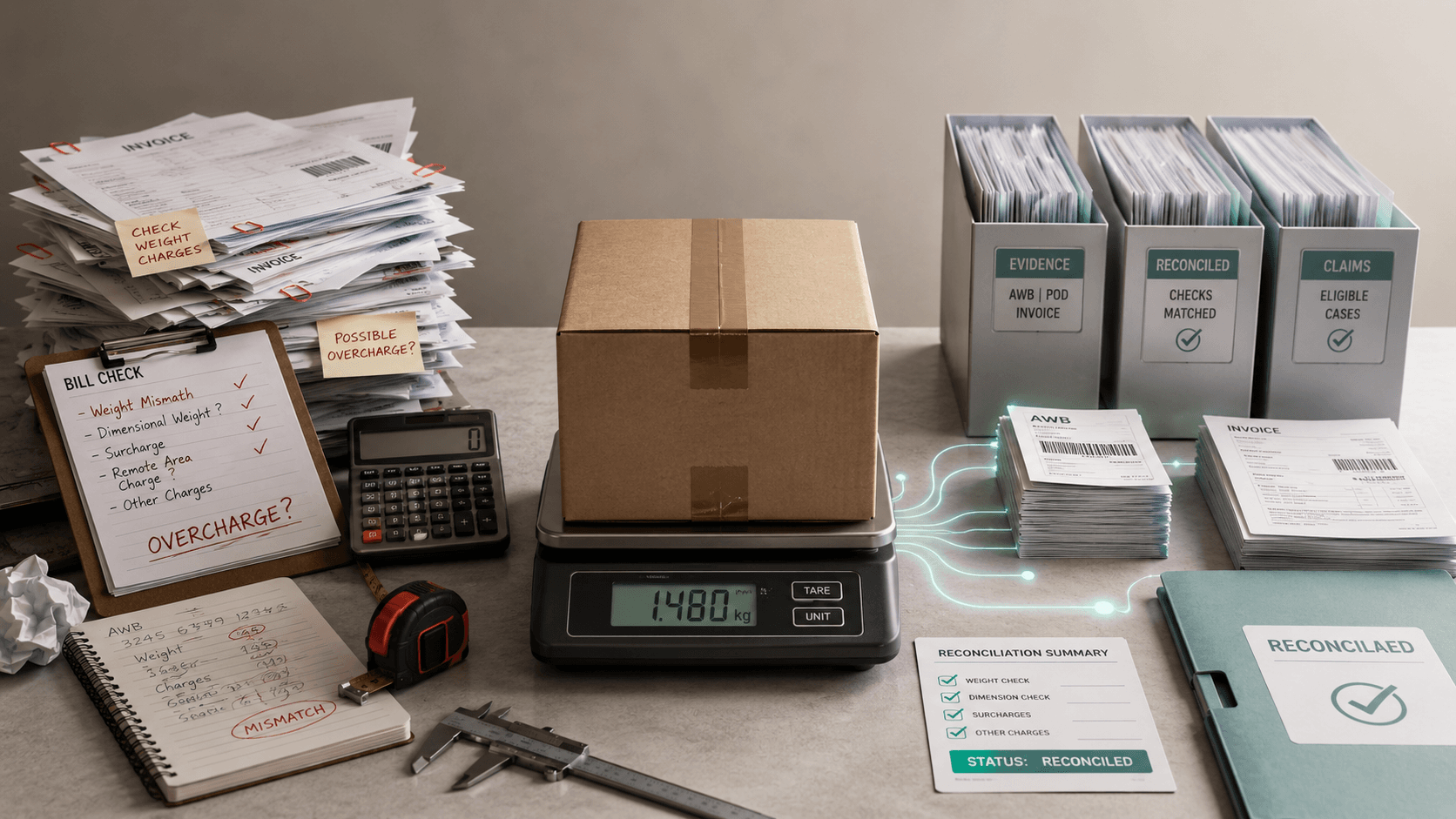
Courier reconciliation is the process of comparing what your courier charged you against what they should have charged you. Your contracted rate card says ₹45 for a 500g shipment to Zone 3. The invoice says ₹58. The difference is a discrepancy. If you catch it, submit evidence, and win the dispute, you get ₹13 back. If you miss it, it stays gone.
For Indian D2C brands, the overcharges come from several directions at once. Weight discrepancies are the most common — the courier scans your parcel at a different weight than what you declared. Zone misclassification is second — a shipment going from Mumbai to Pune gets billed at Zone 4 instead of Zone 2. Then there are ODA charges applied to serviceable pincodes, fuel surcharges calculated on the wrong base rate, COD remittances short-paid by a few rupees per order, and RTO charges billed twice when a return is reinitiated.
None of these are large individually. But across 3,000 shipments a month across Delhivery, Shiprocket, and Bluedart, they add up. Industry estimates put recoverable overcharges at 3–8% of total freight spend for brands that reconcile consistently.
Reconciliation covers everything that flows through your courier relationship: forward shipments, RTO returns, COD remittances, surcharges, and adjustments. Doing it well means you are not just catching random errors — you are auditing the entire billing relationship.
How manual reconciliation actually works
Manual reconciliation follows the same basic process at every brand that does it. Someone on the ops team downloads the courier's invoice CSV from the portal at the end of the billing cycle. For Delhivery, that is the Business Portal. For Shiprocket, the billing dashboard. For Bluedart, usually an email attachment from the account manager.
Then the matching begins. The team builds or maintains a master spreadsheet with VLOOKUP formulas that pull in the AWB number, declared weight, destination pincode, and expected rate from the order management system. Each invoice line gets matched. Anything where the actual charge does not match the expected charge gets flagged.
The flagged rows go into a separate dispute tab. Someone formats the dispute request — AWB number, declared weight, actual charge, expected charge, supporting evidence — and submits it through the courier's portal or by email. Then they track responses in another column, follow up manually, and log recoveries when they arrive.
This works. It is not wrong. A disciplined team doing this process weekly can catch a meaningful portion of overcharges. The problems start at scale.
Typical manual setup for a 2,000 order/month brand: One ops staff member spending 6–8 hours per week on invoice download, matching, dispute preparation, and follow-up. Roughly 25–35 hours per month total. Our courier invoice audit guide walks through what to check.
A brand shipping 3,000 orders a month across three couriers generates roughly 4,500 to 5,000 invoice line items per month — forward shipments, RTO returns, adjustments, surcharge rows. Checking each one manually against the rate card is not realistic for a two-person ops team that also handles NDRs, customer support, and marketplace settlements.
Where manual breaks down
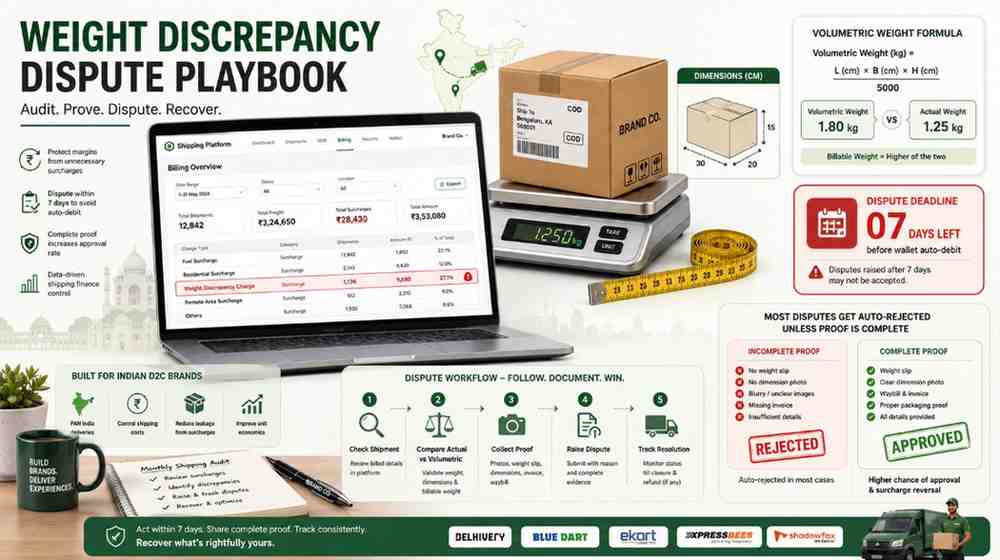
The most common failure mode is the dispute window. Delhivery gives you 7 days from invoice date. Ekart gives you 48 hours from when the charge is flagged. If the ops team is downloading invoices weekly and the billing cycle runs Monday to Sunday, a Thursday invoice may only have one working day left in its dispute window by the time anyone reviews it on the following Monday. The charge is gone before the dispute is filed.
The second failure mode is pattern blindness. If Bluedart's billing system is misclassifying all 560xxx Bengaluru pincodes as Zone 4 instead of Zone 3, a manual review might catch 15 or 20 of those in a month and file individual disputes. But without looking across all AWBs simultaneously, nobody spots that the same wrong zone is applied to every single Bengaluru shipment. The systematic error keeps running, and only a fraction of the overcharges get disputed.
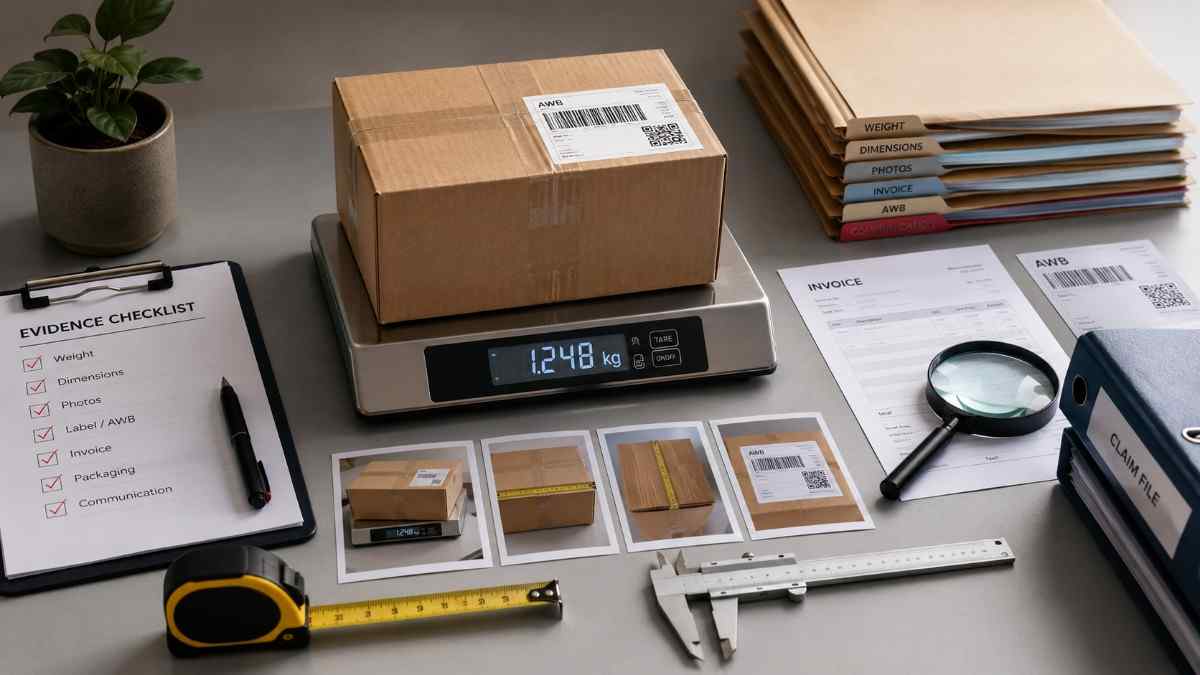
The third failure mode is evidence completeness. Manual reconciliation catches billing errors but cannot file disputes without evidence. If the team does not have pre-dispatch photos of packages on calibrated scales with AWB labels visible — the standard that Delhivery, Shiprocket, and Bluedart all require — the dispute gets filed without evidence and rejected. The overcharge is found but not recovered. See the weight-dispute evidence couriers accept.
The real cost of missed windows: If you're catching overcharges but submitting disputes after the deadline, your recovery rate is zero regardless of how clean your evidence is. Automated tools track dispute windows per courier and alert you before they close.
The fourth failure mode is cross-courier visibility. Manual reconciliation is almost always done per courier, per invoice cycle. You rarely see that your Shiprocket effective rate is ₹4.20 per shipment above what your Delhivery direct rate would be for the same zones, because you are not comparing the two systems in the same view. That intelligence is unavailable in a spreadsheet-per-courier approach.
What automation actually changes
Automated courier reconciliation tools connect to your courier portals via API or structured CSV import and pull in invoice data as soon as it is available. They match each AWB against your rate card, your order management data, and your manifest file simultaneously. Every discrepancy is flagged within hours of the invoice landing, not days.
The practical changes are significant.
Dispute windows get tracked automatically
The tool knows that Delhivery disputes need to be filed within 7 days and Ekart within 48 hours. It surfaces the high-urgency items first and alerts the ops team before deadlines close. You stop losing legitimate claims to timing.
Pattern detection becomes possible
When the same discrepancy appears across 20 or more AWBs in a billing cycle, the tool flags it as a systematic error. This is the difference between filing 20 individual disputes and sending one escalation to your courier account manager with a full data export showing every affected AWB. Couriers resolve systematic errors faster and more completely when you present the pattern, not just individual cases.
The matching volume is no longer a constraint
A tool running automated matching handles 50,000 AWBs in the same time it handles 500. The ops team goes from spending 25–35 hours per month on reconciliation to spending 2–4 hours reviewing flagged items, approving dispute files, and tracking resolutions.
Cross-courier view becomes standard
Because all courier data flows into one system, you can compare your effective rate per courier by zone, by weight slab, by product category. You can see whether Delhivery or XpressBees is cheaper for 500g shipments to Tier-2 pincodes. That is a business intelligence layer that manual reconciliation cannot produce.
Head-to-head comparison
| Parameter | Manual (spreadsheet) | Automated (software) |
|---|---|---|
| Setup cost | Near zero | ₹5,000–₹25,000/month depending on volume |
| Time investment | 25–40 hours/month ops time | 2–4 hours/month review time |
| Overcharge catch rate | 30–50% of discrepancies | 85–95% of discrepancies |
| Dispute window tracking | Manual, often missed | Automatic, alert before deadline |
| Scales to 5,000+ orders/month | No — volume overwhelms the team | Yes — no degradation at scale |
| Systematic error detection | Rarely — requires cross-AWB pattern analysis | Yes — flags patterns automatically |
| Cross-courier visibility | No — siloed per courier | Yes — unified dashboard |
| COD remittance matching | Manual, slow | Automated per AWB |
| Works well under 1,000 orders/month | Yes — manageable volume | Software cost may not justify ROI |
| Breakeven timeline | — | Typically under 60 days |
The table is not saying manual is useless. At 500–800 orders per month with one or two couriers, a disciplined manual process catches most of what matters. The case for automation gets compelling from 1,500 orders per month upward, where the invoice volume outpaces what any ops team can review thoroughly in a reasonable time budget.
The switch playbook: moving from manual to automated reconciliation
The switch is not technically complex. The preparation is what determines whether it actually works.
Step 1: Audit your current overcharge rate
Before evaluating any tool, pull last month's courier invoice and manually cross-reference 50 AWBs against your rate card. Count how many show a discrepancy and what the total overcharge value is. This is your baseline — and the number you will compare against your first automated reconciliation run.
This step is not optional. Without a baseline, you cannot evaluate whether the tool is working or justify its cost internally. One ops head at a Mumbai apparel brand did this exercise and found ₹38,000 in overcharges from a single month's Delhivery invoices — from a sample of 50 AWBs out of 2,800 that month. That number made the automation decision easy. See our Delhivery weight disputes playbook.
Step 2: Map your contracted rate cards before onboarding
Every tool will ask you to input your rate cards — the negotiated rates per weight slab, per zone, per courier, including COD percentage, fuel surcharge formula, ODA rates, and RTO charges. This is the highest-effort step and the one most teams underestimate.
If your Delhivery rate card is the standard published rate, the mapping is fast. If you have negotiated custom rates — ₹42 for 500g instead of ₹47, fuel surcharge capped at 18% instead of the standard formula — every exception needs to be documented correctly. Budget one full working day per active courier for rate card mapping. Errors here produce false positives in the reconciliation output and erode trust in the tool.
Step 3: Run parallel for 30 days
Do not switch off manual reconciliation immediately. For the first 30 days, run both. Have the ops team do their usual manual review while the automated tool also processes the same invoices. Compare what each method flags.
This parallel run serves two purposes. It validates the tool's output — if the tool is flagging discrepancies the manual process missed, you have found real money. If the tool is generating false positives on legitimate charges, you catch the rate card mapping errors before they create bad dispute submissions. After 30 days, the tool's catch rate relative to manual gives you a real number for the ROI calculation.
Step 4: Build and document the dispute workflow
Automation finds the overcharges and generates the dispute files. Humans still need to review, approve, and submit them. Document who does this, how often, and through which channel for each courier.
Delhivery disputes go through the Delhivery Business Portal under the billing section. Shiprocket disputes go through the support ticket system with the automated report attached. Bluedart disputes go by email to the account manager. Ekart disputes go through the seller portal. These channels are different and the turnaround time on each varies. Build a simple process doc so this is not in one person's head. Our Shiprocket dispute walkthrough shows one courier's flow end to end.
Step 5: Set pattern alerts for systematic errors
Configure the tool to alert you when the same type of discrepancy appears across 10 or more AWBs in a billing cycle. When you see that pattern, do not file 10 individual disputes. Pull the full dataset of every affected AWB, document the pattern, and send a single escalation to your courier's account manager with the data attached.
Couriers resolve systematic billing errors differently from individual disputes. Account managers have authority to process bulk credits that individual dispute submissions do not trigger. This is where the highest-value recoveries come from — not per-AWB disputes, but systematic errors caught across hundreds of shipments at once.
- Map every rate card exception before the tool goes live
- Run parallel reconciliation for 30 days before switching fully
- Document dispute channels per courier so any ops team member can submit
- Escalate systematic errors to the account manager, not just the portal
- Track dispute resolution times per courier to identify which partner has billing issues
- Assume the tool's default rate cards match your negotiated rates — they won't
- Submit disputes without evidence — even automated tools need you to attach proof
- File disputes for every discrepancy without reviewing them — false positives damage the relationship
- Ignore small per-shipment discrepancies — ₹8 per shipment across 3,000 shipments is ₹24,000/month
- Switch off manual reconciliation on day one before validating the tool's accuracy
Benchmarks: what good looks like
Once automated reconciliation is running properly, here is what mature brands achieve.
| Metric | Manual (typical) | Automated (mature) |
|---|---|---|
| Overcharges caught as % of total overcharges | 30–50% | 85–95% |
| Ops hours per month on reconciliation | 25–40 hours | 2–4 hours |
| Dispute window compliance rate | 60–70% | 95%+ |
| Dispute success rate (legitimate claims) | 50–65% | 65–80% with proper evidence |
| Time to dispute resolution | 15–25 days | 7–15 days |
| Recovery as % of freight spend | 1–2% | 3–6% |
The dispute success rate does not improve dramatically with automation alone — that is still driven by evidence quality and the accuracy of the claim. What improves significantly is the catch rate and the compliance rate. You submit more valid claims, within their windows, with proper documentation.
The realistic recovery expectation: A brand spending ₹8 lakh per month on shipping across Delhivery, Shiprocket, and Ekart should expect to recover ₹25,000–₹60,000 per month through systematic automated reconciliation once the process matures. The first month often shows a spike as historical overcharges get caught; subsequent months normalize.
The other benchmark worth tracking is the overcharge rate itself over time. Consistent reconciliation and dispute filing trains your courier's billing system. Once a courier's team sees systematic dispute filings on ODA charges for specific pincodes, they tend to fix the underlying data. Your overcharge rate actually declines over 6–12 months of active reconciliation.
This is the compounding benefit that never shows up in the initial ROI calculation: the problem gets smaller the longer you do it.
For brands running reconciliation through OneflowAI, this entire process runs automatically — courier invoice imports, rate card matching, discrepancy flagging, and dispute file generation are handled without ops team involvement. Human review focuses on approving dispute submissions and tracking resolutions, not on finding the overcharges.
FAQ
What is courier reconciliation in ecommerce?
Courier reconciliation is the process of comparing what your courier actually billed you against what they should have billed you based on your contracted rate card and shipment details. Any gap — weight discrepancy, wrong zone code, incorrect surcharge — is a discrepancy. If the courier billed more than they should, it is an overcharge you can dispute and recover. For Indian D2C brands, this covers Delhivery, Shiprocket, Bluedart, Ekart, XpressBees, and any other active courier.
How much can Indian D2C brands recover through courier reconciliation?
Recovery varies by volume, courier mix, and consistency. Industry data suggests 3–8% of total freight spend is recoverable for brands doing it systematically. A brand spending ₹10 lakh per month on shipping could recover ₹30,000–₹80,000 monthly. Brands switching from manual to automated reconciliation typically see a 40–60% increase in recovery because automation catches overcharges that manual review misses.
What does manual courier reconciliation miss?
Manual reconciliation typically misses systematic billing errors where the same wrong rate applies across many shipments, ODA charges on pincodes that are not actually ODA, fuel surcharge miscalculations that are small per shipment but large in aggregate, and RTO charges billed at the wrong rate or twice. These are hard to catch line-by-line in a spreadsheet but surface immediately as patterns in automated tools.
Which courier reconciliation tools work for Indian D2C brands?
Tools with native integrations for Shiprocket, Delhivery, Bluedart, Ekart, and XpressBees include BUSY Recom and dedicated reconciliation platforms. Some Shopify-native ops tools also handle courier reconciliation alongside marketplace settlement reconciliation. Evaluate on courier integration breadth, rate card mapping flexibility, and whether the tool tracks dispute windows automatically.
What is the dispute window for courier overcharges in India?
Delhivery: 7 days from invoice date. Bluedart: 7 working days from AWB date. Shiprocket: 7 days from wallet deduction. Ekart/Flipkart: 48 hours from when the charge is flagged. Missing these windows means the overcharge is final regardless of how clear-cut the error is. Automated reconciliation tracks these windows and alerts you before they close.
Is automated reconciliation worth it for brands doing under 1,000 orders per month?
At under 1,000 orders per month, manual reconciliation is still manageable with a disciplined process — weekly invoice downloads, a maintained rate card VLOOKUP sheet, and tracked dispute submissions. Automation becomes clearly worth it from 1,500 to 2,000 orders per month upward, where invoice volume makes manual review genuinely incomplete and the tool cost is easily justified by additional recoveries.
Can Shiprocket's dashboard replace a separate reconciliation tool?
No. Shiprocket's dashboard shows billing and deductions but does not validate charges against your rate card, does not flag overcharges automatically, and does not generate dispute files. It is useful for tracking remittances and COD settlements but is not a reconciliation tool. If you use Shiprocket plus direct courier contracts, you need a separate reconciliation layer.
What is a systematic courier billing error?
A systematic billing error is when the same wrong charge applies across many shipments — for example, all shipments to 700xxx Kolkata pincodes billed as Zone 5 instead of Zone 4, or all Bluedart shipments getting an ODA surcharge for serviceable pincodes. These are often configuration mistakes in the courier's billing system. They are nearly impossible to catch manually but show up immediately as patterns in automated reconciliation.
How long does switching from manual to automated reconciliation take?
Integration takes 2 to 5 working days for most tools. Rate card mapping takes 1 to 2 days per active courier, especially for negotiated rates. Running a 30-day parallel validation period before fully switching is strongly recommended. Total timeline: 4 to 8 weeks from decision to full switch, depending on how many couriers you actively use.
The clearest signal that manual reconciliation has become a problem is when your ops team is doing it thoroughly but nobody is confident they are catching everything. That uncertainty is the cost. Automation does not eliminate human judgment from reconciliation — it removes the parts that do not require human judgment and concentrates review where it matters.
If you want to see how much your couriers currently owe you before committing to any tool, a free audit from OneflowAI runs the reconciliation on your last 90 days of invoices and surfaces the gap. No commitment required.
- WareIQ — Shipping Weight Discrepancy in Indian eCommerce
- BUSY Recom — Shiprocket and Delhivery Shipping Reconciliation Guide
- Eshopbox — Minimizing Shipping Overcharges
- Bepragma — Getting 48–57 hours Back Every Week: An Indian D2C Playbook
- Edgistify — Weight Disputes: Fighting Courier Charges for Volumetric Weight

Omkar Kamble builds OneflowAI, which shows consumer brands what every order really earned after RTO, freight and COD. These guides come from real order and courier data, not theory. Figures we cannot independently verify are flagged.
Published 1 July 2026 Last reviewed 1 July 2026 11 min read