Open this article in your favourite assistant
Get an instant summary, or save it as a source your AI can cite later.
- Festive RTO lands in November. Orders placed around Dhanteras come back after everyone has already called the sale a success.
- Four things shift at once: who buys, what they order, how long couriers take, and whether the customer is home.
- Your usual high-RTO pincode list is the wrong list for October. Build a festive one from last October and November.
- Set rules by pincode tier and by order type, and switch them on before the first sale day.
- A blanket prepaid discount can cost more than the RTO it saves. Put the nudge where the RTO is.
Here is how the season usually goes at a brand doing 4,000 orders a month.
Sale week looks brilliant. Daily orders run close to double, Meta costs behave for once, and someone posts a Shopify screenshot in the founders' WhatsApp group.
Around the middle of November, the warehouse starts filling with boxes nobody opened. A kurta ordered for Diwali that reached after Diwali. A dry fruit hamper sent to a parent in Gorakhpur who had no idea a ₹1,899 COD parcel was coming. A Bengaluru PG address where the customer had gone home for the week.
By the time finance closes November, part of October's revenue has reversed and you have paid freight both ways on every one of those parcels. We put the all-in cost of an RTO at ₹450 to ₹900, so a few hundred extra returns is several lakh gone in a month.
It happens to most brands. Unicommerce's India D2C Report 2026, built on more than 410 million shipments, found that 58% of COD orders in the festive season came back, against under 15% of prepaid orders.
RTO trails the order by one to three weeks, so the returns arrive after the sale review is done. Below is what to change before the rush, per pincode and per order type.
Why festive RTO is its own problem
A shipment the courier could not deliver, sent back to your warehouse. You pay forward freight, return freight and usually a handling charge, and earn nothing on the order.
Here, the festive window means Navratri through Bhai Dooj: 11 October to 11 November in 2026, with Dussehra on 20 October and Diwali on 8 November. Marketplaces go first. Amazon's Great Indian Festival opens on 8 October, which trains buyers to expect deep discounts and fast delivery at the same time.
Redseer expects $15 to 16 billion of festive ecommerce GMV this year from 180 to 185 million shoppers. Over Diwali 2025, COD orders on Unicommerce grew 35% by value.
The economics underneath stay the same. In one D2C pilot month, COD orders returned at 24.8% against 1.4% for prepaid. Next to Unicommerce's festive 58% and under 15%, the pattern is plain: the festive season widens the gap, and nearly all the extra damage lands on COD.
What changes is everything around that gap.
| What changes | Normal month | Festive window |
|---|---|---|
| Who is buying | Mostly repeat and organic | A spike in first-time buyers from paid ads |
| What they order | For themselves | Gifts, multiples, impulse buys at sale prices |
| Courier transit | Your usual TAT | Slower on long lanes, more NDRs a day |
| Where the customer is | At the address | Often travelling home for Diwali |
Any one of these pushes RTO up. All four in the same three weeks is why October needs its own rules, and your usual ones turned up will not do it.
Where festive returns come from
Sale traffic brings buyers you have never seen
Bain and Flipkart's How India Shops Online 2026 found that festive periods bring in about one in four new online shoppers, with close to triple the daily traffic during events like Big Billion Days. Your site gets a smaller version of that wave, so more of your COD orders come from people with no history with you.
A buyer who added a ₹1,499 serum to cart at 11 pm because it said 40% off is a different risk from a repeat buyer ordering the same serum. Without history you cannot tell them apart. First-order COD above your normal AOV is the order to confirm before you spend freight on it.
Transit slips on the lanes that matter
To be fair to couriers, peak handling keeps improving: Unicommerce measured festive shipping times 15% faster in 2025 than the year before. Averages hide lanes, though. Adecco estimates a 10 to 15% shortfall in peak frontline staff for 2026, and close to 30% of the 2.5 lakh seasonal jobs Flipkart has created across Ekart are going to first-time workers. The long lanes into Tier 2 and 3 slip first.
A lehenga for Navratri that arrives after Dussehra gets refused without a second thought. For festive orders, the delivery promise matters more than the speed.
Gifts go to people who did not order them
A buyer in Pune orders a smartwatch for their father in Hubballi, picks COD because it feels safer, and forgets to mention it. The father sees a ₹2,400 COD parcel he never ordered and says no.
Nothing is wrong with the address and nobody meant any harm. The wrong person was holding the cash. When the shipping name differs from the billing name on a COD order, treat it as a gift and handle it like one.
Metro addresses go quiet in Diwali week
A large share of the working population in Bengaluru, Pune, Gurugram and Hyderabad goes home for Diwali. Orders to a PG or office address in early November reach a locked door.
You see it as a jump in "customer not available" NDRs from metro pincodes, which are usually your best-delivering areas. For about ten days around Diwali, treat them as risky.
Nobody works the NDR queue in time
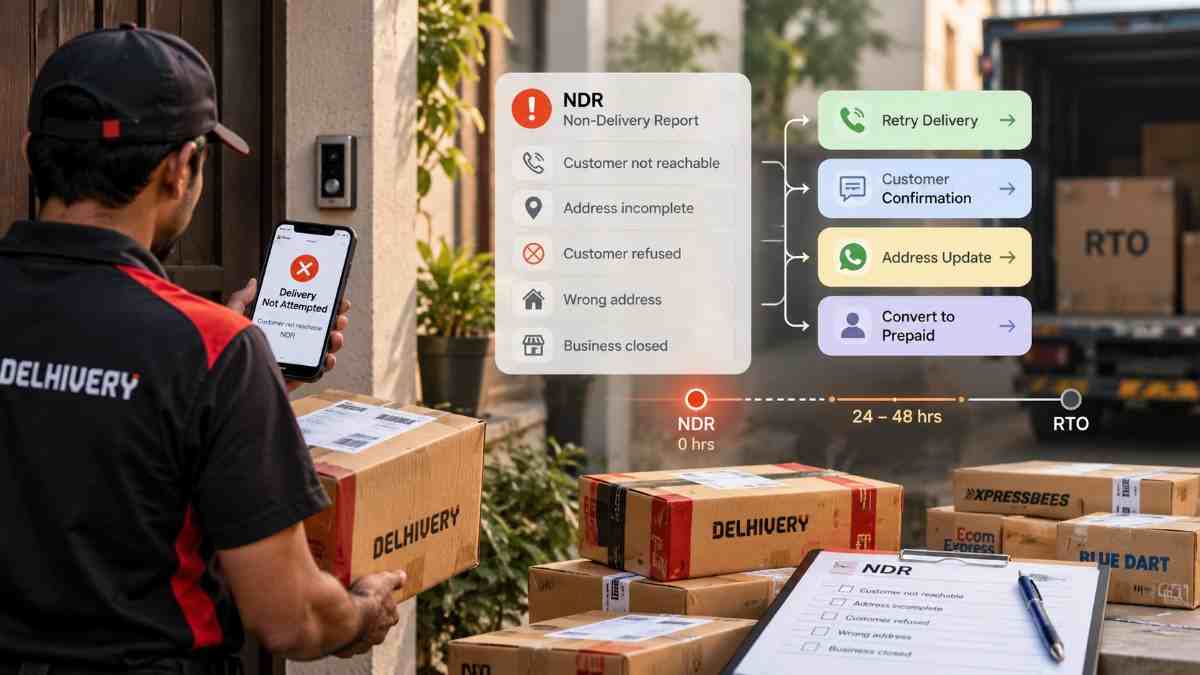
NDRs grow with volume while the same team packs twice the usual orders. An NDR raised on Dhanteras sits until after Bhai Dooj, and by then the parcel has used its three attempts.
Rider data gets looser under route pressure too. A spike in "customer refused" on one courier is worth a few phone calls before you accept it. Festive NDRs need same-day handling and one named owner for the week.
Read last festive season before you plan this one
Your usual high-RTO pincode list comes from annual data, which makes it the wrong list for October. A few metro pincodes that behave for eleven months will show up on the festive one.
Export Shopify orders placed from 1 October to 15 November 2025 with payment method, pincode, customer order count, discount code, billing and shipping names, and quantities. Join each AWB's final status, delivered or RTO, from your Shiprocket, Shipway or courier panel. Pull August and September 2025 the same way as your baseline. Then run these cuts:
| Cut | What you are looking for |
|---|---|
| RTO by payment method, festive vs baseline | How far the COD and prepaid gap widened |
| COD RTO by pincode (20+ COD orders) | Pincodes that ran at 1.3x baseline or worse |
| New vs repeat buyers, COD only | How much worse first orders did |
| Shipping name differs from billing name, COD | Your gift RTO rate |
| Courier by zone | Which courier held up on which lanes |
A pincode with 6 COD orders and 3 RTOs is noise. Use a floor of about 20 COD orders. Where volume is thin, roll up to the first three digits of the pincode, which is the sorting district, and judge the district.
No sale last year, or too little volume to cut? Use September 2026 as the baseline and start with the order-type rules below, which need no history. The full pincode method is in our guide to RTO analytics for D2C.
The playbook: what to switch on, and when
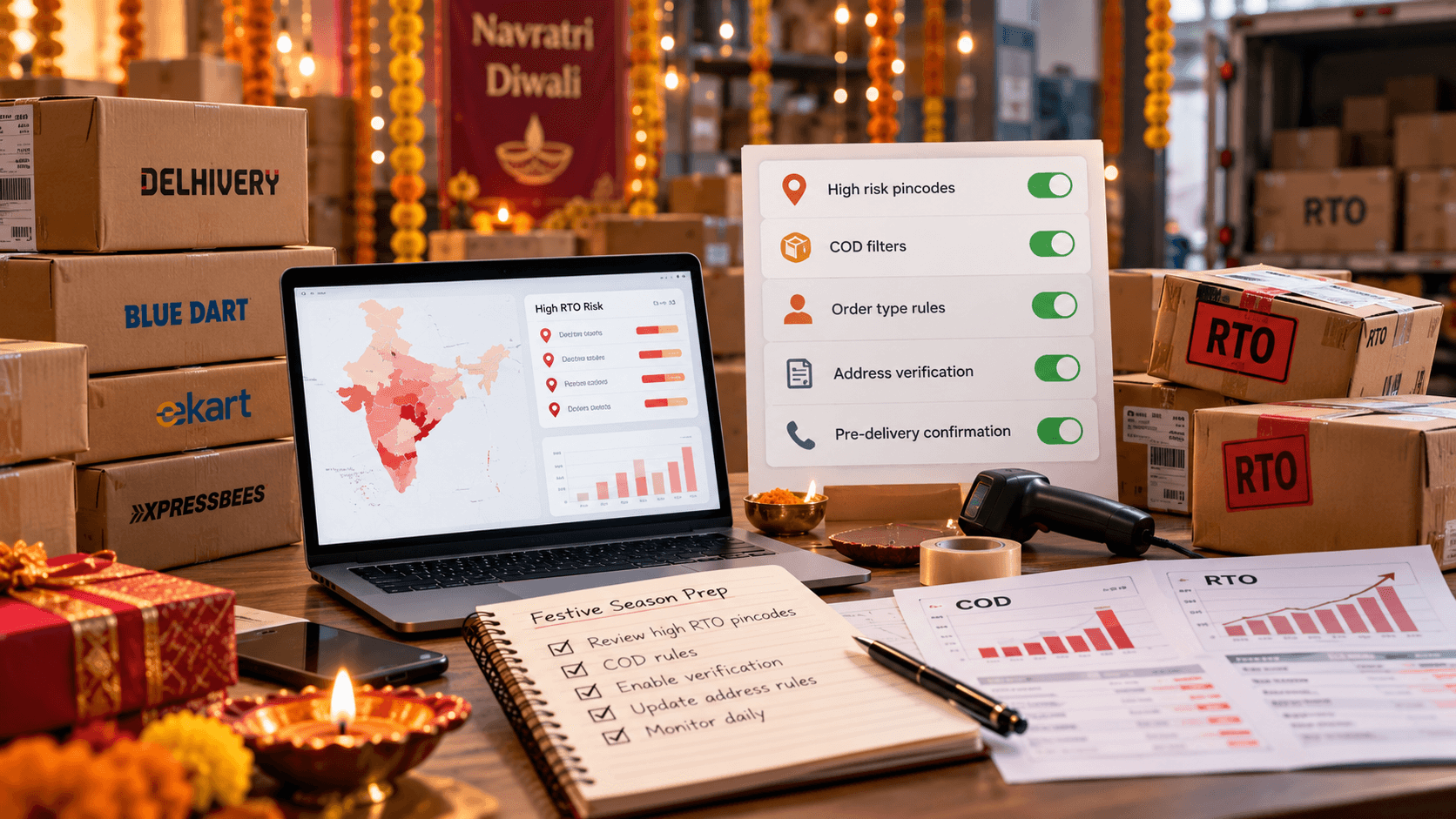
Count back from your first sale day. If it opens with Navratri, you have about a week from the day this is published. If it opens near Dhanteras, you have a month. Do the rules first, then the incentives, then people and couriers.
1. Build a festive pincode list with three tiers
- Tier A, festive COD RTO at 2x baseline or worse: full COD off. Prepaid or partial COD only.
- Tier B, 1.3x to 2x baseline: COD stays, every order confirmed before dispatch.
- Tier C, everything else: no change. Good pincodes should not pay for a bad season elsewhere.
| Pincode | Area | Festive COD orders | Festive COD RTO | Baseline | Tier |
|---|---|---|---|---|---|
| 841301 | Chhapra, Bihar | 64 | 41% | 22% | A |
| 273001 | Gorakhpur, UP | 118 | 33% | 21% | B |
| 560034 | Koramangala, Bengaluru | 210 | 16% | 9% | B |
| 452001 | Indore, MP | 95 | 14% | 13% | C |
These are illustrative numbers, not a real brand's data. Look at the Koramangala row. A metro pincode landing in Tier B is the Diwali travel effect, and your annual list would never have flagged it.
Before the sale, re-download serviceability files from every courier you use. They change, and COD shipped into a pincode that has been de-scoped for COD is a guaranteed return.
2. Add rules by order type
Pincode rules miss the risky orders that come from good pincodes. A few order-type rules catch most of them.
| Order type | Rule during the sale | Why |
|---|---|---|
| First-order COD above about 1.5x your AOV | Confirm on WhatsApp before dispatch | No history, most impulse buys |
| COD where shipping and billing names differ | Ask the buyer to tell the recipient, or pay now and add a gift note | Recipients refuse parcels they did not order |
| 3 or more units of one SKU on COD | Hold for a manual check | Resellers and fake orders cluster here |
| COD with a stacked sale code | Confirm before dispatch | Bought on price, first to cancel when a marketplace undercuts you |
| Repeat buyer with a delivered order | No friction | Your best orders |
Five rules is plenty. Each extra one is something else to debug in sale week.
3. Target the prepaid nudge before the sale starts
When everything is 30% off, nobody switches to prepaid for ₹20. The nudge has to be real: ₹50 to ₹100 off, free shipping, or partial COD, where the buyer pays ₹99 to ₹199 upfront by UPI and the rest at the door. Someone who has already paid ₹149 is much less likely to refuse.
Buyers do switch when the reason is good. Across GoKwik's D2C merchants, prepaid went from 37% of Diwali-period orders in 2024 to 52% in 2025.
The mistake is giving the nudge to everyone. Run the numbers on a festive month first.
The month: 7,000 festive orders, 60% COD. At the pilot rates above (24.8% COD, 1.4% prepaid), that is 1,042 COD RTOs and 39 prepaid, 1,081 in total.
Blanket nudge: ₹75 off every prepaid order moves COD share to 50%. RTOs fall to 917, so 164 fewer, worth ₹0.74 to ₹1.48 lakh at ₹450 to ₹900 each. But you paid ₹75 on all 3,500 prepaid orders, ₹2.63 lakh, most of it to buyers who were paying online anyway.
Targeted nudge: the same ₹75, shown only to the 1,600 buyers who pick COD in a Tier B pincode or on a first order. If one in four switches, that is 400 orders and about 94 fewer RTOs, worth ₹42,300 to ₹84,600, for ₹30,000 in discounts.
Both are before margin on the orders that now deliver. The one-in-four switch rate is an assumption, so use your own.
Most one-click checkouts used by Indian Shopify brands can show or hide COD and offers by pincode or cart rules. Test yours on a real phone with a Tier A pincode before the sale opens, and do not change payment options mid-sale unless something is on fire. The year-round version of these rules is in our guide on how to reduce RTO for COD orders.
4. Confirm risky COD orders before dispatch, and staff it
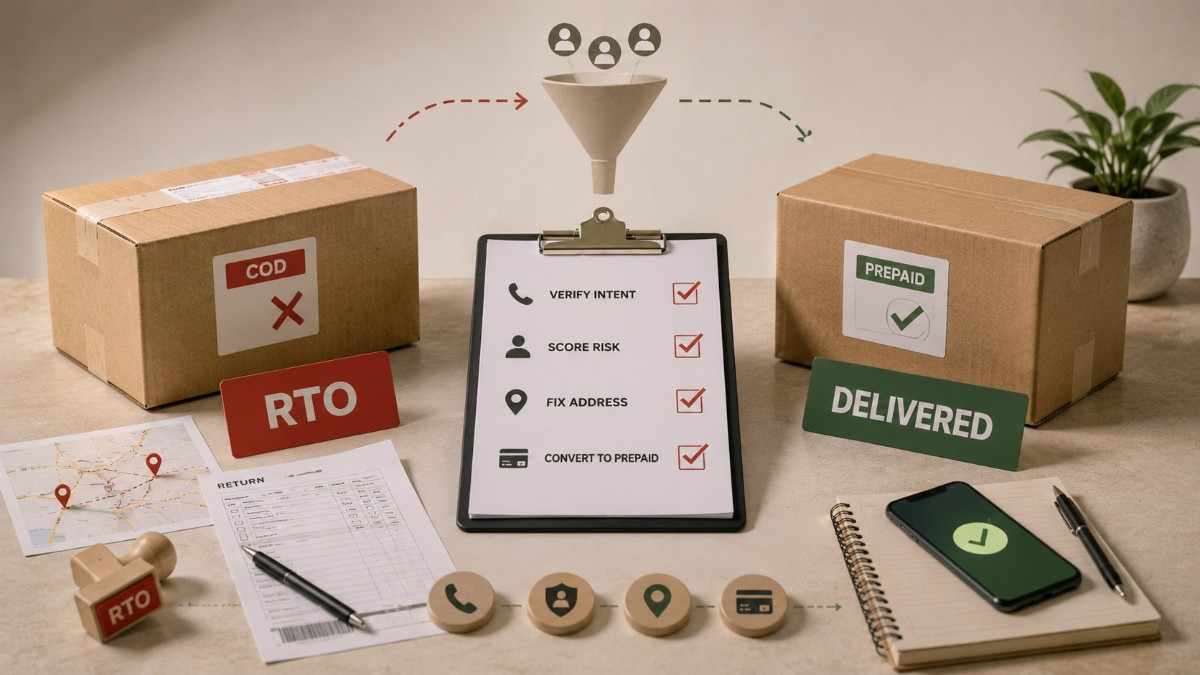
Every Tier B order and every risky order type gets a WhatsApp before it is packed: product, cash amount due, expected delivery date, and two buttons, Confirm and Cancel. Our WhatsApp COD confirmation templates are a usable starting point.
Submit templates through your provider (Interakt, WATI, Gupshup, AiSensy or whoever you use) at least a week ahead. Meta can reject one, and you do not want to find that out on Dhanteras.
Set the no-reply rule now. One reminder at 12 hours. Still nothing at 24 hours, call orders above ₹2,000 and hold the rest. Do not auto-cancel on first silence, because plenty of real buyers ignore the first message.
Staff for the peak, which comes early. GoKwik saw the busiest D2C day of Diwali 2025 land eight days before Diwali, which for 2026 points to the end of October. Then name who owns confirmations and NDRs on Dhanteras, Diwali and Bhai Dooj. Most brands find out on Diwali morning that nobody is on shift.
5. Set delivery promises and courier allocation per zone
Ask each courier account manager (Delhivery, Bluedart, Ekart, Xpressbees, or your Shiprocket or Shipway KAM) for festive hub closures and the last pickup date for pre-Diwali delivery by zone. Get both on email.
Show a zone-wise "order by" date on the product page and at checkout. For example: metros by 3 November, rest of India by 31 October, North East and J&K earlier. After each cut-off, switch the copy to "delivered after Diwali". A buyer who knows the parcel arrives on the 12th and still orders will not refuse it on the 12th.
Route by last festive season's lane performance, not the annual rate card. If Bluedart did better in Kerala and Delhivery across eastern UP, split them. And do not onboard a new courier in October.
If you ship heavily into Bihar and eastern UP, plan for Chhath as well. It falls about a week after Diwali, many customers travel for it, and deliveries in the region slow down.
6. Run a 20-minute RTO check every morning of the sale
- NDR queue, oldest first. Anything older than 24 hours gets actioned today
- Yesterday's RTOs by pincode. A Tier C pincode with 3 or more moves to Tier B
- Confirmation reply rate. A sudden drop usually means a paused template
- Unconfirmed risky orders. Cancel before pickup, where it costs nothing
- "Customer refused" by courier. A spike on one courier means calling a few customers
- Click reattempt without speaking to the customer
- Leave NDRs for a weekly clean-up
- Ship a Tier B order nobody confirmed
NDRs deserve their own routine. Our guide to NDR management covers the reason codes and the 36-hour window that decides most outcomes.
7. Close the season on the courier invoices
November and December invoices carry the most RTO charges of the year, and the most mistakes: RTO billed on orders that were delivered, the same RTO billed twice, and return weight re-rated above forward weight.
Courier dispute windows usually run 7 to 15 days from the invoice date, and after that the charge stands. Check festive invoices the week they arrive, using the filters in our guide to recovering wrong RTO deductions. While the data is fresh, update the pincode list. You will want it in September 2027.
What good looks like
The first three are targets we would hold an ops team to, not industry averages. Measure against your own baseline, because category and payment mix swing the absolute number too much.
| In the festive window | Struggling | Good |
|---|---|---|
| COD RTO vs September baseline | +10 points or more | Within +3 points |
| Prepaid RTO | Above 3% | Under 2% |
| COD share of orders | Above a normal month | At or below a normal month |
| NDRs actioned the same day | Under half | Over 90% |
| Festive RTO invoice lines checked in the window | None | All of them |
The Unicommerce report also shows what recovery looks like. One brand in it ran 39.2% RTO at the November 2025 peak and reached 21% by March 2026 after three changes: a prepaid incentive at checkout, pincode-level courier routing based on actual delivery performance, and address verification before dispatch. That is steps 1, 3 and 5 above, made after the peak. You can make them before it.
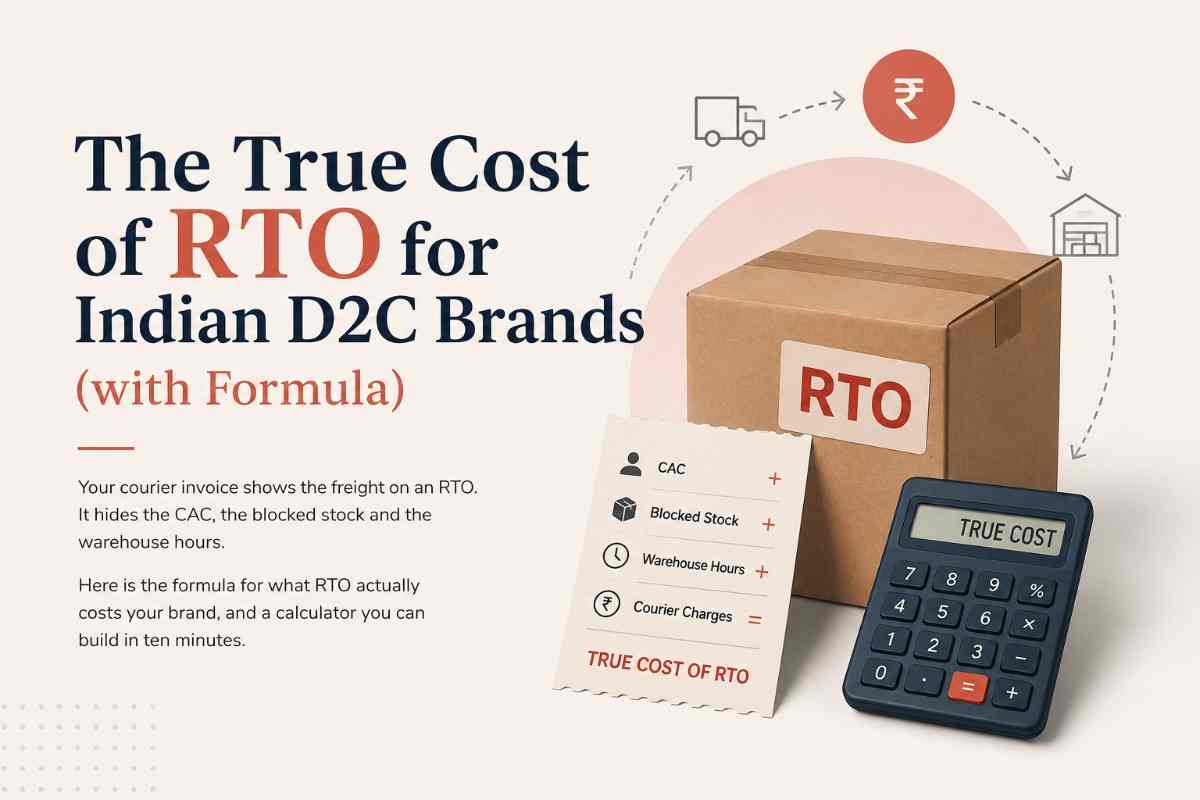
Some festive uplift is buyer behaviour you cannot switch off. What you want is growth from more orders, with the return rate close to flat. For what each point of RTO costs, see the true cost of RTO.
Frequently asked questions
Why does RTO go up during the festive season in India?
Four things shift at once. Sale traffic brings first-time COD buyers, more orders are gifts for people who did not place them, long courier lanes slow down, and metro customers travel home for Diwali. Each one pushes RTO up, and they all happen in the same three weeks.
When should I start preparing for festive RTO?
Two weeks before your first sale day is comfortable and one week is the minimum. The pincode list and rules take a few days to build and test, and WhatsApp templates need Meta approval before you can send them.
Should I switch off COD for the Diwali sale?
Not everywhere. Switching COD off across the board loses good orders from pincodes that deliver well. Turn off full COD only in your worst pincodes and offer prepaid or partial COD there.
What is partial COD and does it work during festive sales?
The buyer pays a small advance online, usually ₹99 to ₹199 by UPI, and the rest in cash at the door. Someone who has already paid is less likely to refuse, and if they do, the advance covers part of the freight.
Which orders should I confirm on WhatsApp during the sale?
COD orders in risky pincodes, first-order COD above your AOV threshold, COD gifts where shipping and billing names differ, and multi-unit COD orders of one SKU. Repeat buyers with a delivered order can skip it.
Do courier delays really increase RTO?
For festive orders, yes. A COD parcel ordered for Navratri or Diwali that arrives after the festival is easy to refuse because the buyer has paid nothing. A clear order-by date at checkout prevents many of these.
What festive RTO rate is acceptable?
Measure against your own September baseline, not an industry figure. Staying within about three points of it through the festive window is a good result. Ten points or more means the sale bought volume that came back.
What should I do with RTO charges after the festive season?
Check them the week each invoice arrives. Festive invoices carry the most RTO lines of the year and the most errors, and courier dispute windows usually close 7 to 15 days after the invoice date.
Before the first sale day
If you only get through part of this, go in this order. Cut last October and November by pincode and build the three tiers. Add the order-type rules for first-order COD and gifts. Get the WhatsApp templates approved and put a name against Diwali week.
None of that needs new software. A brand at 4,000 orders a month can run a first version on a spreadsheet within a week.
It gets hard when you have to make the call on every order, in real time, at sale volume. That is the layer Oneflow handles: checkout infrastructure for Shopify D2C brands that scores each COD order for RTO risk as it is placed, confirms the risky ones and moves the right buyers to prepaid. If you would rather have the festive cut done for you, ask for a free RTO risk report on last season's orders.
Either way, pull last year's festive orders this week. Every other step in this piece starts from that export.
- Unicommerce, India D2C Report 2026 (festive COD vs prepaid returns, 39.2% to 21% brand case)
- Unicommerce Diwali 2025 data, via MediaBrief (brand-website growth, COD volume and value, shipping times)
- GoKwik Diwali 2025 D2C data, via MediaBrief (prepaid share, peak day timing)
- Bain and Flipkart, How India Shops Online 2026 (festive share of new shoppers)
- Redseer festive 2026 projection, via Business Today (GMV and shopper count)
- Inc42, The festive delivery squeeze (2026 frontline staffing gap)
- Outlook Business, Flipkart seasonal hiring 2026
- Construction World, Delhivery October 2025 festive volumes
- Delhivery One Help Centre, Non-Delivery Report (three-attempt policy)

Omkar Kamble builds the courier billing audit and recovery engine behind OneflowAI, so these guides come from real courier billing data, not theory. Figures we cannot independently verify are flagged.
Published 5 October 2026 Last reviewed 5 October 2026 12 min read